Meats and Sausages

Fermented Sausages
Fermented sausages are cured sausages and to produce salami of a consistent quality one must strictly obey the rules of sausage making. This field of knowledge has been limited to just a few lucky ones but with today's meat science and starter cultures available to everybody, there is little reason to abstain from making quality salamis at home. It is unlikely that a home sausage maker will measure meat pH (acidity) or Aw (water activity) but he should control temperatures and humidity levels in his drying chamber.
There is a difference in fermented sausage technology between the United States and the European countries. American methods rely on rapid acid production (lowering pH) through a fast fermentation in order to stabilize the sausage against spoilage bacteria. Fast acting starter cultures such as Lactobacillus plantarum and Pediococus acidilactici are used at high temperatures up to 40º C (104º F). As a result pH drops to 4.6, the sausage is stable but the flavor suffers and the product is sour and tangy. In European countries, the temperatures of 22º -26º C (72º -78º F) are used and the drying, instead of the acidity (pH) is the main hurdle against spoilage bacteria which favors better flavor development. The final acidity of a traditionally made salami is low (high pH) and the sourly taste is gone.
Some known European sausages are French saucisson, Spanish chorizo, and Italian salami. These are slow-fermented sausages with nitrate addition and moderate drying temperatures. North European sausages such as German or Hungarian salamis are made faster, with nitrite addition and are usually smoked.
Fermented sausages can be divided into two groups:
- Sliceable raw sausages (Salami, Summer Sausage, Pepperoni)
- Spreadable raw sausages (Teewurst, Mettwurst)
OR depending on the manufacturing method:
- Fast-fermented
- Medium-fast-fermented
- Slow-fermented. These can be smoked or not, or made with mold or without
Depending on the amount of moisture that they contain, they can be grouped as:
- moist - 10% weight loss
- semi-dry - 20% weight loss
- dry - 30% weight loss
There is also a group of non-fermented cooked salamis that are made in many European countries. This group will cover any sausage that is smoked, cooked and then air-dried for 1-3 weeks at 10º-12º C (50º-52º F). This reduces Aw (water activity) to about 0.92 which makes the product shelf stable without refrigeration. The fact that a raw sausage is safe to consume may sound questionable to some but we have been eating them for thousands of years and as far as we follow the rules of meat science we have nothing to be afraid of.
The Magic Behind Fermented Sausages - It's All About Bacteria
Making fermented sausages is a combination of the art of the sausage maker and unseen magic performed by bacteria. The friendly bacteria are working together with a sausage maker, but the dangerous ones are trying to wreak havoc. Using his knowledge the sausage maker monitors temperature and humidity, which allows him to control reactions that take place inside the sausage. This game is played for quite a while and at the end a high quality product is created.
We all know that meat left at room temperature will spoil in time and that is why it is kept in a refrigerator/freezer. Yet fermented or air dried sausages are not cooked and don't have to be stored under refrigeration. What makes them different? Fermented sausages and air dried meats are at an extra risk as in many cases they are not subject to cooking/refrigerating process. In a freshly filled with meat casing, bacteria seem to hold all advantages: temperatures that favor their growth, moisture, food (sugar), oxygen, we have to come up with some radical solutions otherwise we might lose the battle. Fortunately, meat science is on our side and what was a secretive art for many years is being revealed and made accessible to everybody today. Even so, manufacture of fermented products is still a combination of an art and technology.
A meat processing facility develops its own microbiological flora in which bacteria live all over the establishment (walls, ceilings, machinery, tools etc). Each place will have its own peculiar flora and some places will contain more bacteria which is needed for making fermented sausages. Keep in mind that in the past meat facilities were not sanitized so scrupulously as the ones of today. These bacteria are just waiting to jump on a new piece of meat and start working in. All they need is a bit of food: moisture (meat is 75% water), oxygen (the air) and sugar (meat contains sugar). Sugar has been introduced into sausage recipes for hundreds of years as somehow we have always known that it is needed. Some places in Italy hadinside flora which was beneficial to produce a product of a great quality and they suddenly developed a name for making wonderful meat products. They were probably not better sausage makers than their counterparts working in different locations. Most likely they were lucky to have their shop located in their area which was blessed by mother nature for making fermented sausages. They did not have much clue to what was happening, this empirical knowledge was passed from father to son but it worked like magic.
Fermented sausages are made by use of "beneficial or friendly" bacteria that we manipulate to our advantage and they become microscopic laborers performing tasks that we can not do ourselves. They are the tiny soldiers and we are the command center and if we manage this army well they become a formidable force. All this bacteria talk should not alarm anybody as we are surrounded with fermented foods: sour bread, wine, yogurt, sourkraut, cheeses, etc. Some of the most dangerous bacteria (E.coli and Listeria monocytongenes) live in our digestive tract and help us to digest foods, other (Staph.aureus) are present in our skin, mouth and nose. The most toxic poison known to men is in soil (Clostridium botulinum) and we touch those spores every time when working the garden, yet we are perfecly fine. Dangerous bacteria are present in meat and we eat them every time when undercooked meat is served and that does not seem to affect us either. This is due tothe small number of bacteria present and if their number were higher our immune system would not be able to fight them off.
In regards to sausage making we could divide bacteria as:
- Spoilage
- These bacteria cause food to deteriorate and develop unpleasant odors, tastes and textures. These one-celled microorganisms can cause fruits and vegetables to get mushy or slimy, or meat to develop a bad odor. Most people would not choose to eat spoiled food. However, if they did, they probably would not get sick.
- Dangerous
- These are known as pathogenic bacteria and they cause illness. They grow rapidly in the "Danger Zone" - the temperatures between 40º and 140º F (4-60º C) - and do not generally affect the taste, smell, or appearance of food. Food that is left too long at unsafe temperatures could be dangerous to eat, but smell and look just fine. E.coli 0157:H7 (Most illness has been associated with eating undercooked, contaminated ground beef), Campylobacter (Most cases of illness are associated with handling raw poultry or eating raw or undercooked poultry meat), and Salmonella (Salmonella is usually transmitted to humans by eating foods contaminated with animal feces. They are often of animal origin, such as beef, poultry, milk or eggs. Chicken meat is known to contain more Salmonella than other meats. Staph.aureus is hard to control and to inhibit its growth Aw must be lower than 0.89 and pH below 5.2. Cl.botulinum, very toxic and heat resistant, likes moisture but hates oxygen.
- Beneficial
- These bacteria can be managed to our advantage to produce fermented sausage. They are naturally occuring in meat and are responsible for:
- converting nitrate to nitrite: (Micrococcus, Staph.xylosus, Staph.carnosus)
- improving flavor:(Micrococcus)
- increasing acidity (lowering pH) by producing lactic acid through sugar metabolism: (Pediococcus and Lactobactillus)
- mold growth: (Penicillium nalgiovense) which is highly desired in some Italian salamis.
To produce a quality safe product it is necessary to:
- prevent the growth of spoilage bacteria
- prevent the growth of dangerous bacteria
- create favorable conditions for the growth of beneficial bacteria
To eliminate the risk of bacteria growth and to prevent meat spoilage we employ the following steps, also known as "hurdles":
- using meats with a low bacteria count
- curing - adding salt and sodium nitrite/nitrate
- lowering pH of the meat to 5.2
- lowering Aw (water activity) by drying to 0.89
- smoking
Meat selection
Going into details on selecting meats according to their pH or using terms like PSE, GFD or MDM meats is beyond the scope of these pages and will make them confusing to read. What we want to stress is that meat must be perfectly fresh with the lowest count of bacteria possible. Commercial producers try to keep this number between 100 and 1000 per gram of meat but a home based sausage maker has to make sure that:
- meat is very fresh and kept cold
- facilities and tools are very clean
- working temperatures are as low as possible
If the above conditions are not met bacteria will multiply and will compete for food with starter cultures inhibiting the growth. As a result, the product will fault, especially the slow-fermented salami. It makes little difference to what kind of meat is used and salamis can be made from pork, beef, venison, buffalo, horse and other meats. If chicken is used the thigh (dark meat) will be the better choice than a breast (light meat). Chicken breast being light meat contain little myoglobin that reacts with nitrite to produce curing color and the finished sausage will have a very light pink color unless chicken meat will be mixed with darker meats. Keep in mind that chicken meat has higher chances to be infected with Salmonella than other types of meat. Also remember that raw pork or venison meat may be infected with trichinosis so please read the following link to be safe: trichinae
Typical values of meats selected for commercial production are: pork: pH-<5.9-6.0, beef: pH-<5.8 and Aw- 0.98 - 0.99
Curing
The application of salt and nitrite is actually our first line of defense against the growth of spoilage bacteria as in many cases (home production) there is very little we can do about a selected meat's bacteria count except making sure that the meat is fresh. As the sausage slowly dries out it loses moisture but not the original amount of salt which remains inside. As a result, in time the sausage becomes much saltier to bacteria. In about 3-6 days the Aw drops to about 0.95 and the sausage is microbiologically more stable as some pathogenic bacteria (for example Salmonella) stop multiplying now.
Using a combination of different hurdles is more effective that relaying on one method only. For example the first hurdle is an application of salt and sodium nitrite which eliminates some of the microbiological spoilage. This will not be enough to produce a stable sausage if we don't follow up with addidional hurdles such as lowering pH (increasing acidity) and then lowering water activity Aw (eliminating moisture by drying).
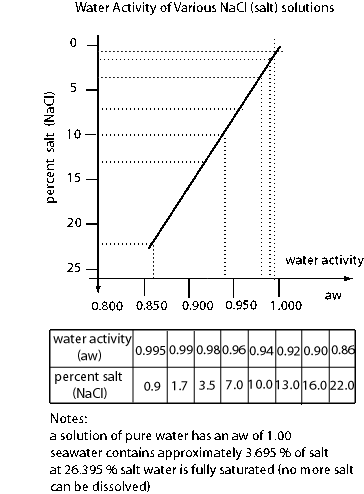
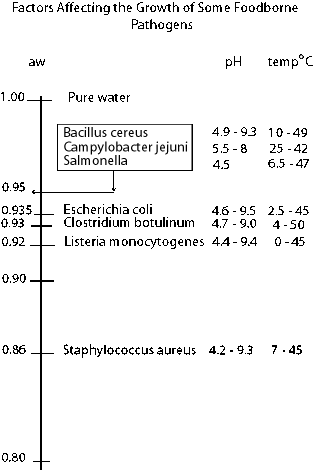
Salt. In the right part of the table below it can be seen that most bacteria can tolerate water activity levels (Aw) up to 0.92. For example Clostridium botulinum (food poisoning) bacteria are active all the way down to 0.93 Aw. The table on the left below depicts that to bring water activity level down to 0.93 level about 10 % salt solution is needed. We will have to add 100 g of salt to 1 kg of meat to be sure that Clostridium growth will be inhibited. But any salt level above 3 % will make meat unpalatable to most people so salting alone will not cut it. Additional hurdles such as lowering water activity and lowering of pH (increasing acidity) will have to be implemented. Hundreds of years ago heavy salting was commonly used to preserve and to transport fish to different countries but that fish was non-edible in its original state. It had to be soaked in water first to eliminate an excess salt and only then it would be cooked. The more salt applied to meat the stronger fence is created against bacteria and some compromise has to be made as the salt plays a very important role preventing bacteria growth, especially in the first stages of a process.
pH - Accidity
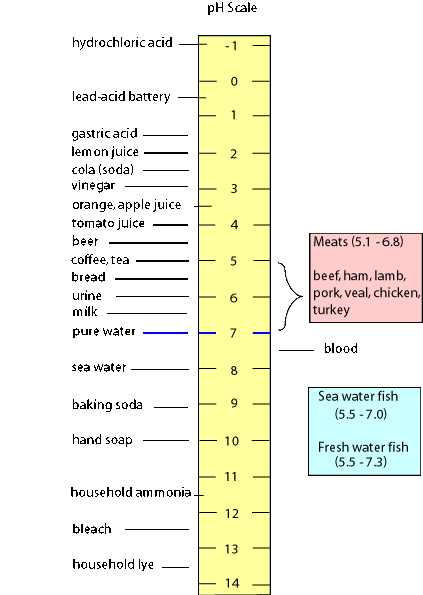
Foods with a low pH value (high acidity) develop resistance against microbiological spoilage. Pickles, sourkraut, eggs, pig feet, anything submerged in vinegar will have a long shelf life. Even ordinary meat jelly (headcheese) will last longer if some vinegar is added and this type of headcheese is known as "souse". Bacteria hate acidic foods and this fact plays an important role in the production and stabilization of fermented sausages. Ideally the pH value of meat to be used for making fermented products should be below 5.8.
| Pork | 5.9 - 6.0 |
| Back fat | 6.2 - 7.0 |
| Emulsified pork skins | 7.3 - 7.8 |
| Beef | 5.8 |
Sugar, Glucono-lactone (GDL) and Citric Acid are important additives in the manufacturing of fast and medium-fermented salamis as in these sausages pH reduction (increasing acicity) is the main hurdle against bacteria growth. In slow-fermented sausages which are dried for a much longer time, lowering moisture (Aw) is the main hurdle employed to inhibit bacteria growth.
Glucono-delta-lactone is manufactured by microbial fermentation of pure glucose to gluconic acid but is also produced by the fermentation of glucose derived from rice. It is soluble in water and is non-toxic and completely metabolized in our bodies. It can be found in honey, fruit juices, wine and many fermented products. It is a natural food acid (it has roughly a third of the sourness of citric acid) and it contributes to the tangy flavor of various foods. Since it lowers the pH it also helps preserve the food from deterioration by enzymes and microorganisms. It is metabolized to glucose; one gram of GDL is equivalent to one gram of sugar. Glucono-Delta-Lactone is often used to make cottage cheese, Tofu, bakery products and fermented sausages.
About 1 g (0.1%) of GDL per 1 kg of meat lowers pH of meat by 0.1 pH. It shall be noted that the addition of sugar already lowers the pH of the meat and adding GDL will lower the pH even more. As it is a natural acid, adding more than 10 g may cause a bitter and sour flavor.
Citric acid is a weak organic acid found in citrus fruits. It is a natural preservative and is used to add an acidic (sour) taste to foods, soft drinks and wine. In lemons and limes it can account for as much as 8 % of the dry weight of the fruit. Citric acid is mentioned in these pages more for its informational value in lowering pH than by its practical usefulness in making fermented sausages. It acts about three times faster than GDL (1 g of citric acid added to 1 kg of meat lowers ph of meat by about 0.3 units) and in higher doses it will contribute to a sour taste. Its usefulness is therefore strictly limited.
Sugar is mainly added to provide food for starter cultures. The pH drop in sausage depends on the type and amount of sugar utilized. Introduction of more sugar generally leads to lower pH and stronger acidification. What is notable is that lactic bacteria process different sugars differently. Only dextrose (glucose) can be fermented directly into lactic acid and by all lactic bacteria. Other sugars molecular structure must be broken down until monosaccharides are produced and this takes time and some lactic bacteria are more effective than others. Sugar introduction also helps to offset the sourly and tangy flavor of fastand medium-fermented sausages and acts as a minor hurdle in lowering water activity. The types of sugar which may be used in making fermented sausages are listed in order of their importance on producing lactic acid by lactic acid bacteria:
- glucose - "dextrose" is glucose sugar refined from corn starch which is approximately 70% as sweet as sucrose but it has an advantage of being directly fermented into lactic acid and is the fasted acting sugar for lowering pH. As lowering pH is the main hurdle against bacteria growth in fast-fermented sausages, dextrose is obviously the sugar of choice. It can be easily obtained from all sausage equipment and supplies companies.
- sucrose - common sugar (also colled saccharose) made from sugar cane and sugar beets but also appears in fruit, honey, sugar maple and in many other sources. It is the second fastest acting sugar. It can be used with GDL in medium-fermented sausages. In slow-fermented sausages common sugar should be chosen as it has been used for hundreds of years. There is no need to lower fast pH and sugar contributes better to a strong curing color and better flavor.
- maltose - malt sugar is made from germinating cereals such as barley, is an important part of the brewing process. It's added mainly to offset sour flavor and to lower water activity.
- actose - also referred to as milk sugar is found most notably in milk. Lactose makes up around 2-8% of milk (by weight). Maltose and lactose are less important as primary fermenting sugars but may be used in combinations with common sugar to bring extra flavor.
About 1 g (0.1%) of dextrose per 1 kg of meat lowers pH of meat by 0.1 pH. This means that 10 g of dextrose added to meat with initial pH value of 5.9 will lower pH by one full unit to 4.9. Sugar levels of 0.5% - 0.7% are usually added for reducing pH levels to just under 5.0.
When using acidification as a main safety hurdle, salami is microbiologically stable when pH is 5.2 or lower and this normally requires about 48 hrs fermentation time for fast-fermented product and 72 - 96 hours for medium-fermented type. In slow-fermented salami pH does not drop lower than 5.5 but the sausage is microbiologically stable due to its low moisture level (prolonged drying).
Aw - Water Activity
Water activity is an indication of how tightly water is "bound" inside of a product. It does not say how much water is there, but how much is available to support the growth of bacteria, yeasts or molds (fungi). Adding salt or sugar "binds" some of this free water inside of the product and lowers the amount of available water to bacteria which compete very poorly with salt. Molds are very good competitors for free water. We could make Aw lower by lowering the temperature of the product but that is not practical as the temperatures for making fermented sausages are well defined. A much better solution is to lower water activity by drying.
- Air drying is the process employed in lowering water activity (moisture removal) and has to be properly controlled otherwise it may lead to a number of defects including a total loss of product.
- During the long drying process of salami, the original hurdles lose some of their original strength as the nitrite is depleted and the number of lactic-acid bacteria decreases and the pH increases. This is offset by drying which lowers water activity by removing moisture and the sausage becomes more stable in time.
- When using drying as a main safety hurdle, salami is microbiologically stable when Aw is 0.89 or lower.
- The drying chamber should not be overloaded as a uniform air draft is needed for proper drying and mold prevention.
| Water Activity (aw) of Some Foods | |
|---|---|
| Pure water | 1.00 |
| *Fresh meat & fish | 0.99 |
| Bread | 0.99 |
| *Salami | 0.87 |
| Aged cheddar | 0.85 |
| Jams and jellies | 0.80 |
| Plum pudding | 0.80 |
| Dried fruit | 0.60 |
| Biscuits | 0.30 |
| Milk powder | 0.20 |
| Instant coffee | 0.20 |
| Bone dry | 0.00 |
Below certain Aw levels, microbes can not grow. USDA guidelines state:
"A potentially hazardous food does not include . . . a food with a WATER ACTIVITY value of 0.85 or less."
Common spoilage organisms and their Aw limits for growth
| Microbial Group | Example | aw | Products Affected |
| Normal bacteria | Salmonella species, Escherichia coli | 0.95-0.93 | Fresh meat, milk, animal intestinal tracts, unchlorinated water |
| Clostridium botulinum | 0.91 | Meat, soil | |
| Staph. aureus | 0.89 | Skin, red meats, poultry | |
| Normal yeast | Torulopsis species | 0.88 | Fruit juice concentrate |
| Normal molds | Aspergillus flavus | 0.80 | Jams, jellies |
| Halophilic bacteria | Wallemia sebi | 0.75 | Honey |
| Xerophilic molds | Aspergillus echimulatas | 0.65 | Flour |
| Osmophilic yeast | Saccharomyces bisporus | 0.60 | Dried fruits |
Smoking
Smoking may or may not be utilized in a production of fermented sausages. It has been used in countries in Northern Europe where due to colder climate and shorter seasons, the drying conditions were less favorable than in Spain or Italy. Smoking imparts a different flavor, has some effect of fighting bacteria, especially on the surface of the product and thus prevents growth of molds on fermented sausages. Mold is desired on some traditionally made Italian salamis and obviously smoking is not deployed. Most consumers prefer sausages without mold on the surface and smoking is an old method to prevent it. As mold can already grow in the first days of fermentation it is recommended to smoke sausages at the early stage of production. In order not to unbalance ongoing fermentation, the temperature of the smoke should approximate the temperature of the fermentation chamber which in raw slow fermented sausages falls into 18-22º C, (66-72º F) range. For the same reason cold smoking will be applied to semi-dry sausages which will be fermented but not cooked.
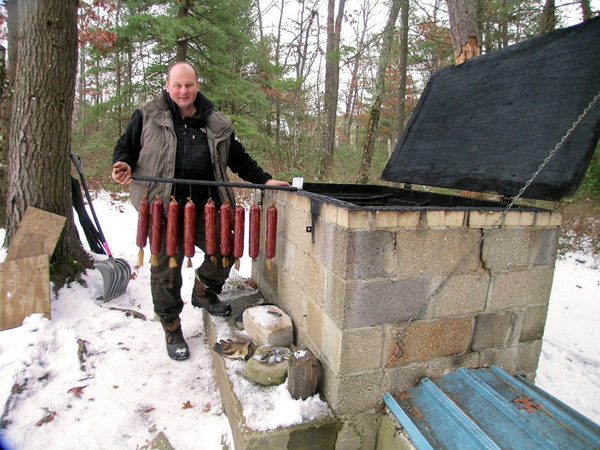
Cold smoking is performed with a thin smoke, 70-80% humidity, and good air ventilation to remove excess moisture. Cold smoking is drying with smoke and should be interrupted by drying periods without smoke. Often recipes call for 3-4 days of cold smoking, but that does not mean that the smoking is continuous. Heavy continuous smoke application for such a long period may impart a bitter taste to the product. All raw fermented sausages which are not subject to heat treatment and which are smoked, must be smoked with cold smoke.
Warm smoking (25-50º C, 77-122º F) will be applied to semi-dry sausages which will be cooked. If sausages are fully cooked (68-71º C, 154-160º F), the hot smoke (60-80º C, 140-176º F) may be administered. Smoke may be applied late during the fermentation stage (preferably after) when the surface of the sausage is dry. If mold appears before smoking was performed, or shortly after, the sausage should be rinsed and wiped off and then smoke may be applied again. Applying smoke for about 4 hours after fermentation prevents mold growth but only for some time.
Fermented sausages which will be cooked may be smoked with warmer smoke, which will increase the core temperature of the sausage and will shorten the cooking process. If mold reappears later, the sausage is wiped off and the smoke is reapplied again. Applying heavy smoke early during the fermentation stage is not the best idea as smoke contains many ingredients (phenols, carbonyls, acids etc.) which may impede reactions between meat and beneficial bacteria, especially in the surface area. After hot smoking/cooking, shower sausages with hot water (removes grease and soot), then with cold water and then transfer them to storage. At home, the sausages are normally smoked/cooked outside and they are cold showered only. This prevents them from shrivelling and shortens the meat’s exposure to high temperatures.
Most semi-dry sausages are smoked, many with cold smoke. Traditionally made slow fermented sausages (Hungarian salami) are cold smoked. In the past cold smoking was firstly a preservation step with a benefit of better flavor. Today, cold smoking is seldom performed as a preservation step due to the widespread use of refrigeration. Some foods, notably cold smoked salmon (lox) are still made with cold smoke but the majority of regular sausages are hot smoked today. Think of cold smoke as a part of the drying/fermentation cycle and not as the flavoring step. If the temperature of the smoke is close to the fermentation temperature, there is very little difference between the two. The sausage will still ferment and the drying will continue and the extra benefit is the prevention of mold that would normally accumulate on the surface. Cold smoking is performed with a dry, thin smoke. If we applied heavy smoke for a long time, that would definitely inhibit the growth of color and flavor forming bacteria which are so important for the development of flavor in slow-fermented sausages. As drying continues for a long time and cold smoking is a part of it, it makes little difference whether cold smoke is interrupted and then re-applied again. In traditional smokehouses the fire was started in the morning and burning logs produced smoke until late night hours until the fire died out. Then it was re-ignited again and the smoke continued. The drying temperature falls into 15-18º C (59-64º F) range and cold smoke (< 22º C, 72º F) fits nicely into this range. To sum it up, the length of cold smoking is loosely defined, but the upper temperature should remain below 22º C (72º F). Unfortunately, this rule puts some restraints on making slow-fermented sausages in hot climates for most of the year, when using an outside smokehouse. You can’t produce cooler smoke than the ambient temperature around the smokehouse, unless some cooling methods are devised. By the same token, people living in cooler climates can make those sausages for most of the year. Semi-dry sausages, which are of fast-fermented type, are fermented at higher temperatures. These sausages can be smoked with warmer smoke as they are subsequently cooked.
Manufacturing Technology
The first manufacturing steps such as meat selection, grinding, mixing and stuffing are common to all sausages whether fresh, smoked or fermented types. The main difference is that no water should be added to meat during processing as water is the necessary nutrient for bacteria. The technology of making dry sausages relies on removal of water and not on bringing water in. After being stuffed with meat the fermented sausages are submitted to:
- conditioning (optional)
- fermenting
- drying
- storing
Conditioning is an optional step for a home sausage maker and he has to exercise his own judgement. In commercial plants the process of grinding, mixing and stuffing salami is undertaken at a low temperature (0º C, 32º F) and as the cold sausage is placed in a warmer (fermenting/drying) room, not needed condensation will appear on the surface of the sausage. The sausage must remain there for 1-6 hours (depending on its diameter) at low humidity (no air draft) until the moisture evaporates. Then we can start the fermentation process.
If the sausage casing is dry there is no need for conditioning. It should also be very carefully monitored (or even eliminated) in small diameter casings which can dry out too quickly on the surface. This will eliminate moisture (food) for lactic bacteria and they will not reduce pH within the outer layers. As a result the sliced sausage will have a different color in its outer layer (see effects of too fast drying above).
Fermentation refers to the production of lactic acid and to produce consistent quality product parameters such as temperature, humidity and air flow should be carefully monitored. The humidity in a drying room is increased to about 92-95 % and the temperature is increased to 18º -26 C, (66º -78F). The temperature range depends on the type of the sausage produced (fast, medium or slow-fermented) and the type of the starter culture used. The air flow is kept about 0.8 m/sec. Commercial plants monitor Aw (water activity) of the sausage and readjust the correspondingly humidity level of the drying chamber. There is normally a difference of less than 5% between moisture level of the sausage and relative humidity of the room, the latter figure being lower. This means if the Aw of the sausage is 0.95, the humidity is set at 90%. Then when Aw drops to 0.90, the humidity drops to 85% and so on.
When the fermentation starts the main hurdles against microbiological spoilage of the sausage are the low bacteria count of the meat, the presence of nitrite and salt. Keep in mind that in time the sausage will be losing more and more moisture but the salt remains inside and the percentage of salt in a finished sausage will be higher. In about 48 hours lactic bacteria metabolize enough sugar to produce a sufficient amount of lactic acid to drop pH (increase acidity) of the sausage and this stabilizes the sausage making it more resistant to spoilage.
Lactic acid producing bacteria widely used in starter cultures are:
- Lactobacillus: Lb.sakei, Lb.plantarum, Lb.farcimis, Lb.curvatus
- Pediococcus: Pediococcus pentosaceus, Pediococcus acidilactici
They all have different recommended growth temperatures and can be optimized for making fast or slow-fermented sausages. In the USA fast fermented sausages dominate the market and Pediococcus acidilactici is widely used as it allows fermentation at temperatures as high as 45º C (114º F).
Fermentation Temperatures of Commercial Lactic Acid Bacteria
| Name | Temperature range in ºC |
| Lactobacillus curvatus | 22 - 37 |
| Lactobacillus farciminis | 22 - 32 |
| Lactobacillus plantarum | 25 - 35 |
| Lactobacillus sakei | 21 - 32 |
| Pediococcus acidilactici | 25 - 45 |
| Pediococcus pentosaceus | 20 - 37 |
| Source: Chr. Hansen | |
Drying
Drying is a very important process especially in the initial stages of production. One may say why not to dry a sausage very fast which will remove moisture and be done with all this pH stuff and bacteria. Well, there are basically two reasons:
- The outside layer of the sausage must not be hardened as it may prevent removal of the remaining moisture. It may effect the curing of the outside layer which will become visible when slicing the sausage (see the drawings below).
- Naturally existing in meat, bacteria and/or introduced starter cultures need moisture and some time before they can metabolize sugar and produce lactic acid which lowers pH. They are not going to multiply in one second and start heavy production of acid. Similar to yeasts used to ferment wine, these bacteria need some time to accomodate themselves in this new environment, they keep on eating sugar and only then comes a moment when they say OK, let's do some serious work.
Even if we could rapidly dry out the sausage without hardening its surface this will inhibit beneficial bacteria from doing their work by removing moisture which they need. The only possibility will be to lower pH using chemical reactions such as adding GDL or citric acid. This method does not depend on bacteria but unfortunatelly it will add so much acidity that the product will not be edible. Moisture removal during fermentation (it is a part of drying) must proceed slowly
Water activity (Aw) can be lowered faster in a sausage which contains more fat than a leaner sausage. Fat contains only about 10% water and a fatter sausage having proportionally less meat also contains less water. It will dry out faster.
Drying basically starts already in the fermentation stage and the humidity is kept at a high level of about 92%. Air flow is quite fast (0.8 m/sec) to permit fast moisture removal but the high humidity level moisturizes the surface of the casing preventing it from hardening. After about 48 hours the fermentation stage ends but the drying continues to remove more moisture from the sausage. As the Aw has dropped lower the humidity level is decreased to about 0.85-90%. Maintaining previous fast air flow may harden the surface of the casing so the air speed is decreased to about 0.5 m/sec (1.8 miles/per hour-slow walk). The temperature is lowered to create less favorable conditions for the growth of bacteria. At this time the medium-fermented sausage will be finished.
Slow-fermented sausages require additional drying time and the humidity is lowered again just to be a few percents lower than the moisture content of a sausage and that falls into 75-80% range. Air flow is decreased again to about 1 ft/sec. The temperature is lowered to 15º C (60º F) to create less favorable conditions for the growth of bacteria. At those conditions the sausage will remain in a drying chamber for an additional 4-8 weeks, depending on the diameter of the casing.
Sausage is microbiologically stable and can remain at the above settings for a very long time. It should be kept in a dark room which will prevent color change and fat rancidity. There is very little need for the air flow now and it can be kept to the minimum. Some air flow is welcome as it inhibits formation of mold. The temperature is set to about 10-15º C (50-60º F). The humidity should remain at about 75% as lower humidity will increasing drying and the sausage will lose more of its weight. Much higher humidity levels may create favorable conditions for development of mold. If any mold develops it can be easily wiped off with a solution of water and vinegar. The sausage can also be cold smoked for a few hours which will inhibit the growth of a new mold. At these temperatures and humidity levels, the sausage has an almost indefinite shelf life. Depending on the method of manufacture (drying time), diameter of a casing and the content of fat in a sausage mass, fermented sausages lose from 5 - 40% of its original weight.
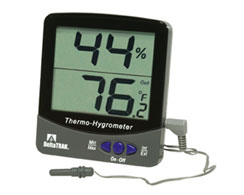
Jumbo Display Thermo-Hygrometer that measures temperature and humidity at the same time made by DeltaTRAK
http://www.deltatrak.com
Air speed is a factor that helps remove moisture and stale air, and of course it influences drying. Sausages will dry faster at higher temperatures, but in order to prevent the growth of bacteria, drying must be performed at lower levels, generally between 15-12º C (59-53º F). The speed of drying does not remain constant, but changes throughout the process: it is the fastest during the beginning of fermentation, then it slows down to a trickle. At the beginning of fermentation humidity is very high due to the high moisture content of the sausage. When starter cultures are used the temperature is at the highest during fermentation which speeds up moisture escape from the sausage. The surface of the sausage contains a lot of moisture and it must be constantly removed otherwise slime might appear. If the sausages are soaking wet during fermentation, the humidity should be lowered. At the beginning of fermentation the fastest air speed is applied, about 0.8 - 1.0 m/sec. The speed of 3.6 km/h (2.2 mile/hour) corresponds to the speed of 1 meter/second. Ideally, the amount of removed moisture should equal the amount of moisture moving to the surface.
Fermentation is performed at high humidity (92-95%) to prevent case hardening. If the humidity were low and the air speed fast, the moisture would evaporate from the surface so fast, that the moisture from the inside of the sausage would not make it to the surface in time. The surface of the casing will harden, creating a barrier to the subsequent drying process. In slow fermented sausages this will create a big problem as the inside of the sausage may never dry out and the product will spoil. As the sausage enters the drying stage, less moisture remains inside and the humidity and air speed are lowered. After about a week the air speed is only about 0.5 m/sec and after another week it drops to 0.1 m/sec (4 inches/sec). It will stay below this value for the duration of the drying.
Fast moisture removal is not beneficial in fast-fermented sausages, either. Lactic acid bacteria need water to grow and if we suddenly removed this moisture, they would stop producing lactic acid which would affect fermentation and safety of the product. The technology of making fast fermented sausages relies on pH and not on drying and the air speed control is less crucial as there is little drying. Spreadable sausages. Course ground spreadable sausages are fermented at 95% humidity and have an air speed of about 0.8 m/sec dropping down about 0.1 m/sec every two days.
Finely ground spreadable sausages are fermented at about 90% humidity but with a slower air speed. As they contain more fat (it helps with spreadability) there is less water to remove. It is much harder for the moisture to maneuver among fine meat particles on its way to the surface and the distance is longer, too. As a result, less moisture gets to the surface and the air speed of about 0.1 m/sec generally suffices.
More on drying can be found here.
A typical medium-fermented salami process
| Process | Temp | Humidity % | aw | pH | Air speed meter/sec | Time | |
| º C | º F | ||||||
| Conditioning | 20-25 | 68-77 | < 60 | 0.96-0.97 | 5.8 | 0 | < 6 hours |
| 1. Fermenting | 18-25 | 66-77 | 98-92 | 0.94-0.96 | 5.6-5.2 | 0.8 | 2 - 4 days |
| 2. Drying | 18-22 | 66-70 | 85-90 | 0.95-0.90 | 5.2-4.8 | 0.5 | 5 - 10 days |
Note The speed of 3.6 km/h (2.2 mile/hour) corresponds to the speed of 1 meter/second. Based on parameters in the table above, a medium-fermented salami will lose about 1.0 - 1.5% of its mass daily.
Depending on the manufacturing method salamis can be divided into:
Fast-fermented
Inexpensive, low quality, shortest shelf life, strong tangy and sour taste.
Production time: 5-7 days
The technology of this product is based on a fast drop of pH (below 5.0 in just 2 days) to make it stable. The pH of a finished sausage is about 4.6-4.8 making it safe. Water activity (Aw) is of a lesser hurdle as there is not enough time to remove enough moisture by controlled drying. Aw of a finished sausage is about 0.92.
Lowering pH is accomplished by the addition of fast acting sugar (dextrose) and/or GDL (glucono-δ-lactone) plus fast-acting starter cultures. The flavor is greatly influenced by the acidification of the sausage and spices employed.
Temperatures: Initial fermentation temperatures are quite high 26 º -30 º C, (78 º -86 º F) to allow rapid growth of fast-acting starter cultures. Some very fast cultured are targeted for fermentation temperatures up to 45 º C (113º F).
Sodium nitrite (Cure 1) is used as the first hurdle against bacteria spoilage. Nitrate is not used as there is not enough time for it to release nitrite.
Bactoferm™ HLP
Bactoferm™ HLP - fast culture targeted for fermentation temperatures of 90º -115º F, 30º -45º C.
Use dextrose.
Bactoferm™ F-LC
Bactoferm™ F-LC - meat culture with bioprotective properties for production of fast or medium-fast fermented sausages where a higher count of L.monocytogenes bacteria may be suspected. Recommended fermentation temperature is 20º -24º C (68º -75º F) for at least 48 hours. Use dextrose as this culture ferments sugar slowly.
Medium-fermented
Better quality, less sour and generally better salami flavor than that of a fast-fermented sausage.
Production time: 4-6 weeks
The technology of this product is based on a moderate drop of pH (below 5.0 in about 4 days) and is about 4.8 in a finished sausage. The production time is long enough to dry out enough moisture so that water activity (Aw) level of 0.93 is achieved making it resistant against Salmonella and Staph.aureus. The flavor of the finished product is due to acidification, addition of spices and to a smaller extent (insufficient drying time) to some natural processes (proteolysis and lipolysis) within a sausage.
Temperatures: Temperatures of 22 º -25 º C, ( 70 º -77 º F) are applied during the initial fermentation stages and at those temperatures fast-acting bacteria cultures perform a bit slower.
Sodium nitrite (Cure #1) is added being the first hurdle against bacteria spoilage. Nitrate is not needed as the production times are still relatively short.
Bactoferm™ F-RM-52
Bactoferm™ F-RM-52 - medium fast culture targeted for fermentation temperatures of 22º -32º C (70º -90º F)
Use dextrose.
Bactoferm™ F-LC
Bactoferm™ F-LC - meat culture with bioprotective properties for production of fast or medium-fast fermented sausages where a higher count of L.monocytogenes bacteria may be suspected. Recommended fermentation temperature is 20º -24º C (68º -75º F) for at least 48 hours. Use dextrose as this culture ferments sugar slowly.
Slow-fermented
High quality, traditionally made salami with a superior salami flavor. They are never fully acidifed and that is why there is little of a sour and tangy flavor so pronounced in a fast fermented types. Salamis develop a desired, classical salami flavor, somewhat cheese and moldy, due to a long drying period which permits for many of the natural biochemical reactions to take place inside of the meat.
Production time: 6 weeks or longer for a 45 mm casing (a very large diameter salami can take 5, 8 months or even a year to dry).
The technology of this product is based on the drying process (lowering Aw-water activity) and on very slow drop in pH (almost never dropping to 5.2) which will later reverse (increase) as the drying progresses. Slow drop in pH gives Micrococcus bacteria sufficient time to react with nitrate. As a result nitrate releases nitrite which is necessary for:
- control of Cl.botulinum
- proper color of the sausage
- improved flavor
The Aw of a finished sausage is between 0.82-0.88and the pH of a finished sausage is about 5.3-6.0 (the initial pH value of the meat used for processing is about 5.8). Although this final pH value might seem to be high the sausage is microbiologically very stable due to its low moisture content (low Aw).
Temperatures: Temperatures of 16º -20º C, (62º -68º F) are applied during fermentation stage.
Sodium nitrate or sodium nitrite and nitrate (Cure #2)are added.
Bactoferm™ T-SPX
Bactoferm™ T-SPX - slow culture for making traditional sausages and targeted for temperatures not higher than 24º C (76º F).
Use sugar.
- Once the temperature drops below 25º C (77º F) the cold smoke can be applied which contributes positively to the flavor and inhibits mold growth. No more drying is needed and the sausage can be sold.
- Mold is usually applied after 2-3 days by spraying or dipping sausages in a mold solution.
- Salamis which are produced without mold on its surface can be cold smoked after 48 hours which is basically drying with a thin smoke.
Higher temperatures speed up bacteria growth which results in:
- faster pH drop due to increased lactic acid production
- faster development of strong curing color
- faster rancidity of fat which is an unwelcome scenario especially in slow-fermented products that are stored for long time
Starter Cultures
In the past fermented sausages were made by using natural flora (bacteria) of the establishment. Which is fine even today for a home based sausagemaker or a small plant. A commercial producer can not relay on mother nature to produced a constant quality product and he has to eliminate any possible risks that may come up. He has to control parameters pH of meat material, sausage pH, water activity Aw, temperature, air speed and bacteria. For a meat plant making a thousand pounds of sausages a day it is out of the question to rely on natural bacteria to start the fermentation process and this is where starter cultures come into play.
This is similar to the wine making process:
- originally wine was made by leaving fruit with water to start fermenting
- then we started to add wine yeasts which were produced in tightly controlled laboratory conditions. The wine was being fermented using its own fruit yeasts plus added starter cultures (wine fermenting yeasts)
- commercial wine makers do not want ANY yeasts that reside in fruit as that will not produce a constant quality product. In the first stage of a production process a chemical is introduced that will kill all yeasts present in the fruit and then after a day commercially produced wine fermenting yeasts are introduced into fruit and water.
In meats we don't introduced chemicals to kill bacteria but we have these options:
- use meats with the initial bacteria count of 100-1000 per gram of meat
- use laboratory grown starter cultures
There are many manufacturers of starter cultures that are used in Europe and in the USA and we are going to list products made by the Danish manufacturer "Chr. Hansen" as their products are easily obtained from American distributors of sausage making equipment and supplies.
Some typical starter cultures are listed in the table below. In addition to starter cultures whose main purpose is production of lactic acid, there are two cultures that are very useful:
Bactoferm™ F-LC
M-EK-4 Bactoferm™
Salamis with a surface mold
In many European countries (France, Italy and others) it is a normal occurence to see a salami with a white surface mold. This is how it has been made for hundreds of years, the mold is intentional and it contributes to the wonderful flavor of the sausage. It also protects the sausage from the effects of light and oxygen which helps to preserve color and slows down rancidity of fat. Mold covered salamis are not smoked as the smoke application will prevent molds from growing on the surface. Cold smoking sausages (below 25º C, 78º F after fermentation (after around 48 hours) will prevent mold from growing on its surface. Mold can be removed by wiping it off with a rag soaked in vinegar solution. The color of the mold should be white or off-white and not yellow, green, or black. As mold in time can grow to a considerable length it is brushed off before sale.
Sausages that are made nowadays are dipped into a mold solution or have a mold solution sprayed on the surface. The factory grown molds such as the M-EK-4 Bactoferm™ described in table above are easily obtainable which permits the growth of a constant quality intentional mold.
- Optimal conditions for the growth of mold are: warm temperatures, no air draft and over 75% humidity.
- To prevent growth of mold the commercial producers dip the sausage after filling for a few seconds into 10% solution of potassium sorbate.
Yeast and molds grow much slower than bacteria in fermented meats and sausages and they develop later in a ripening process. They utilize some of the lactic acid that was created during the fermentation stage thus increasing pH (lowering acidity) what as a result improves flavor in a slower fermented product. They don't seem to be affected by a pH drop in the fermentation stage and will grow in a vast range of temperatures (8º -25º C, 46º -78º F) as long as there is high humidity in a chamber. To ensure fast growth at the begining temperatures higher than 20º C (68º F) and humidity over 90% is required.
- Yeast - Debaromyces
- Mold - Penicillium
Chr. Hansen produces mold starter cultures with Penicillium nalgoviense which permits to grow white uniform mold on the surface of the product.
Salami Flavor
The flavor of salami is largely dictated by the manufacturing method (fast, medium or slow-fermented). In fast-fermented products the economics play the major role and the product must be made fast and cheap. There is little reason to produce high quality salami or pepperoni that will end up as a pizza topping. Most super market sold salamis are fast-fermented sausages. A fast fermented product is based on the rapid drop of pH (increasing acidity) and that inevitably leaves a sour and tangy acidic flavor. Spices come to play an important role as their part is to offset this sourness. Applying smoke will add in bringing a new flavor.
In slow-fermented traditionally made salami the flavor is the result of many microbiological reactions that take place in many months of its production. Lactic bacteria process sugar much slower than dextrose which leads to a slow pH drop. Most of sugar is converted into lactic acid but as temperatures drop so does the activity of bacteria which leads to a very slow pH drop. As a result complex biological reactions that are taking place with remaining sugar create a different salami flavor. Spices play a lesser role as spices lose their flavor in time anyhow. There is no sourly flavor as in slow-fermented products pH is known to increase (less acidity) to quite a high value (6.0) in time. The flavor is kind of cheesy, very typical of a traditionally made product. Salamis with mold will have distinctive cheesy-moldy flavor.
Bacteria strains such as Staphylococcus and Kocuria have been known to be the main mechanism of producing nitrite from nitrate during the curing process. Meat containing an insufficient number of these bacteria will not cure properly and ultimately the color and the flavor of the product will suffer. In addition the microbiological safety of a fermented sausage will be at risk as sodium nitrite and salt are the main hurdles against meat spoilage at the beginning of the process. In order for those bacteria to start reacting with nitrate a temperature of 8º C (48º F) is required as at lower temperatures (refrigerator) bacteria stop growing and these strains are no exception.
Today most meat products contain sodium nitrite which does not depend on action of Staphylococcus and Kocuria bacteria and a cured product is submitted to heat treatment which will guarantee the pink color providing that the meat with enough myoglobin was selected. In case of slow fermented sausages which still use nitrate (Cure #2) Staphylococcus and Kocuria bacteria are needed to force nitrate into releasing nitrite which in turn will start curing meat. Besides, some nitrite is converted back into the nitrate which need the above bacteria to react upon.
Two main species of Staphylococcus that are widely used as starter cultures are: Staph.carnosus and Staph.xylosus.
Making Fermented Sausages at Home
If you have read the sections above you should have a pretty good understanding of the subject by now. At least you know how it should be made according to the rules of the meat science. To make consistent products parameters such as temperature, humidity and air speed must be continuously monitored and adjusted and this is exactly what modern drying chambers do. It is not expected that one will invest into sophisticated drying chamber with temperature, humidity and air flow controls and the technology of making fermented sausages has to be somewhat modified and adapted to the local conditions of the home sausage maker. Fermented sausages were made in Europe for thousands of years without all this technology and they tasted great. Yes they were made, but not during all 12 months of the year. They were made when the temperature and humidity were right and some moderately blowing wind was of immense help, too (Italy, Spain). You can find a window of opportunity for making fermented sausages everywhere: in the summer in Alaska, in the winter in Florida. Ever heard of Summer Sausage? It was not made in summer when temperatures are high and humidity is low. It was made in winter when temperatures were lower and humidity was high, then it dried and was eaten in the summer when harvesting crops.
As long as we remember that in the first stages of production the temperatures are higher and the drying chamber must have a bowl of water to create high humidity levels we can produce a fermented sausage. Then as the process progresses the levels of humidity and temperature settings can be lowered. Cures (cure #1 or Cure #2) are an absolute necessity and commonly available and inexpensive starter cultures will guarantee a successful quality product.
The above tables provide all information that is necessary to produce a fermented sausage. At home conditions there are basically two stages:
- Fermenting - which lasts about 48 hours
- Drying - which may be subdivided into:
- fast-fermented type - 5-7 days
- medium-fermented type - 4-6 weeks
- slow-fermented type - 6 weeks or longer
It is impossible to provide exact drying times as these will depend on the size of the casing, percentage of the fat, temperature, humidity, air draft, how full is the drying room and so on. Nevertheless the above figures may be considered to be a rule of the thumb values which provide a point of reference. The rest is trial and error and gaining experience. You will find in many sources advice such as: this is how I like to do it, I have been doing this that way and it worked for me and so on.... without any concrete data to temperatures, humidity or air speed. Instead of writing about what works for us we have decided to create the table which shows how salamis are made commercially in accordance to the rules of meat science. It will be unrealistic to expect that a home based sausage maker will have enough equipment at his disposal to measure all those parameters. Nevertheless he will have a valuable point of reference and he will be able to improvise his production according to what he has and what he can do in order to make his salami making process as close as possible to the recommended data. For instance, temperatures might be too high and humidity too low to dry sausages in summer time in hot climatic zones and in those areas winter time is more suitable. If a drying chamber is available (old refrigerator, a suitable box, etc.) a dish filled with water will provide more humidity. So will a wet rag. Nothing will happen if sausages are removed every 3-4 hours from the drying chamber and showered with water for a few minutes. Water will moisten the surface of the sausage and prevent it from too rapid drying. To control air speed think of a home made smokehouse and its draft control. The air enters with smoke into the smoking chamber, raises up and escapes the chamber through the exit pipe on top which has a draft control. If its fully open you have full draft (full air speed), if it is open 1/4 there is 1/4 of the draft. In a smokehouse the reason for this air draft is to remove moist air that accumulates in the upper parts of the chamber. If it was not removed the sausages will taste rancid and bitter and the color will be very dark due to accumulation of soot and other unburnt particles. In making fermented sausages, evaporating moisture must also be removed otherwise it will create favorable conditions for the growth of mold and we may not need this. If the drying chamber is fully enclosed without any natural draft, one can open the door to it every now and then and allow the moisture to escape. We all know the smell of a refrigerator when we open it after coming from extended vacation and the drying chamber is no exception.
Salami making process
Raw material:
|
Temperature | Humidity in % | Air-speed in m/sec | Time | Expected pH | Expected Aw | |
| º C | º F | ||||||
| Conditioning | 20-25 | 68-77 | 60-70 | 1-6 hours | little change | little change | |
| 1. Fermenting/drying | 18-25 | 66-77 | 92-95 | 0.5-0.8 | 2-4 days | 5.2-5.6 | 0.94-0.96 |
| 2. Drying | 18-22 | 66-72 | 85-90 | 0.2-0.5 | 5-10 days | 4.8-5.2 | 0.90-0.95 |
| When the sausage achieves pH acidity value 5.2 or lower or water activity Aw 0.89, it is considered microbiologically stable and it is safe to consume. This will be a fast fermented product. This does not mean that the process must be stopped. The drying can continue, the sausage will lose more moisture and weight and its shelf life will be longer. | |||||||
| 3. Drying | 15 | 60 | 75-80 | 0.1-0.2 | 4-8 weeks | 4.6-5.0 | 0.85-0.92 |
| When the sausage achieves pH acidity value 5.2 or lower or water activity Aw 0.89, it is considered microbiologically stable and it is safe to consume. This will be a medium fermented product. This does not mean that the process must be stopped. The drying can continue, the sausage will lose more moisture and weight and its shelf life will be longer. | |||||||
| Storing | 10-15 | 50-60 | 70-75 | 0.05-0.1 | more than 8 weeks | will increase up to 6.0 | 0.85-0.89 |
| During the storage period the pH value of the sausage will increase, the sausage will be less acidic and its flavor will be more mellow. Less acidic and more cheesy. Sausage will lose more moisture and if kept at those conditions in a dark room, it will have an almost indefinite shelf life. USDA guidelines state: "A potentially hazardous food does not include . . . a food with a WATER ACTIVITY value of 0.85 or less." | |||||||
Notes:
|
|||||||
Making fermented products is a combination of art and sausage making and one will be ill advised to start with a traditionally slow fermented product which is made without any starter cultures. On the other hand slow and medium fermented products are much easier to make and gained experience can lead to production of slow-fermented sausages.
Notes:
- Smearing of the fat (dull knife or warm fat) should be avoided as it will clog the inside passages of the casing and inhibit moisture from escaping which will affect drying.
- Starter cultures must be kept frozen and should not be mixed with other ingredients until ready to use. Other ingredients such as salt, sugar, spices or others will always contain some moisture which will trigger reaction with starter cultures. Starter cultures are after all bacteria that needs only higher temperature, humidity (moisture) and food (sugar) to start multiplying.
- To keep humidity at high levels, the sausages may be showered a few times a day for a minute or two.
- Some air draft should be present even in the final months of drying to prevent mold creation.
By choosing an appropriate starter culture a fast, medium or slow-fermented sausage can be produced, even if the recipe remains the same. It will have different texture and flavor but as long as the rules are followed it will always be a quality sausage.
At least 2.5 % salt (25 g salt/1 kg of meat) should be added which will help to lower water activity and inhibit the growth of bacteria.
Sodium nitrite/nitrate is added to the majority of salamis to suppress the growth of Salmonella or eliminate the danger of Clostridium botulinum. It also contributes to the development of the desired curing color and curing flavor. A combination of nitrite and nitate (Cure #2) is applied to slow fermenting products as nitrate guarantees a stable color even after drying for some months.
Use of Spices in Fermented Sausages
Throughout history spices were known to possess antibacterial properties and cinnamon, cumin, and thyme were used in the mummification of bodies in ancient Egypt. It is hard to imagine anything that is being cooked in India without curry powder (coriander, turmeric, cumin, fenugreek and other spices). Latest research establishes that spices such as mustard, cinnamon, and cloves are helpful in slowing the growth of molds, yeast, and bacteria. Garlic and clove are effective against some common strains of E.coli. Spices alone can not be used as a hurdle against meat spoilage as the average amount added to meat is only about 1% (1 g/1 kg). To inhibit bacteria the amounts of spices will have to be very large and that will alter the taste of the sausage. Rosemary and sage have antioxidant properties that can delay the rancidity of fat. Marjoram is a proxidant and will speed up the rancidity of fats.