Meats and Sausages

Head Cheese
Traditionally head cheese was made entirely from the meat of the head of a hog, cured and stuffed in large beef bungs or in pork stomachs. We may find this choice of meat today less appealing, forgetting at the same time the fact that pork head meat is highly nutritional and flavorsome. Do not confuse head meat with brains. Bear in mind that the head is boiled first until the meat easily separates from the bones and then it looks like any other meat. Persons living in metropolitan areas cannot buy pork head anyhow but still can make a great tasting product by using pork picnic and pigs feet. Nowadays head cheese can include edible parts of the feet, tongue, and heart.
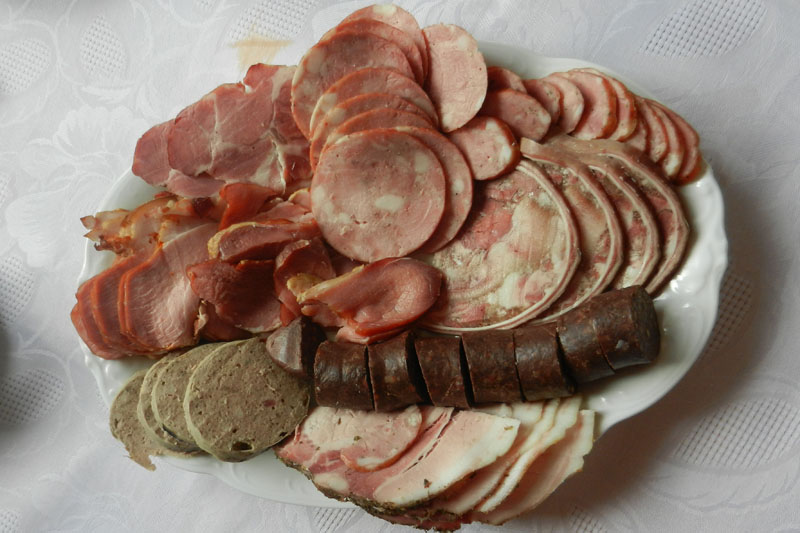
A plate with a variety of meats and sausages.
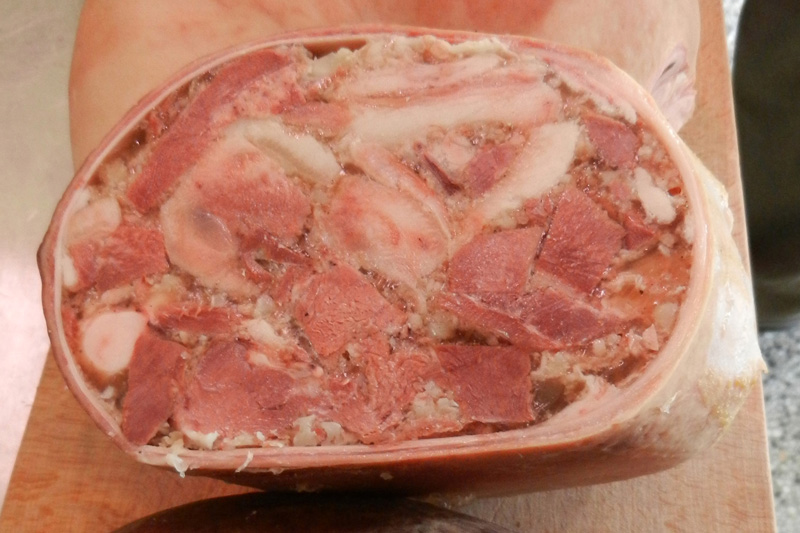
Traditionally made head cheese incorporates many different meat cuts.
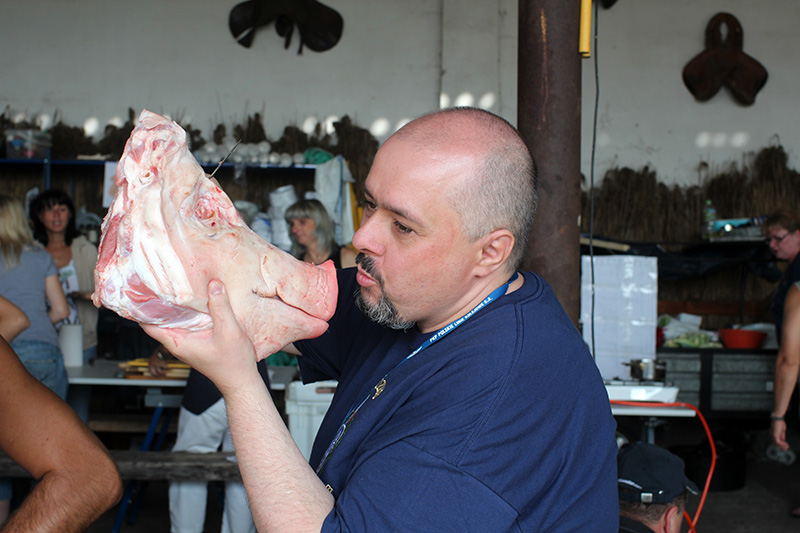
A head cheese incorporates a variety of meat cuts: pork head meat, jowls, skins, tongue, snout, ears, heart; all those cuts exhibit different texture and flavor. It is a combination meat platter inside one casing.
In English, the name head cheese doesn't sound appealing and it prevents many people from trying the product. In other languages it is called in a friendlier manner, without the word “head” being part of the name. When vinegar is added, it is called “souse” and this already sounds much better. Head cheese, brawn, or souse are not cheeses, but rather jellied loaves or sausages that may or may not be stuffed into the large diameter casing. They can be easily found in places that cater to Central Europeans, Eastern Europeans and Italians.
Many of us have made a head cheese before without even realizing it, although pork head meat was not a part of the recipe. Every time we cook meat stock or chicken soup based on bones we are making a weak version of a head cheese. The reason the soup does not become a meat jelly is because there is too much water in it.
If this stock would simmer for a long time, enough water will be lost, and the resulting liquid, when cooled will solidify and become a jelly. In the past, after the first and second World War, or even in most countries today, people had no opportunity to buy a commercially made gelatin. And this is why those unappealing cuts of meat like pork head, jowls, skins, hocks, legs and fatty picnic legs started to shine.
You cannot make the real head cheese by using noble cuts like hams, tender loins or other tender lean meats. Those expensive cuts don’t contain enough connective tissues (collagen) in order to make natural gelatin. You can use them, but a commercial grade gelatin must be added and of course the taste and flavor of the finished product will be less satisfactory although the resulting jelly will be very clear. Making head cheese is quite easy as the procedure does not involve the use of special equipment like a grinder or stuffer. Every kitchen contains all utensils that will be needed.
Types of Head Cheeses
- Regular head cheese - pork head meat, jowls, skins, snouts, pigs feet, gelatin.
- Tongue head cheese - in addition to the above mentioned meats the tongue added. It should be cured with salt and nitrite in order to develop a pink color.
- Blood head cheese - head cheese made with blood. Such a head cheese is much darker in color.
- Souse - a typical head cheese to which vinegar has been added. Similar to sulz but not limited to pig’s feet only. Most people eat head cheese with vinegar or lemon juice anyway so it comes as no surprise that vinegar would be added to head cheese during manufacture. It also increases the keeping qualities of the sausage as all foods containing vinegar last longer. Souse contains more jelly than a regular head cheese. In addition pimentos, green peppers or pickles are often added for decoration. Both sulz and souse contain about 75% of meat, 25% of jelly and around 3% of vinegar.
- Sulz - original head cheese made of pigs feet with the bone in. Later bones were removed to facilitate slicing. This name can be found in some older books. It was made with pig’s feet only but often snouts and pig skins were added as well. Meat jellies made from pig’s feet are still popular in many European countries, for example in Poland where they are known as pig’s feet in aspic ( Nóżki w Galarecie). Pickled pigs feet which are sold today are basically sulz in vinegar.
Head cheese, souse and sulz are all very similar, the main difference is that souse and sulz contain vinegar and more gelatin.
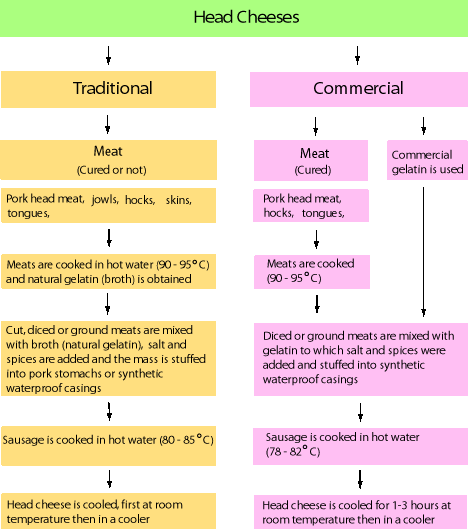
Manufacturing Process
Meat Selection
Traditionally made head cheese requires meats with a <em>high collagen content to produce a natural gelatin. </em>Anybody can buy a commercial gelatin, mix it with water and create jelly. However, such a jelly has no taste at all and is a poor in=mitation of a naturally produced meat stock. Meat cuts such as pork head, hocks and skins are capable of producing a lot of natural gelatin as they contain a lot of connective tissue that will produce gelatin. In addition tongues, hearts, snouts and skins are also used as filler meats. Commercially made products don’t depend on natural gelatin and use commercially produced gelatin powder instead. It is a natural product which is made from bones (pork and beef) and skins. Before meats will be submitted to cooking in hot water a decision has to be made whether the meats will be cured or not. Commercial producer will invariably choose to cure meats with nitrite in order to obtain a typical pink color.
Meats that were traditionally used for head cheeses were:
- Pork heads (cured or not), often split in half - boiled in hot water at about 194º F (90º C) until meat is easily removed from bones by hand. They should be first soaked for 1-2 hours in cold water to remove any traces of coagulated blood.
- Pork hocks (cured or not) - boiled at about 194º F (90º C) until meat is easily removed from bones by hand.
- Skins - pork skins should be clean without any remaining hair or excess fat. They are cooked at 185-194º F (85-90º C) until soft. This may require a longer cooking time. Pork shanks with meat (picnic), cured or not - boiled in hot water at about 194º F (90º C) until soft.
- Lean pork trimmings (cured or not) - boiled in hot water at about 194º F (90º C) until soft.
- Hearts (cured or not) - boiled in hot water at about 194º F (90º C) until soft. Hearts are first cut open and any remaining blood is rinsed away in cold water. The heart is a very hard working muscle and will be of a dark red color due to its high content of myoglobin. It should be diced into small diameter pieces (1/4”, 5-6 mm) otherwise it will stand out.
- Tongues (cured or not) - boiled in hot water at about 194º F (90º C) until soft. Pork or beef tongues are very often used but the outer skin on the tongues must be removed due to its bitter taste. It is easily accomplished once the tongues are submerged for a few minutes in hot water.
Looking at the above listed meats it is easy to conclude that a person living in a large city should not face any difficulty in making a head cheese. Some substitutions need to be made as pork heads will not be generally available, but tongues or even hearts are frequently seen in supermarkets (they are of least importance as they contain little collagen). Instead of using unusual and fatty cuts of the hog (head) which may be available only at specialty butcher stores, the similar results could be achieved by smart substitution of meats and adding some gelatin, even if a natural less fatty broth is produced. Picnic (lower front leg) and pork butt are common items and will make a great head cheese. Picnic and <em>pig feet</em> will produce a lot of gelatin.
A meat plant or a farmer will have access to traditionally used cuts of meat:
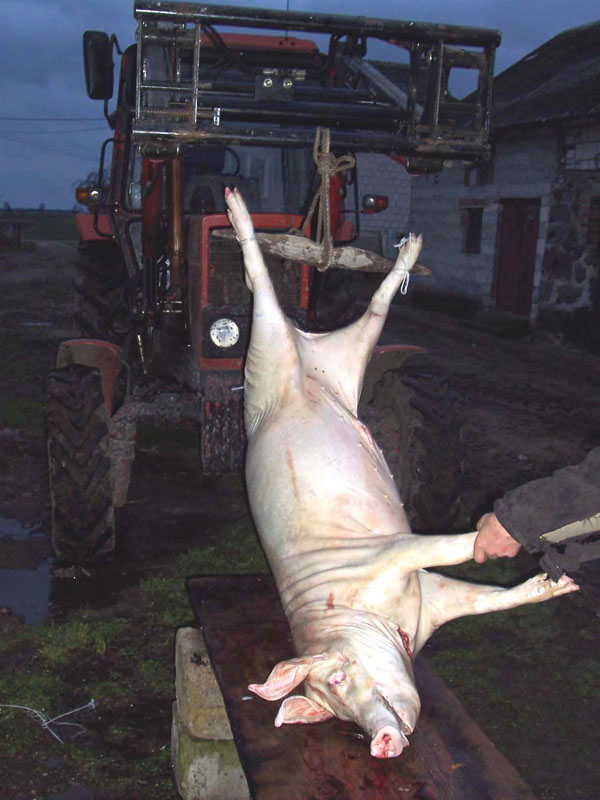
Every year for Christmas and Easter "Dziadek" - the Polish sausagemaker slaughters his own pig
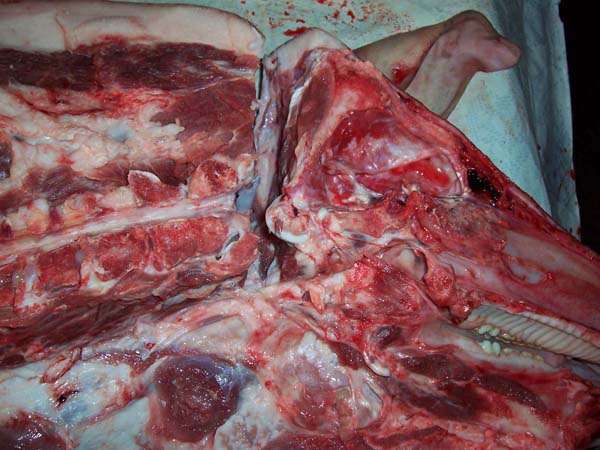
What you see may look gruesome but will make great liver, blood and headcheese sausages.
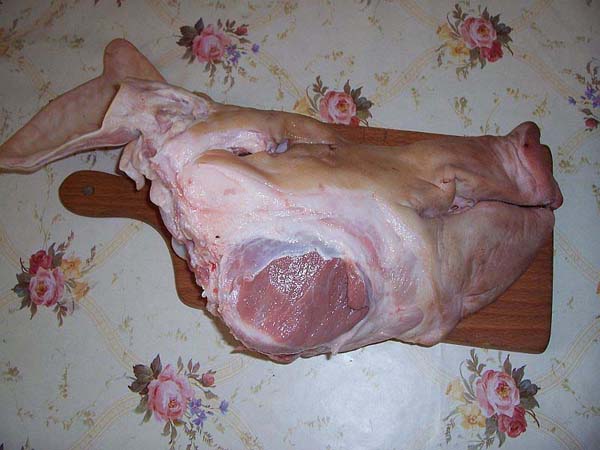
Pork head
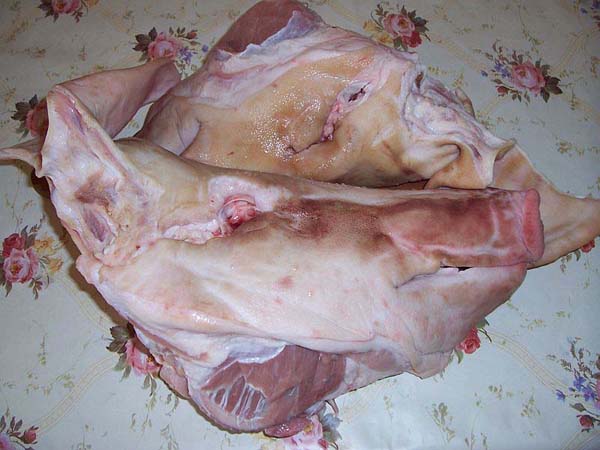
Pork head split in half
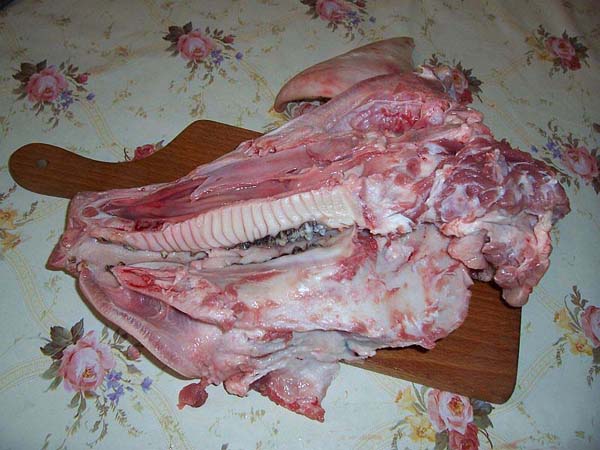
Pork head on inside
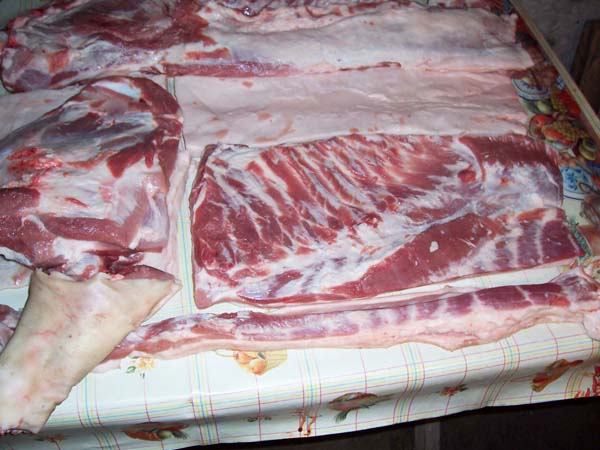
Picnic leg
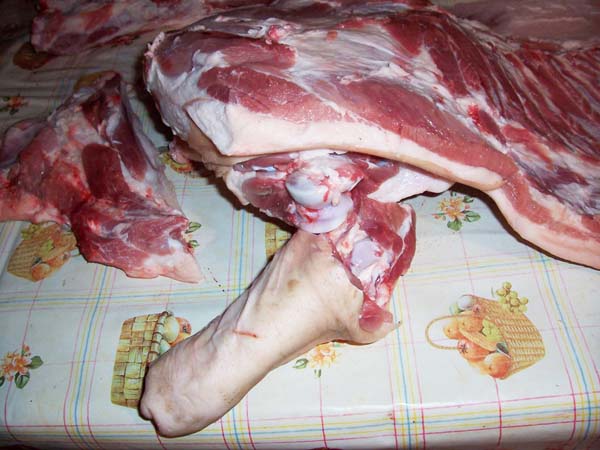
Picnic leg
It is what you know that counts when making superior products
A great product can be made at any conditions and not the amount of space or latest equipment is needed but the knowledge of the subject and sensible work organization as is being demonstrated by Mr. Kruszynka in the photos below, who makes wonderful products in his little kitchen.
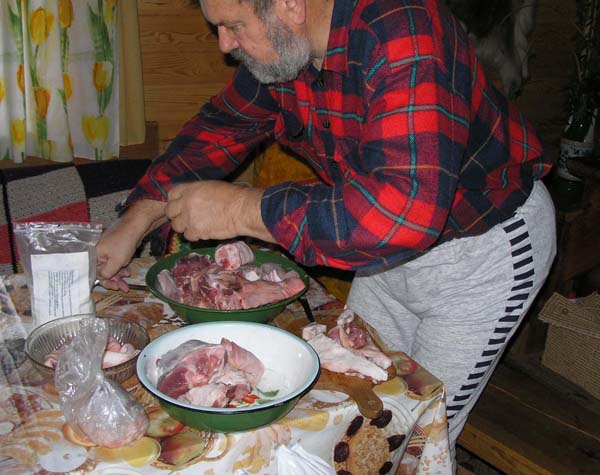
Proper work organization makes everything easy
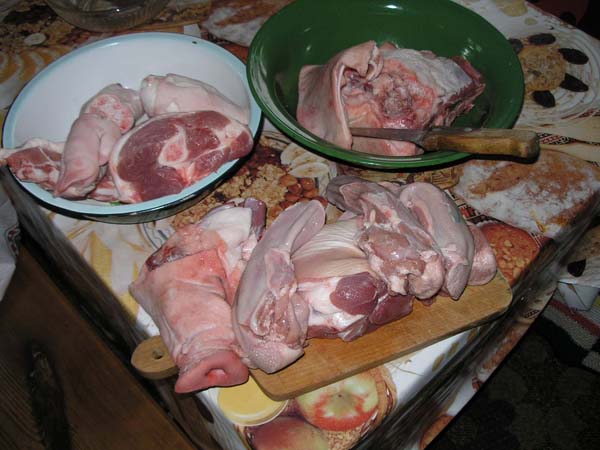
Meat selection
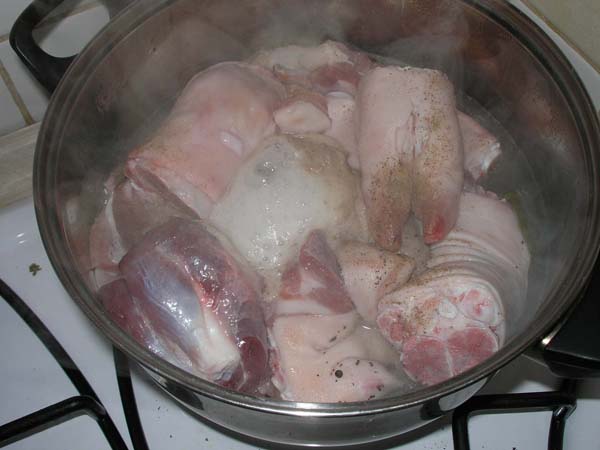
Cooking meats
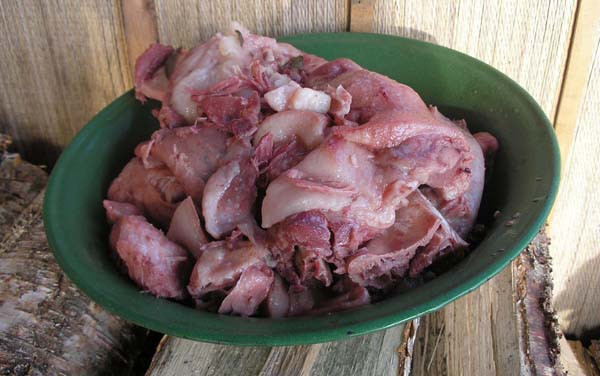
Cooked meats
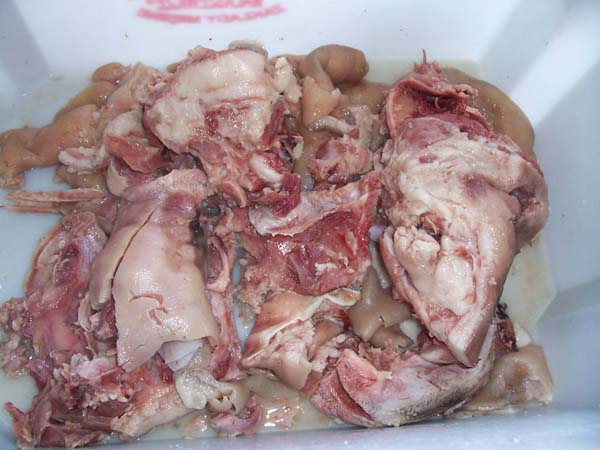
Cooked meats
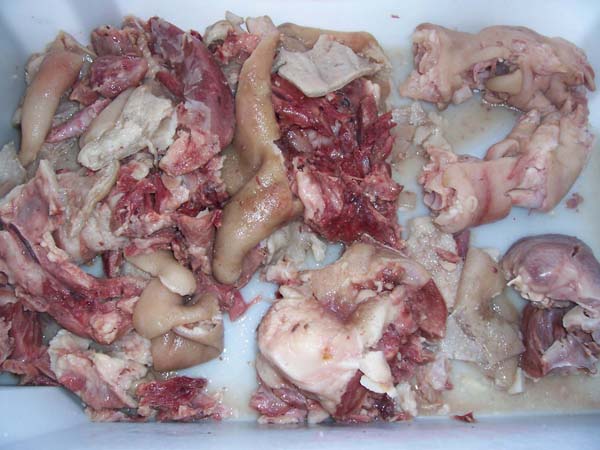
Cooked meats
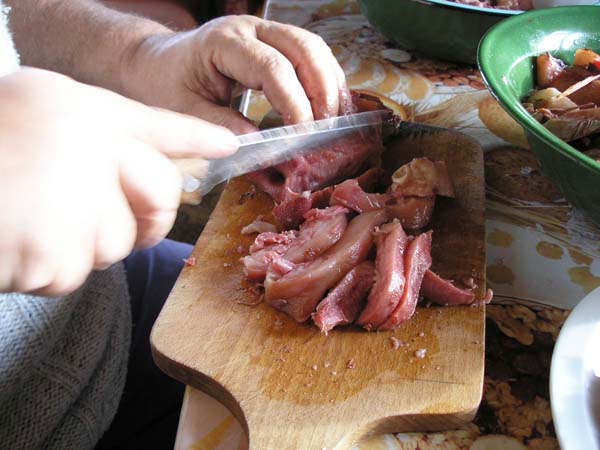
Chopping meats
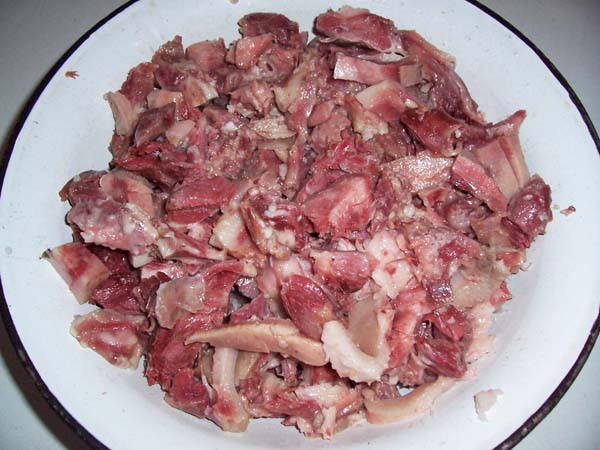
Chopped meats
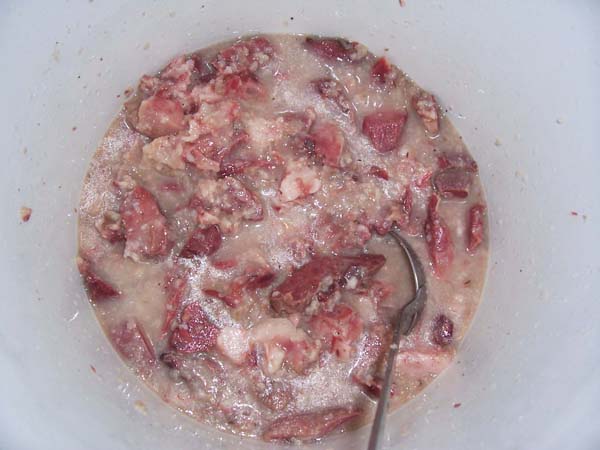
Meats and broth
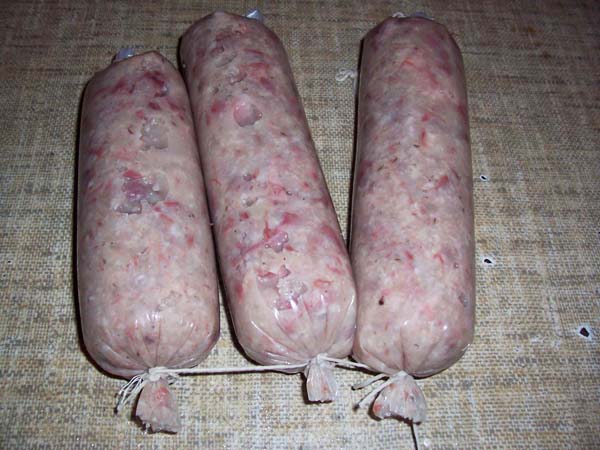
Stuffed casings
Cooking sausages
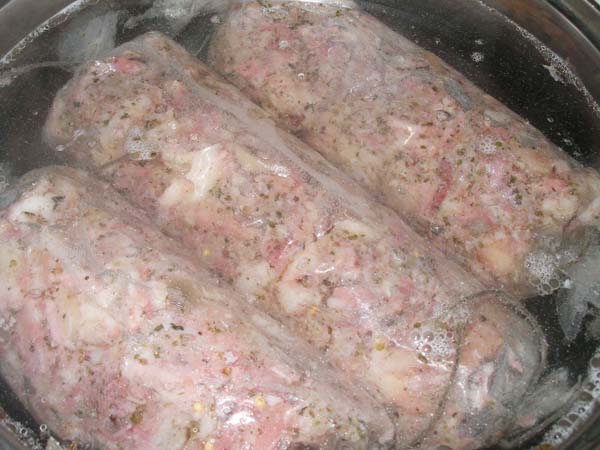
Cooking sausages
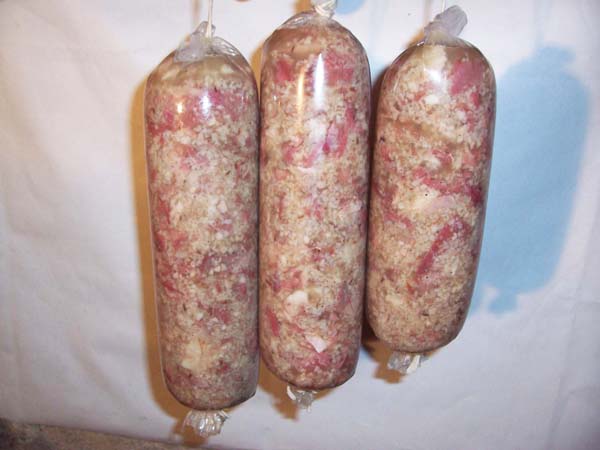
Cooking sausages
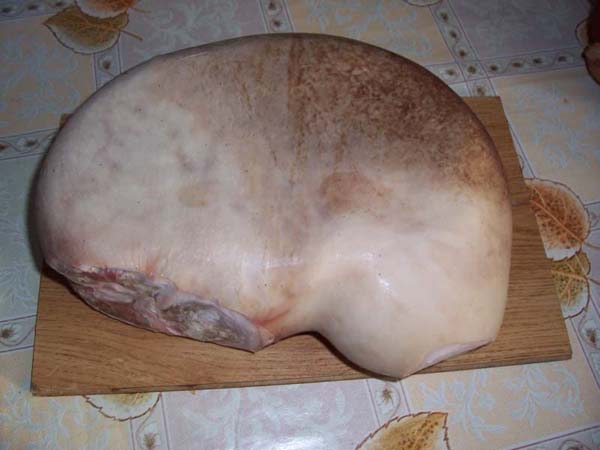
Traditionally used casing is pork stomach
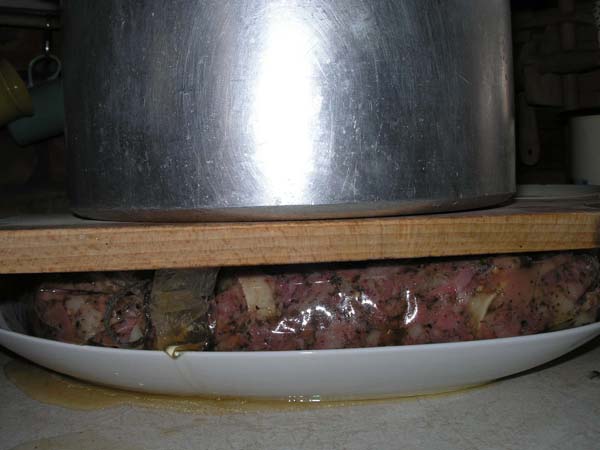
Applying weight on top of the sausage during cooling. Traditionally made headcheeses are flattened
Finished product. Note the pink color of meats which were cured with sodium nitrite
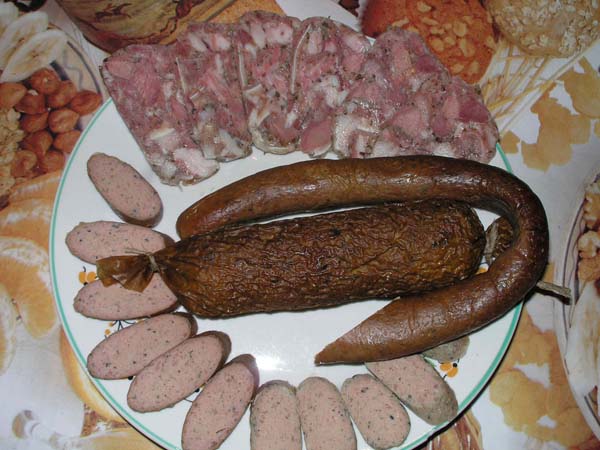
Head cheese and liver sausage ready to eat
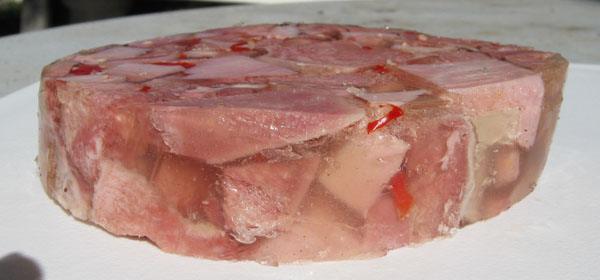
Head cheese
Curing Meats
Traditionally made products may employ meat curing with nitrite or not. If meats are not cured with sodium nitrite the product will be of grey color. Curing pork head or legs is a hassle that requires an extra space in a cooler, needs dedicated containers and will take some time. A hobbyist may not care much about the fact, but a commercial plant need those meats to be pink.
Head cheeses are not smoked so there is very little need for sodium nitrite at least for safety reasons. A commercial producer will cure meats as he is mainly concerned with the profit. The product must look pretty and must have a long shelf life otherwise supermarkets will not carry it. As a customer judges a healthy looking meat product by its red or pink color (poultry meat is an exception) the commercial producer must cure meats and add nitrite to get this pink. Another incentive for a commercial plant to cure meats is that they gain weight and that leads to increased profits.
Cutting Meats
The grinder is usually not employed as this will extract proteins and will break the fat’s structure. As a result a cloudy stock will be obtained. Meats are much easier to cut into smaller pieces when chilled. After they are cut, it is a good idea to rinse them briefly in hot water as this will eliminate unnecessary grease that would normally cloud the jelly. Until now the process of making head cheese or meat jelly has been the same. What differentiates them is that head cheese being a sausage is stuffed into casings and meat jelly is not.
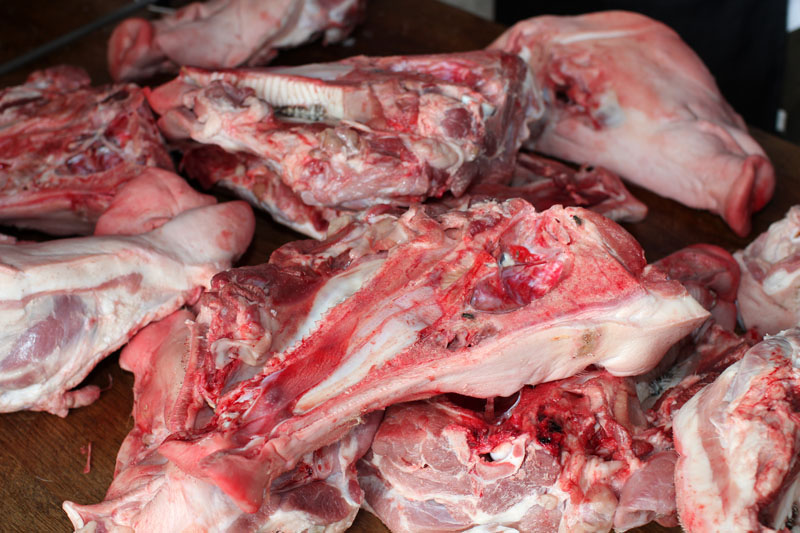
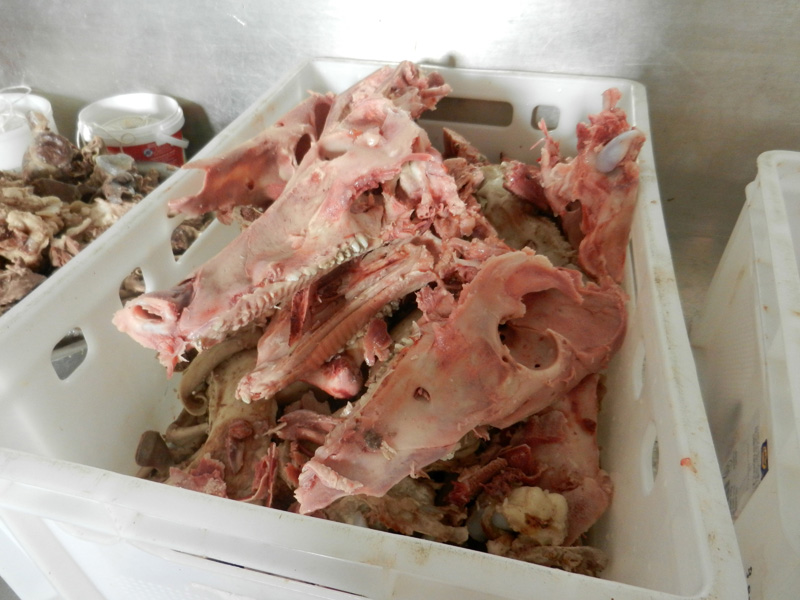
Split pork heads.
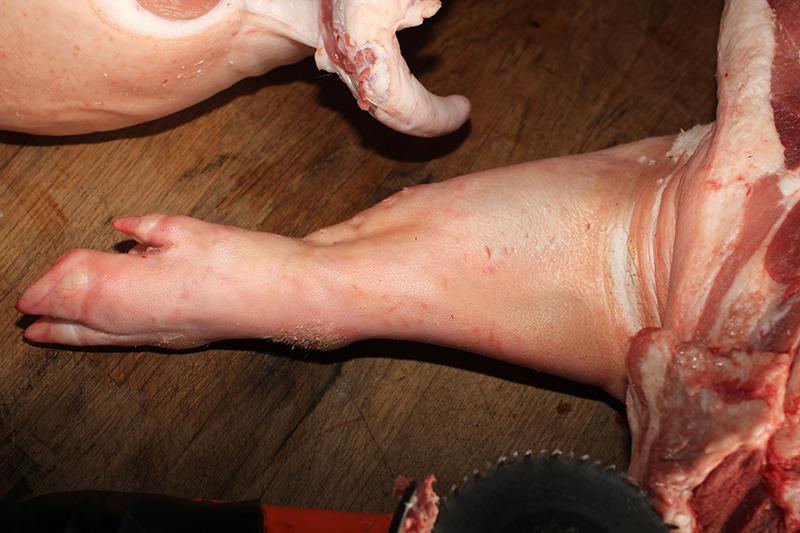
Pork feet and hocks produce plenty of natural gelatin.
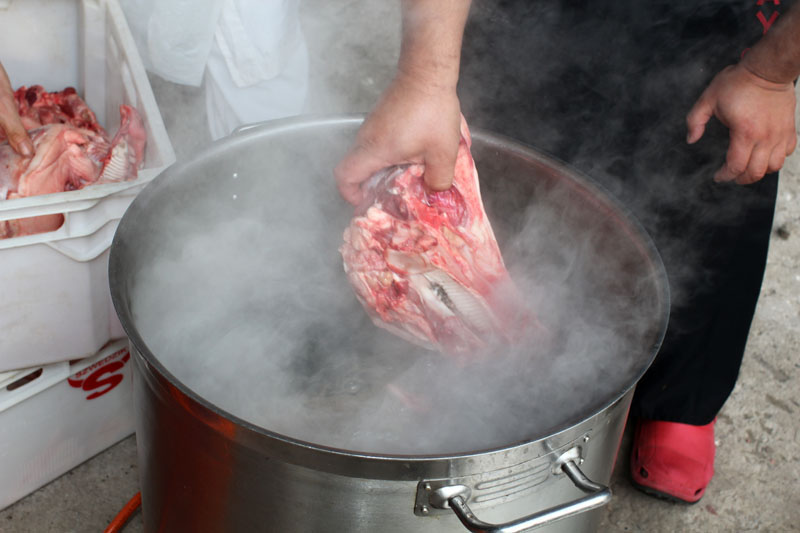
Inserting meats.
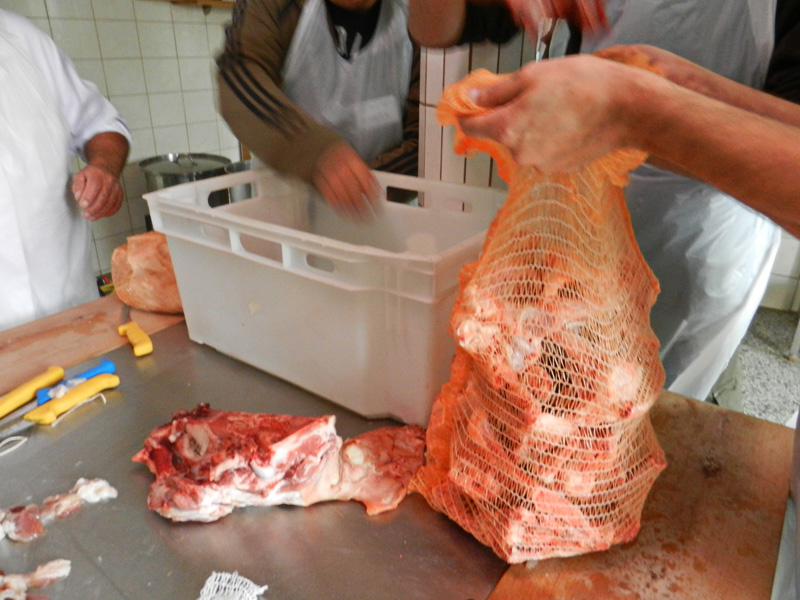
It is easier to remove cooked meat cuts when kept together.
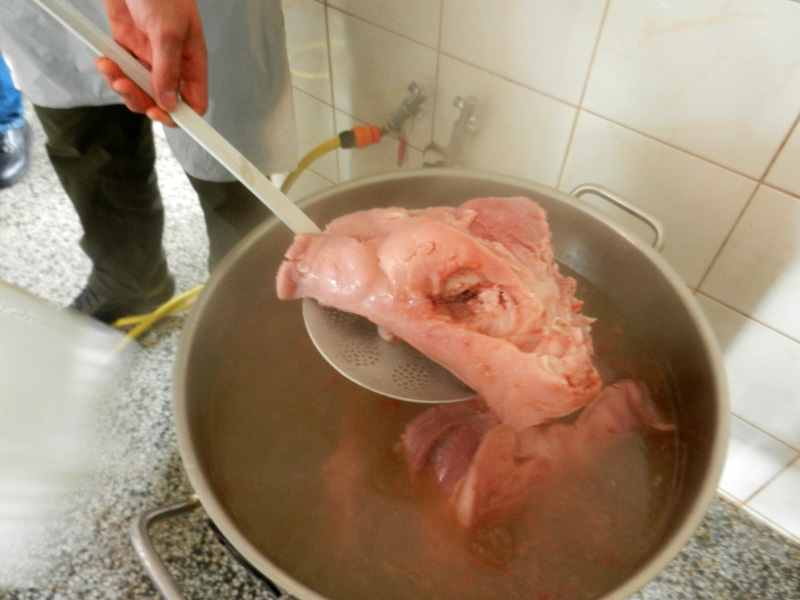
Checking meats.
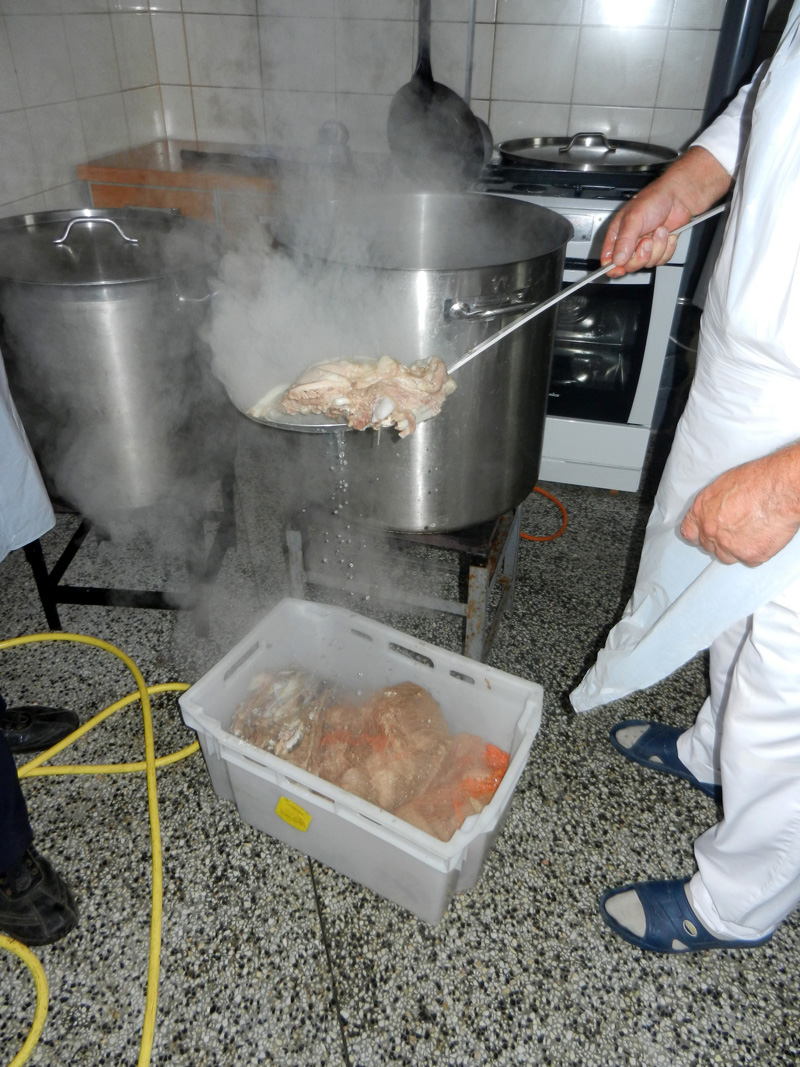
Removing cooked meats.
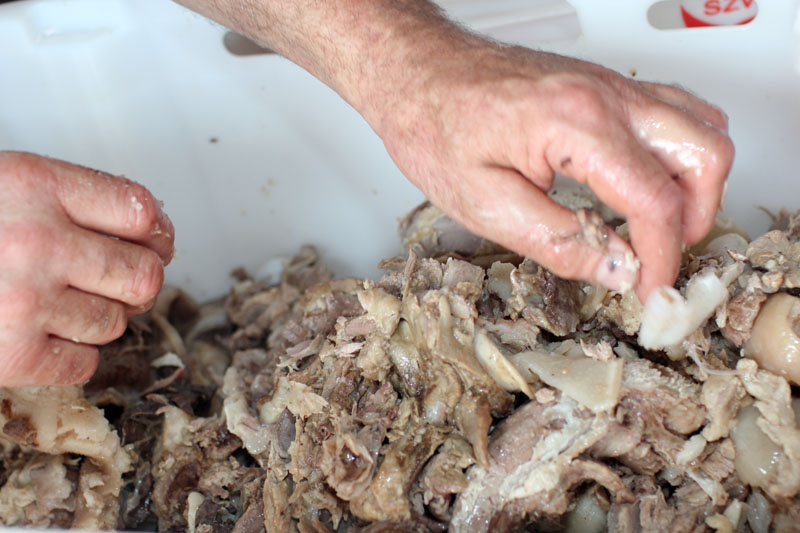
Separating meats from bones.
It is much easier to separate meats when the cuts are still warm.
Cooking Meats and Making Broth
This is basically one easy process but certain rules must be observed. Head cheese differs from other sausages in that meats are cooked before stuffing:
- All meats, skin included are cooked until soft.
- Meat is separated from bones.
Meats should be covered with 1-2 inches of water and simmered below the boiling point for 2-3 hours. The skins should be boiled separately until soft but still in one piece. When still warm, cooked meats should be removed from bones and cooled down. The skins are cut into strips. The resulting meat broth should be filtered though 2-3 layers of cheese cloth until clarified. The better clarity obtained, the better looking cheese head will be produced. Such a jelly is a fat free and rich in protein product.
When too much water was used it is possible to end up with a broth that will contain not enough gelatin and will not set. This may be corrected by additional boiling of the meat stock. As more water evaporates from the stock, the resulting meat broth gets concentrated and when cool it will become a jelly. If this does not work you will have to re-heat the jelly, strain the hot gelatin and add a packet of a commercial gelatin. Then re-arrange meats on a plate and pour the hot gelatin over them. This will become a serious issue if the meat was stuffed into the casing.
When in doubt it is safer to add powdered gelatin straight from the beginning than to create unnecessary extra work for yourself. As an extra precaution you may test your meat broth before it is added to the casing. Place some of it in a refrigerator and see whether it solidifies within one hour. If not enough collagen is present, for example mainly lean meats were used, little gelatin will be produced and the resulting meat stock will not solidify. This can be easily corrected by adding commercial gelatin. For best results mix powdered gelatin with the existing meat broth and not with water. Water will dilute the flavor of the broth.
Mixing
Meats are mixed with all other ingredients. Although the recipe provides the amounts of all ingredients, nevertheless due to precooking meats in water, then washing them with hot water later on, it is recommended to taste the mixture and refine the recipe if needed. Do not mix meat and jelly together before stuffing. The hot jelly will draw some of the juices out of the meat and the jelly becomes cloudy. A good idea is to scald meat with hot water to remove any grease that might cloud the gelatin.
Stuffing
Head cheese was traditionally stuffed into pig stomach. Pig stomach is a one unit chamber of uniform oval shape with two easy to saw openings. Stomachs of a cow or a sheep are basically three stomachs in one unit. The shape of those stomachs is irregular and not easy to fill. After filling, the stomach's opening had to be sewn with butcher's twine. Today, head cheese is stuffed into a large diameter synthetic casing, preferably a plastic one that will prevent loss of aspic during cooking. The tied or clipped at the bottom casing is held vertically and meat pieces are placed first. Then a gelatin, from naturally produced meat broth or made from a commercial powder, is carefully poured down into the casing. This is normally done through a big funnel using a ladle. The casing is tied or clipped on the top and head cheese is ready for cooking.
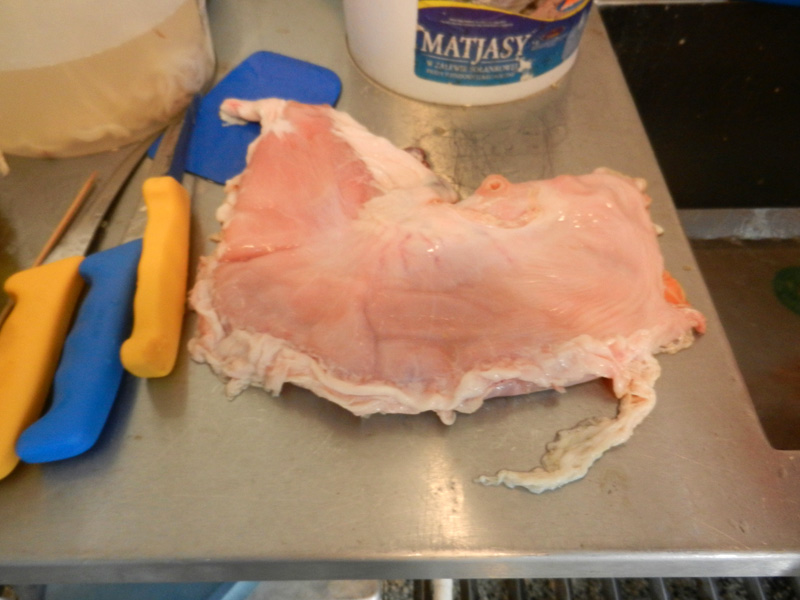
1. Stomach need to be cleaned. It is reversed first.
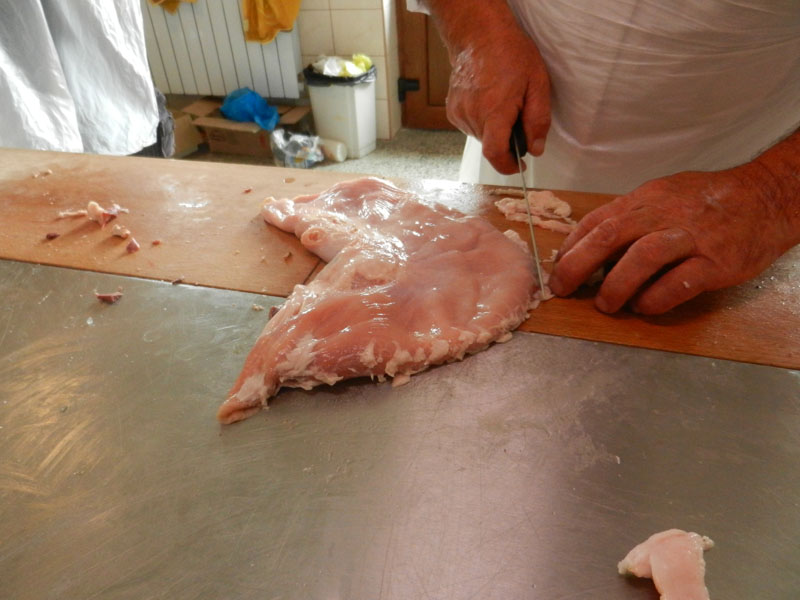
2. Unnecessary fat is trimmed off.
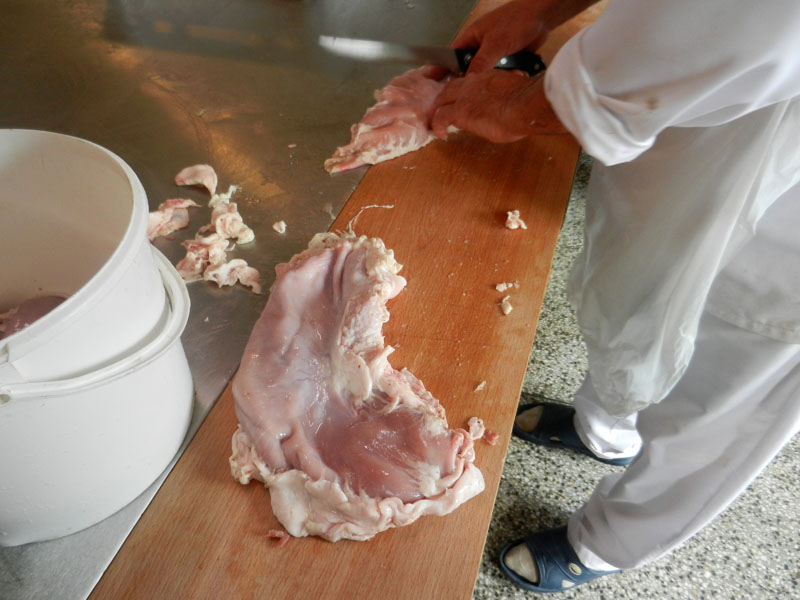
3. Gentle scraping works well.
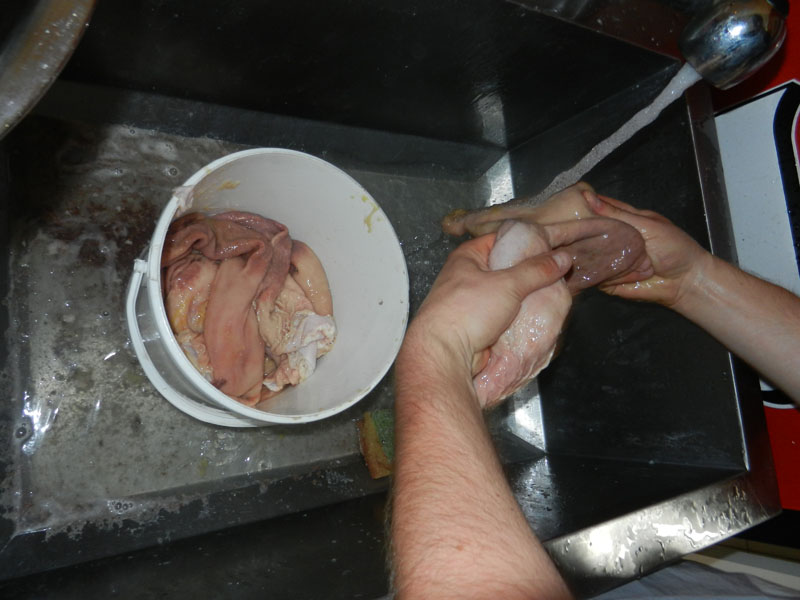
4. Cleaned stomachs are rinsed.
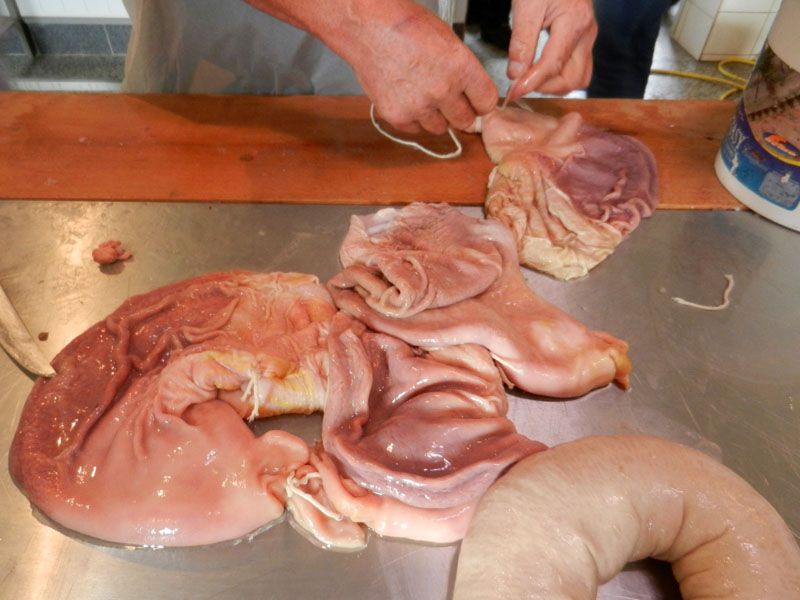
5. Small opening is tied.
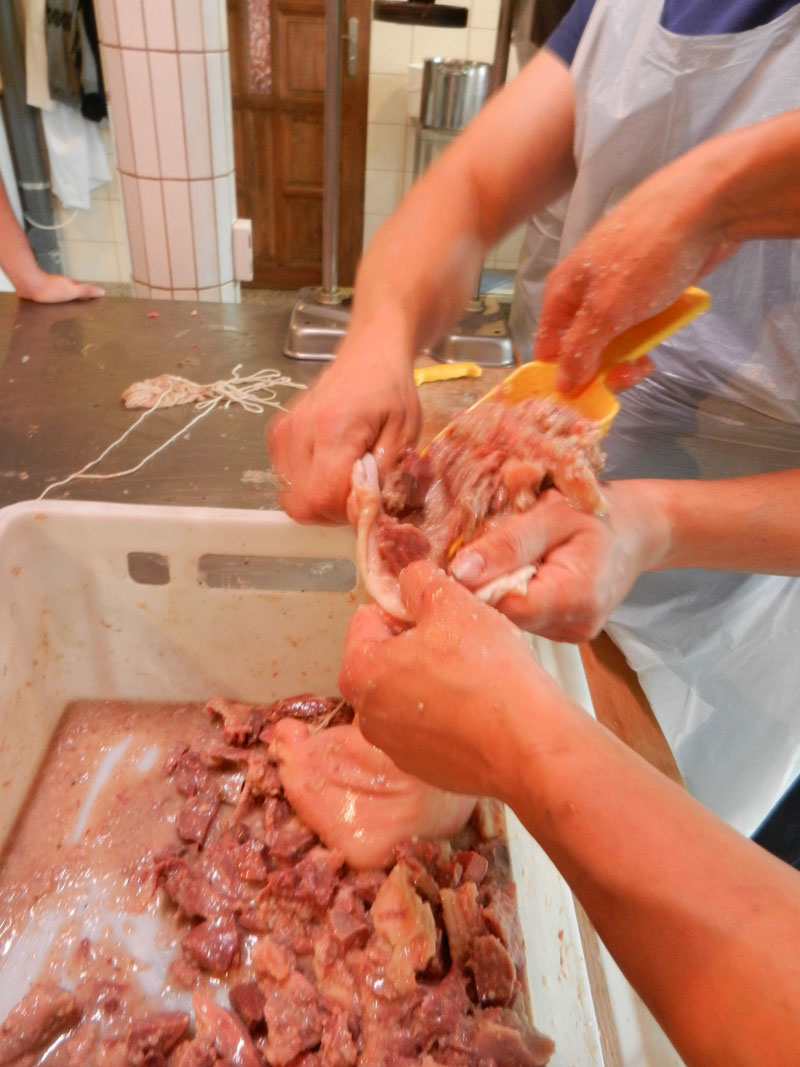
6. Now the stomach is filled with meats.
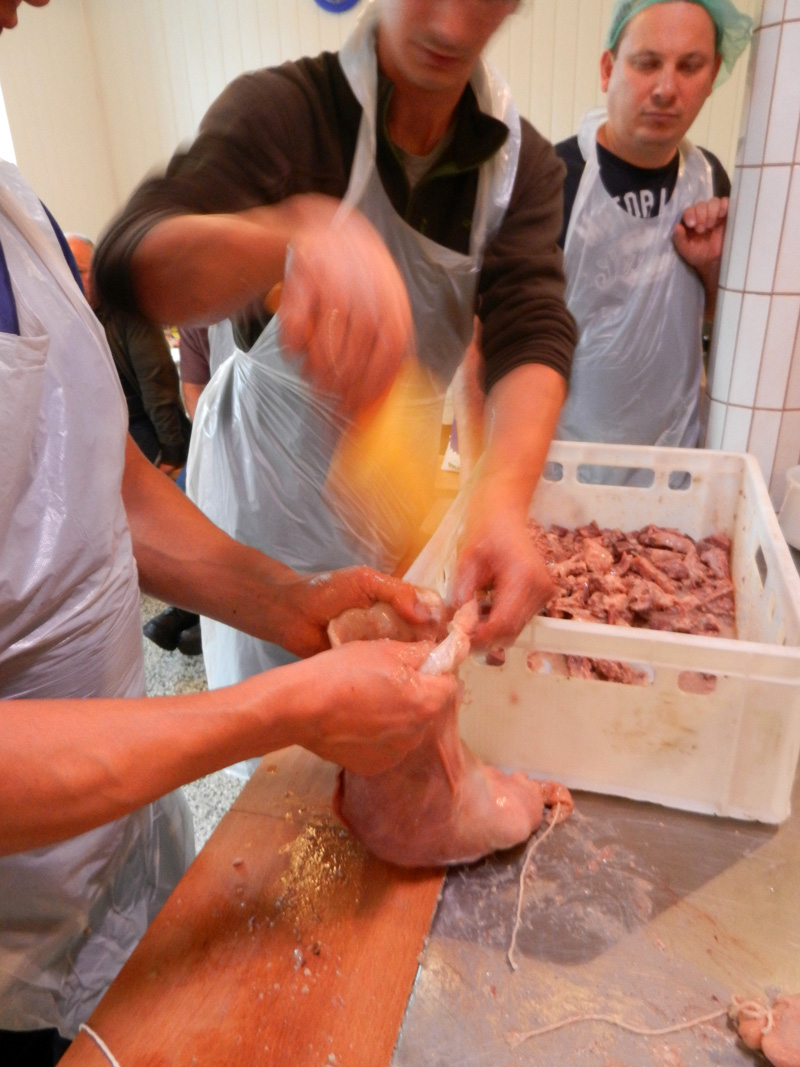
7. Filling stomach.
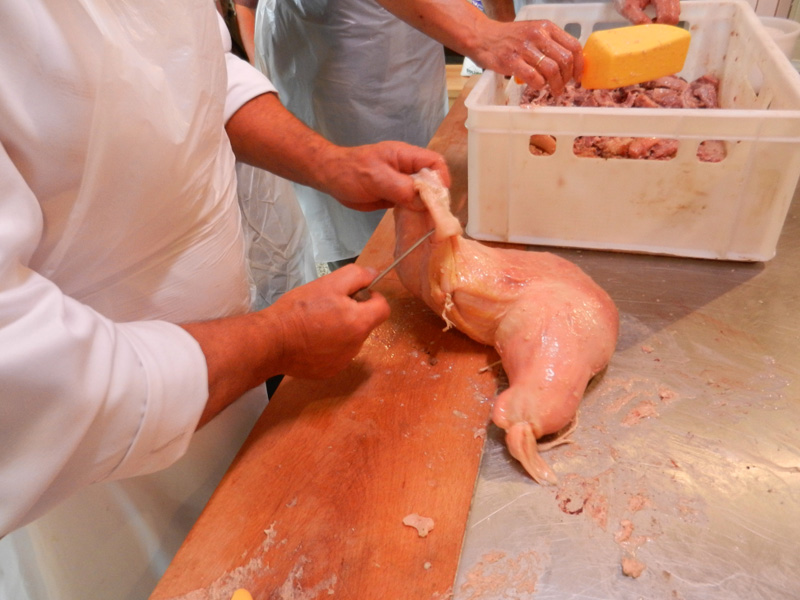
8. The stomach is tied.
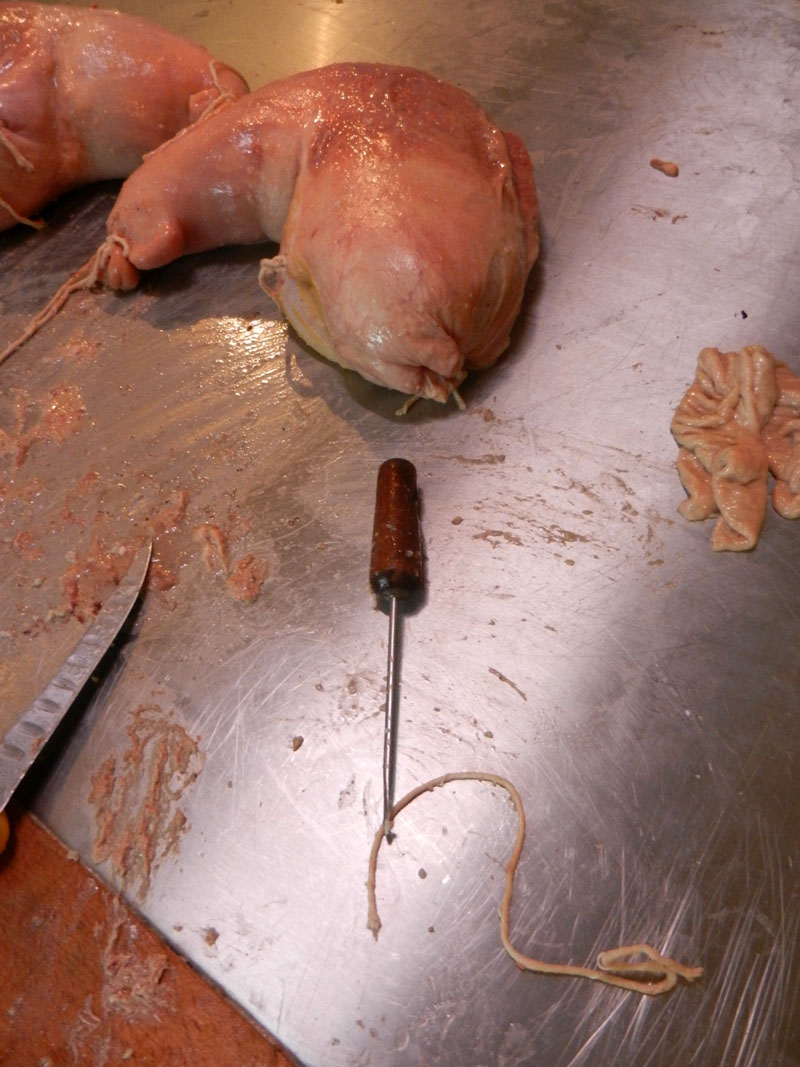
9. The stomach's skin is hard so you need a special tool. A tool for fixing bicycle tire flats will work.
Cooking Head Cheese
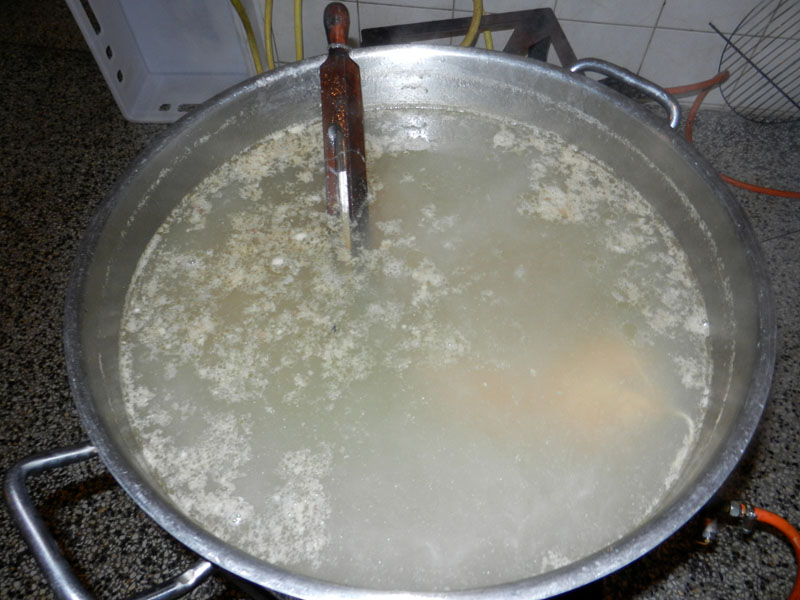
Cooking head cheese at 80-85° C (176-185° F).
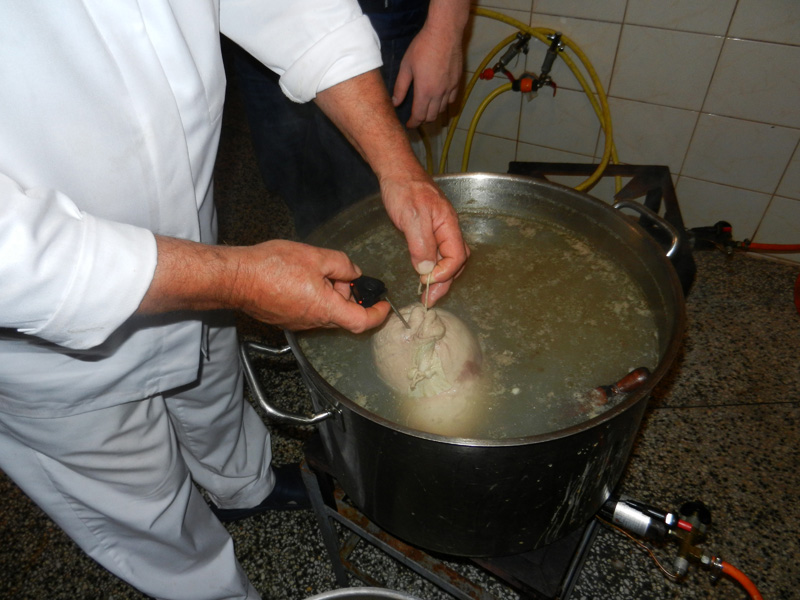
Checking internal temperature.
Cooling Head Cheese
After cooking head cheese should be left at room temperature for a few hours to let the steam out. After that the head cheese was placed between two wooden boards. The top board was weighted and the sausage was stored overnight in a cooler. This permanently flattened head cheese and gave him the rectangular shape with rounded corners.
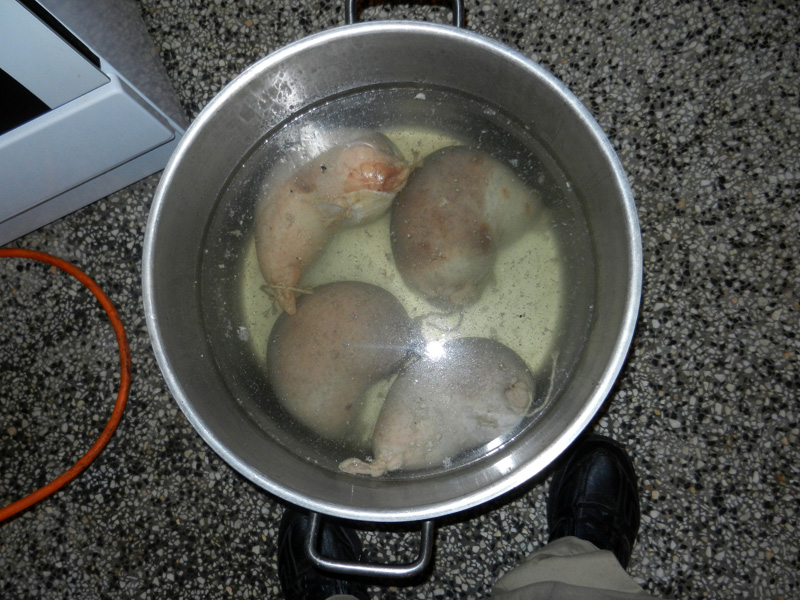
Short partial cooling/washing in cold water.
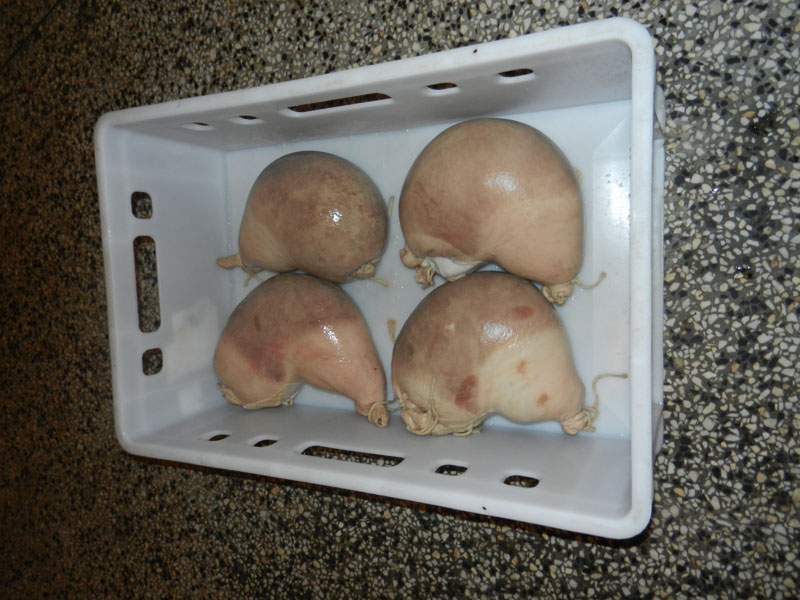
Finished product ready for pressing.
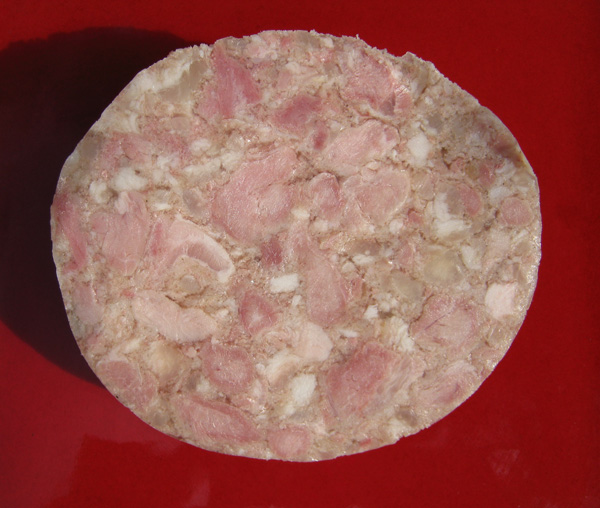
Unpressed head cheese with finely cut meats.
Head cheeses stuffed into round fibrous casings are not flattened.
Ingredients and Spices
Amount of salt varies between 1.5-2% which is the same as for a typical sausage. Commonly used spices: pepper, nutmeg, mace, allspice, cloves, marjoram, cardamom, onions, garlic, caraway, thyme, ginger.
Notes
Head cheeses, liver sausages and blood sausages belong to a special group of products that incorporate less noble cuts of meat that will be much harder to sell to the public at least in their original form.What separates those products from other common sausages is the fact that meats are precooked before being stuffed into casings and then they are submitted to a hot water cooking process. Another pecularity is that all those products are often made without being stuffed into casings:
- When placed in forms and baked in the oven, liver sausages become pates.
- When placed in forms and baked in the oven, blood sausages become blood puddings or blood meat patties.
- When placed in forms and allowed to cool, head cheeses become meat jellies.
Traditionally made head cheese or meat jelly may look less pretty but will be a product of much higher quality due to the following reasons:
- No chemicals added
- No water pumped into the product (stronger meatier flavor)
- Natural broth (no gelatin added). Commercially prepared gelatin is a combination of neutrally flavored powder (natural glue) and water and natural broth is a combination of natural glue plus highly flavored meat stock that remains after cooking bones. On cooling this gelatin will subsequently become a jelly and accounts for about 30% of the total weight of the product. What would you prefer to have in your head cheese or meat jelly: 30% of water or 30% of meat broth?
Many people limit themselves to making just one or two types of sausages (fresh or smoked variety) and mistakenly believe that special sausages (liver, blood or head cheese) must be very complicated to make. Yet a head cheese is a very simple product to make as long as one forgets he is making a sausage and starts to think in terms of cooking a hearty meat broth. And when the broth is cooked, all that remains is to separate meats from bones and stuff them in a large diameter casing or place them to cool in any kind of a food grade container.
Commercial processors like to add some wine or vinegar to create a slightly sourly flavor as this will extend the shelf life of the product. Most home made head cheeses don't contain vinegar or wine in its composition. Head cheese is consumed cold and freezes very well.
Final Note
If head cheese is such a great product why is not commonly available? Well, the manufacturing process is more complicated as it requires precooking meats and separating them from bones. The process becomes time consuming and requires more equipment. As a result the processors will have to charge a steep price to break even. It is more profitable to make a sausage than a head cheese. Secondly, American consumer knows less about head cheese or blood sausage than his European counterpart. We may eat a lot of sausages in the USA, but they are mainly hot dogs, bologna and fresh sausages that will be grilled.
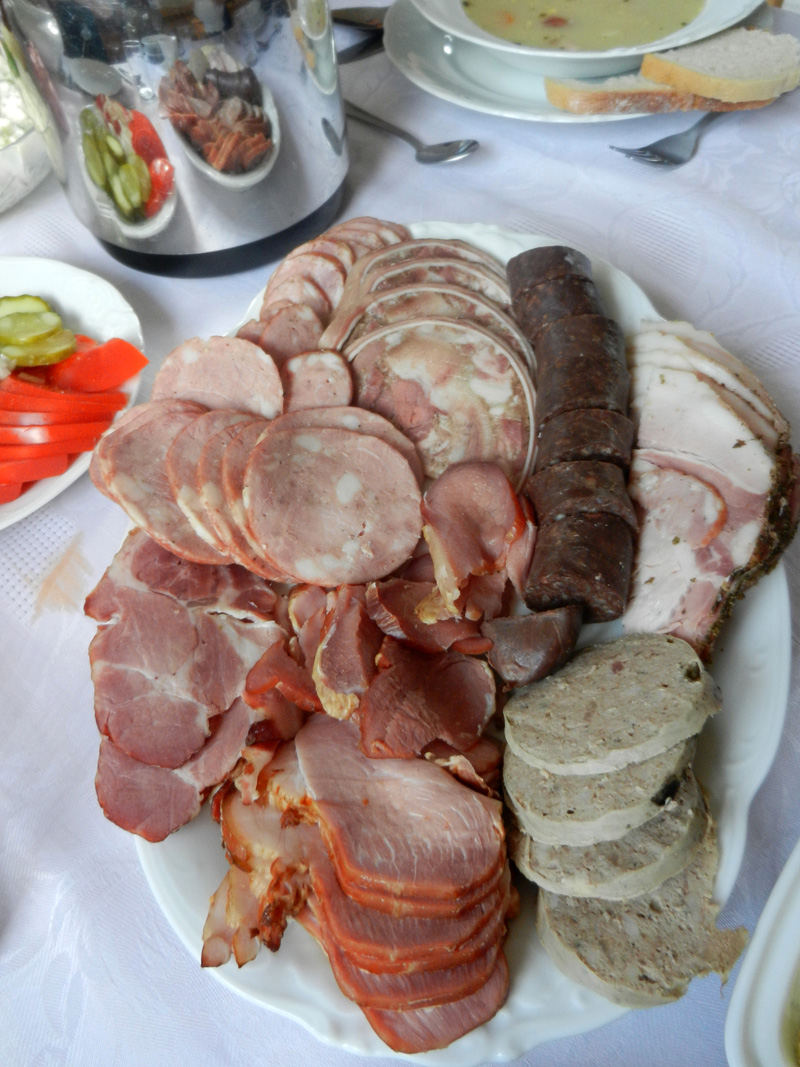
Variety of cold cuts: liver sausage, blood sausage, head cheese, Krakowska sausage, smoked butt (baleron), smoked loin, smoked ham, baked loin.