Meats and Sausages

Sausage Recipe Secrets
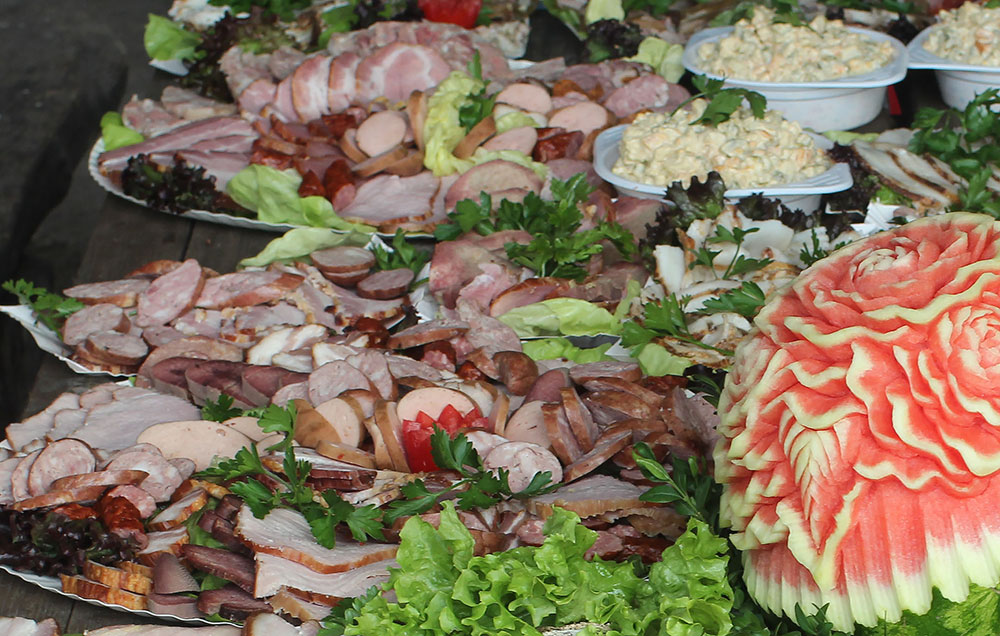
Variety of meats and sausages.
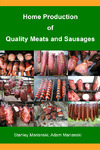
The following information is reprinted with permission from Home Production of Quality Meats and Sausages.
It is mind boggling to see people clicking for hours and hours on a computer keyboard to find magic recipes on the Internet. Searching for the Holy Grail of a sausage. Then when they find something they like, they mess it up by applying too high smoking or cooking temperatures. The recipe of course, gets the blame. Then they look for another magic recipe again.
Recipe is what the word says: ”the recipe”, it does not imply that one will produce an outstanding sausage. Making quality sausages has little to do with recipes, it is all about the meat science and the rules that govern it. All sausage making steps, especially temperature control, are like little building blocks that would erect a house. It is like the strength of the chain, which is only as strong as its weakest link. Each step in sausage making influences the step that follows, and all those steps when performed correctly will, as a final result, create the quality product. Let us quote Madame Benoit, the famous Canadian cookery expert and author who once said:
A good chef is not looking at his notes when making chicken soup and an experienced sausage maker knows how to make a good sausage. We could fill this book with hundreds of recipes but that won’t make you more knowledgeable. There isn’t one standardized recipe for any of the sausages.The best meat science books, written by the foremost experts in this field list different ingredients for the same sausage. Salami Milano and Salami Genoa are basically the same sausage, the difference lies mainly in meat particle size. Replacing mace with nutmeg, using white or black pepper, adding/removing a particular spice will have little final effect on a sausage.
Grinding cold meat or frozen fat is more important for making a quality sausage than a pretty arrangement of expensive spices. It’s all about the technology. By adhering to the guidelines outlined in this book, you have to make a great sausage. By all means look at different recipes but be flexible and not afraid to experiment. Use ingredients that you personally like as in most cases you will make a sausage for yourself, so why not like it? When making a large amount of the product a wise precaution is to taste the meat by frying a tiny piece. After mixing meat with all ingredients there is still time for last minute changes to the recipe. There is not much we can do after a sausage is stuffed. Tasting should always be performed when mixing ground meat with spices to make a sausage. A recipe is just a recipe and let your palate be the final judge.
General Guidelines
Use spices that you and your kids like, after all you will end up eating it. Basically a sausage is meat, salt and pepper. I will never forget when I made my first Polish smoked sausage that turned out very well and I proudly gave it to my friend - professional sausage maker Waldemar to try. I have included salt, pepper, garlic, and added optional marjoram. I also added nutmeg and other spices that I liked. Well my friend’s judgement was as follows:
Great sausage, but why all those perfumes?
For him it was supposed to be the classical Polish Smoked Sausage and all it needed was salt, pepper and garlic. The moral of the story is that putting dozens of spices into the meat does not guarantee the best product.
Another real example is when the owner of a popular Texas barbecue restaurant was asked this question: "what do you put inside your sausages that they taste so great?" The answer was:
It is not what I put into them, but what I don't put is what makes them so good.
Keep it simple. Combining meat with salt and pepper already makes a great sausage providing that you will follow the basic rules of sausage making. It’s that simple. Like roasting a chicken, it needs only salt, pepper, and it always comes out perfect. If you don’t cure your meats properly, grind warm fat or screw up your smoking and cooking temperatures, all the spices in the world will not save your sausage.
There is one rule though which is obeyed by professionals who keep on winning barbecue contests: cook it low and slow. The same principle applies to traditional methods of smoking meats and sausages. It is all about temperatures and patience, other factors such as marinades, sauces, and different woods for smoking are just a dressing.
Sausage Recipe Secrets
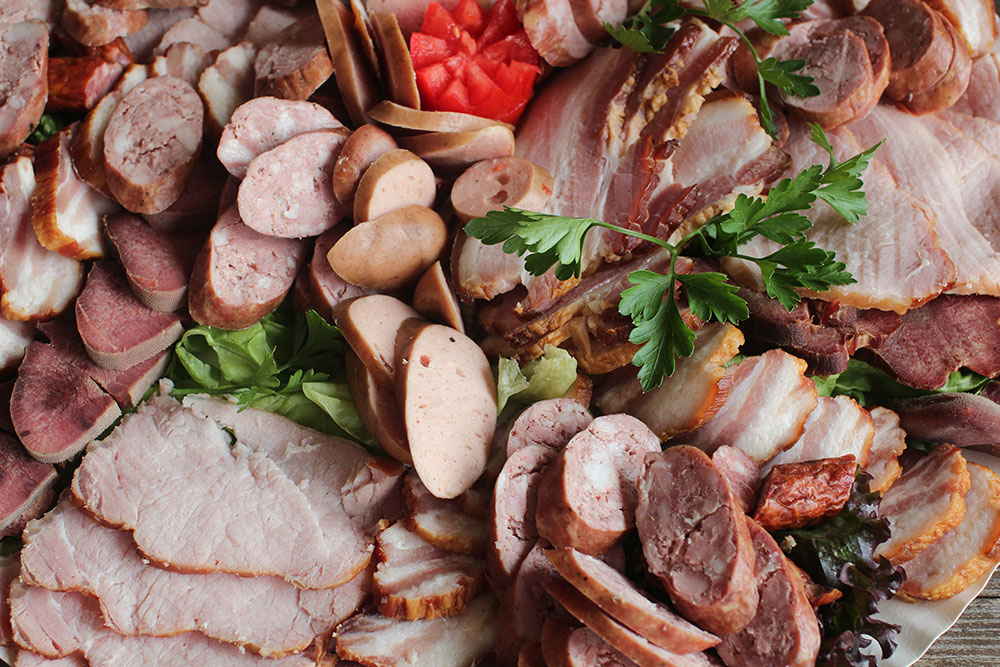
Variety of meats and sausages.
1. Fat. The meat for a sausage should contain about 25 - 30% fat in it. This will make the sausage tender and juicy, without fat it will feel dry. This is not such a big amount as it might seem so at first. Fresh sausages made in the USA can legally contain 50% fat and this is what you get in a supermarket. The fat is cheap and the manufacturer is not going to replace it with a higher priced lean meat. This is where the main advantage of making products at home comes to play: you are in control. Avoid beef fat which is yellow and tastes inferior to pork fat. Fat from lamb or wild game should not be used either, unless you make original sausages like Turkish Sucuk or Scottish Haggis. Sheep or goat fat has a specific odor which lowers quality of the sausage.
2. Salt. The sausage needs salt. Salt contributes to flavor, curing and firmness, water holding and juiciness, binding and texture (protein extraction), safety and it prevents water cooking loss. In general sausages contain 1.5-2% salt. About 3.5-5% will be the upper limit of acceptability, anything more and the product will be too salty. Get the calculator and punch in some numbers. Or if you use the metric system you don’t even need the calculator: You need 2 grams of salt per 100 grams of meat. If you buy ten times more meat (1 kg) you will also need ten times more salt (20 grams). Now for the rest of your life you don’t have to worry about salt in your recipes. If you want a consistent product, weigh out your salt. Estimating salt per cups or spoons can be deceiving as not all salts weigh the same per unit volume.
Salt perception can be an acquired taste. If you decide to go on a low sodium diet and start decreasing the amount of salt you consume, in about three weeks time you may reach a point when your food tastes enjoyable, though you use less salt than before. This is fine as long as you prepare those meals for yourself. When making sausages for your friends, try to adhere to the amount of salt the original recipe calls for, as other people might like a different amount of salt. When smoking large amounts of meat that will be kept for a week or longer, remember that it will keep on drying out (losing moisture). Salt will, however, remain inside and your sausage will now taste saltier and will be of a smaller diameter. The meat flavor will also be stronger now. In such a case you may use less salt than originally planned for, let’s say 15 g/kg. That will not apply when making a fresh sausage which will be consumed in a matter of days, and (1.8-2%) salt will be fine.
There are different types of salt and people often speculate which kind is the best. Well, probably the cheapest salt that is known as rock or canning salt might be the best as it is very pure. Salt was originally mined and transported in huge slabs to different areas. It was a valuable commodity and was named after the mine which had produced it. Different mines produced salt with different impurities content. If a particular salt contained more Nitrate, it would impart pink color to the meat and improve its keeping qualities. Such salt would be popular for meat preservation.Table salt that we use for general cooking contains many added ingredients such as iodine (there is a non-iodized salt, too) and anti-caking agents such as sodium silicoaluminate or magnesium carbonate that prevent salt from acquiring moisture. Pure rock salt will lump together and will not shift from a salt shaker. Salt lumping is of a minor inconvenience as the hardened salt can be reversed to its original powdery form by shaking the container. Cleaner salt will produce cleaner gelatin in a head cheese. Some salts are finely ground and some are flaked. A finely ground salt will be more suitable for curing fish in brine. Due to a short time involved finely pulverized salt will penetrate fish flesh faster. On the other hand dry cured products such as ham or bacon which cure for weeks at the time, might benefit from a coarsely ground salt.
For brining purposes both table salt and kosher salt will work equally well in terms of providing the desired effects, though kosher salt – and in particular Diamond® Crystal kosher salt dissolves more readily. What is important to remember is that kosher salts are less dense than ordinary table salts and measure quite differently from a volume standpoint. Kosher salt has larger crystals and is bulkier. A given weight of Diamond® Crystal takes up nearly twice the volume as the same weight of table salt. One teaspoon of table salt weighs 6 g but 1 teaspoon of Kosher salt weighs 4.8 g. Five tablespoons of Diamond® Kosher Salt (72 g) or five tablespoons of Morton® Table Salt (90 g) will add a different percentage of salt to your product as the former salt is much lighter. Yet when you weigh 90 g of salt on a scale it makes no difference what kind of salt you choose. Ninety grams of table salt equals to 90 g of flaked salt regardless of the volume they might occupy. The table below shows approximate equivalent amounts of different salts:
| Table Salt | 1 cup | 292 g (10.3 oz) |
| Morton® Kosher Salt | 1⅓ to 1½ cup | 218 g (7.7 oz) |
| Diamond® Crystal Kosher Salt | 1 cup | 142 g (5 oz) |
As you can see it is always advisable to weigh out your salt. The above table proves how misleading a recipe can be if listed ingredients are measured in volume units only (cups, spoons, etc).
Sea salt. Sea salt is made by evaporating sea water and what is left is the salt plus impurities which were in sea water. Those impurities include different minerals and chemicals such as magnesium, calcium or nitrate. If a substantial amount of Nitrate is present, such salt will somewhat cure meats and make them pink. Due to imputities sea salt may taste a bit bitter. Sea salt is occasionally added to dry cured and air dried products which are made without Nitrates. Nevertheless such a manufacturing process is not recommended for an amateur. Each gallon of sea water (8.33 lb) produces more than 1/4 pound of salt.
3. Pepper. It is available as whole seeds but you have to grind it. Like in a case of coffee beans, the advantage is that you get a fresher aroma when grinding seeds just before use. It is available as coarse grind, sometimes called butcher’s grind or fine grind. A recipe will call for a particular grind but the final choice will be up to you. Black pepper is normally used in fresh sausages and blood sausages, and white pepper is used in others. Polish sausage might need coarse grind black pepper, but a hot dog, Bologna or Krakowska sausage will call for a fine grind white pepper. The dividing line is whether you want to see the pepper in your product or not. Otherwise it makes no difference and you can replace black pepper with the same amount of white pepper, although the black pepper is a bit hotter. Pepper is added at 0.1-0.4% (1.0-4.0 g per 1 kg of meat). The definition of pepper can be confusing at times. Both white and black pepper are produced by the same plant.
- Black pepper - unripe seeds of the plant with the skin left on.
- White pepper - ripe seeds with the skin removed.
Then there is Capsicums family of peppers which includes hot red pepper, Cayenne pepper, chili pepper and paprika. Chili powder is a combination of chili pepper, cumin, oregano and garlic. Red pepper can be referred to as Cayenne pepper as both are very hot. Interestingly, the smaller the fruit of pepper is, the stronger the pepper. California produces most peppers by variety and volume except tabasco peppers which are grown in Louisiana and made into Tabasco sauce.
The Scoville scale is a measure of the hotness of a chile pepper. These fruits of the Capsicum pepper plants contain capsaicin, a chemical compound which stimulates thermoreceptor nerve endings in the tongue It is named after Wilbur Scoville, who developed the Scoville Organoleptic Test in 1912.
As those peppers figure often in sausage recipes and some of them could be harder to obtain than the others, we hope that the following table will be helpful with the substitution.
| Name | Rating | Place of Origin |
| Bell Pepper | 0 | Common everywhere |
| Pepperoncini | 100 - 500 | Latin America, Mexico, Southern USA |
| Anaheim | 500 - 2,500 | Latin America, Mexico, Southern USA |
| Ancho | 1,000 - 2,000 | Latin America, Mexico, Southern USA |
| Poblano | 1,000-2,000 | Latin America, Mexico, Southern USA |
| Jalapeño | 2,500 - 8,000 | Latin America, Mexico, Southern USA |
| Chipotle | 5,000 - 10,000 | Latin America, Mexico, Southern USA |
| Serrano | 7,000 - 25,000 | Latin America, Mexico, Southern USA |
| Cayenne | 30,000 - 50,000 | Latin America, Mexico, Southern USA |
| Tabasco | 30,000 - 50,000 | Latin America, Mexico, Southern USA |
| Pequin | 40,000 - 75,000 | Latin America, Mexico, Southern USA |
| Thai | 50,000 - 100,000 | Thailand |
| Habanero | 100,000 - 300,00 | Originally from Havana. Yucatan, Costa Rica, Belize, Texas, California |
| Red Savina Habanero | 300,000 - 580,000 | Southern California |
| Common Pepper Spray | 2,0000,000 | Pepper spray used for self - defense |
| Police Grade Pepper Spray | 5,000,000 | Police pepper spray |
| Pure Capsaicin | 16,000,000 | Pure chemical |
4. Sugar. As a flavoring ingredient, sugar plays a little role in making sausages and is added for other reasons:
- To offset the harshness of salt. Adding some sugar can correct the problem but only to a some degree. Anyhow sugar should not be detectable. Chinese sausages may be an exception as Chinese recipes contain a lot of sugar. No more than 3 g of sugar is added to 1 kg of meat otherwise it can be noticeable. This corresponds to about 10% of the salt used in the recipe. Adding too much sugar to a sausage that is smoked for a long time may trigger fermentation by lactic bacteria naturally occurring in meat. This may lead to a sourly flavor.
- To help bacteria produce lactic acid in fermented sausages.
- Process of making semi-dry fermented sausages depends on adding sugar. Adding sugar to traditionally made slow fermented salamis (Hungarian salami) is less crucial as their manufacture does not depend on lactic acid production.
- Adding 1 - 2 g sugar per 1 kg of meat helps to preserve the color of the sausage.
- Potassium nitrate was used in older recipes as food for curing bacteria. These bacteria forced nitrate into releasing nitrite which subsequently cured the meat.
- Use of a small quantity of sugar is said to brighten the color of sausages.
In Europe beet sugar is commonly used, in the USA cane sugar is readily available. Often dextrose is used, but keep in mind that it is only 70% as sweet as sugar. Dextrose is the sugar of choice for making fermented sausages.
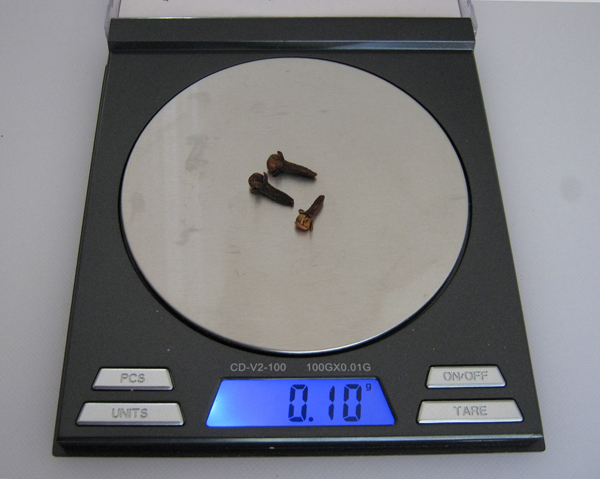
Weighing whole cloves.
AWS Compact Digital Scale v2.0
by American Weigh Systems
5. Spices. The most popular spices in the manufacture of sausages are pepper and garlic, sage, allspice, marjoram, thyme, rosemary, fennel, anise, cinnamon, mace, mustard, nutmeg, ginger, cardamom, coriander, oregano, and are normally added at around 0.1-0.2% (1-2 g/kg). To weigh spices and starter cultures accurately, specialized digital scales are recommended. Spices are very volatile and lose their aroma rapidly which is more pronounced in slow-fermented sausages that take three months or longer to make. Dark spices such as nutmeg, caraway, cloves, and allspice can darken the color of the sausage.
Guidelines for Spice Usage
General rule: About 1-2 g of spice is added to 1 kg (2.2 lbs) of meat. One teaspoon of dried ground spice weighs about 2 grams.
The following tables are reprinted with permission fron the book "Home Production of Quality Meats and Sausages" Chapter 12 Creating Your Own Recipes and will help you create your own recipes. This is how much spices the professional sausage maker adds to 1 kilogram (2.2 lbs) of meat.
| Spice in grams per 1 kg of meat | |
|---|---|
| Allspice | 2.0 |
| Bay leaf | 2 leaves |
| Cardamom | 1.0 - 2.0 |
| Caraway seeds | 2.0 |
| Caraway powder | 0.5 |
| Cayenne pepper | 0.5 |
| Celery salt | 1.0 |
| Chillies | 0.5 |
| Cinnamon | 0.5 - 1.0 |
| Cloves | 1.0 - 2.0 |
| Coriander | 1.0 - 2.0 |
| Cumin | 1.0 |
| Curry powder | 1.0 |
| Fennel | 2.0 |
| Fenugreek | 1.0 |
| Garlic paste | 3.0 - 5.0 |
| Garlic powder | 1.0 |
| Ginger | 0.5 |
| Juniper | 2.0 |
| Mace | 0.5 |
| Marjoram | 2.0 - 3.0 |
| Mustard | 2.0 |
| Nutmeg | 1.0 |
| Onion (fresh) | 10.0 |
| Onion powder | 2.0 - 5.0 |
| Paprika | 2.0 |
| Pepper-white | 2.0 - 3.0 |
| Pepper-black | 2.0 - 3.0 |
| Red peppers | 0.5 |
| Thyme | 1.0 |
| Turmeric | 2.0 - 4.0 |
| Other Ingredients in g per 1 kg of Meat | |
| Non fat dry milk powder | 4.0 |
| Soy powder concentrate | 1.0 - 3.0 |
| Sugar | 1.0 - 2.0 |
| How many grams of spice or ingredient in one flat teaspoon | |
|---|---|
| Allspice, ground | 1.90 |
| Aniseed | 2.10 |
| Basil | 1.50 |
| Bay leaf, crumbled | 0.60 |
| Basil, ground | 1.40 |
| Caraway, seed | 2.10 |
| Caraway, ground | 2.20 |
| Cardamom, ground | 2.00 |
| Cayenne pepper, ground | 2.50 |
| Celery seed | 2.50 |
| Cilantro, dry | 1.30 |
| Cinnamon, ground | 2.30 |
| Cloves, ground | 2.10 |
| Coriander, ground | 2.00 |
| Coriander, seed | 1.80 |
| Cumin, ground | 2.00 |
| Cumin seed | 2.10 |
| Cure #1 | 6.00 |
| Cure #2 | 6.00 |
| Curry powder | 2.50 |
| Dill, whole | 2.42 |
| Fennel, whole | 2.00 |
| Fenugreek, ground | 3.70 |
| Garlic powder | 2.80 |
| Ginger, ground | 1.80 |
| Juniper berries | 1.53 |
| Mace, ground | 1.69 |
| Marjoram, dried | 0.60 |
| Marjoram, ground | 1.50 |
| Milk powder | 2.50 |
| Mustard seed, yellow | 3.20 |
| Mustard, ground | 2.30 |
| Nutmeg, ground | 2.03 |
| Onion powder | 2.50 |
| Oregano, ground | 1.50 |
| Paprika, ground | 2.10 |
| Parsley, dry | 0.50 |
| Pepper-black, ground | 2.10 |
| Pepper-white, ground | 2.40 |
| Pepper, flakes, red | 2.30 |
| Pepper, whole | 4.00 |
| Poppy seed | 2.84 |
| Rosemary, leaf | 1.20 |
| Saffron | 0.70 |
| Sage, ground | 0.70 |
| Savory | 1.72 |
| Salt | 6.00 |
| Soy powder | 3.00 |
| Sugar | 5.00 |
| Tarragon, dry | 1.00 |
| Thyme, crumbled | 0.60 |
| Turmeric, ground | 3.00 |
Useful Information
- 1 US Tablespoon (Tbs) = ½ US fl. oz. = 14.8 ml
- 1 metric tablespoon = 15 ml (Canada, UK, New Zealand)
- 1 metric tablespoon = 20 ml (Australia)
- 1 Tablespoon = 3 teaspoons in both the US and the UK.
- 1 tsp salt = 6 g
- 1 tsp Cure#1 or Cure #2 = 6 g
- 1 tsp sugar (granulated) = 4.1 g
- 1 tsp sugar (brown) = 4.6 g
- 1 Tbs water = 15 ml (15 g)
- 1 cup oil = 215 g
- 1 Tablespoon of oil = 13.6 g
- 1 Tbs of butter = 14.19 g
- 1 cup of all purpose flour = 120 g (4.2 oz).
- 1 Tbs of flour = 9.45 g
- 1 cup finely ground bread crumbs = 120 g
- 1 small onion = 60 g
- 16 tablespoons = 1 cup
- 1 dry ounce = 28.3495 grams.
- 1 cup of water weighs 8.3454 ounces.
- There are 236.588 ml in one cup so 1 cup of water weighs 236.588 g.
- 1 liter = 1.0567 US quart
- 1 ml water = 1 g
Dominant Spices Used in Different Sausages
Most sausages will include a dominant spice plus other spices and ingredients. There are some Polish blood sausages (kaszanka) that add buckwheat grouts or rice, there are English blood sausages (black pudding) that include barley, flour or oatmeal. Some great Cajun sausages like Boudin also include rice, pork, liver and a lot of onion. Let’s see what goes besides salt and pepper into some well known sausages that have a recognized flavor.
| Name | Type of meat | Dominant spice | Sugar |
| Italian Sweet Sausage | Pork | Fennel | Yes |
| Italian Medium Hot Sausage | Pork | Fennel plus cayenne | Yes |
| Italian Hot Sausage | Pork | Fennel plus more cayenne | Yes |
| Polish Smoked Sausage | Pork | Garlic | Yes |
| Kabanosy | Pork | Nutmeg, Caraway | Yes |
| Hunter's Sausage | Pork, beef | Juniper | Yes |
| American Breakfast Sausage | Pork | Sage | No |
| Hungarian Smoked Sausage | Beef | Hungarian Paprika (Sweet) | No |
Andouille |
Pork | Garlic, thyme, cayenne | No |
| Swedish Potato Sausage | Pork, beef | Allspice, potatoes, onions | No |
| Nham (Thai fermented sausage) | Pork | Garlic, hot chillies, rice | Yes |
All those sausages contain salt (about 2%), pepper and sodium nitrite (except Italian Sausages, American Breakfast Sausage as those are fresh sausages that will not be smoked). They also include more spices in smaller doses, but the dominant spice is what gives them their characteristic flavor. Take for example two great Polish classics: Polish Smoked Sausage and Mysliwska Sausage (Hunter’s Sausage). The amount of salt and pepper is exactly the same and they both contain garlic and sugar. The difference is that Mysliwska has 10% of beef in it and juniper. And that gives it a different taste and flavor.
Then if you add more juniper into Mysliwska sausage it becomes the Juniper Sausage although all processing steps remain exactly the same. Adjusting the amount of dominant spices will not produce much change, the sausage may be hotter or may have more garlic flavor. It does not matter much whether you add a bit more or less potatoes to Swedish Sausage but adding new spices will create a different product.
Vinegar though not a spice is used in some sausages like white head cheese or Mexican chorizo. What is the difference between 50, 100, and 200 grain vinegar? The grain strength of vinegar indicates the acetic acid content. The grain strength is ten times the acetic acid content, so 50 grain vinegar is 5% acetic acid, 100 grain is 10% acetic acid, and 200 grain is 20 % acetic acid.
Cold water is often added during mixing and is absorbed by extracted proteins. The finer degree of comminution the more water can be absorbed by the meat. This also depends on meat type and for example beef can absorb much more water than pork. Crushed ice or cold water is added when making emulsified products and the amount depends on the type of device used for emulsifying. A bowl cutter is more effective than a kitchen food processor and the last one is better than a regular grinder. Water is not added to fermented and air dried sausages.
You don’t need a magical recipe to make a good sausage, you need to know how. There are books which list thousands of sausage recipes such as Sausage and Processed Meat Formulations by Herbert Ockerman, but don’t tell you how to make a great product. Once, you know the how, you will transform any recipe into a wonderful sausage.