Meats and Sausages

Curing
In its simplest form, the word ‘curing’ means ‘saving’ or ‘preserving’ meat, and the definition covers preservation processes such as drying, salting, and smoking. When applied to homemade meat products, the term ‘curing’ usually means ‘preserved with salt and nitrite.’ When this term is applied to products made commercially, it means that meats are prepared with salt, nitrite, ascorbates, erythorbates, and dozens more chemicals pumped into the meat. Meat cured only with salt will have a better flavor but will develop a darker color if curing continues for a long time.
Factors that influence curing:
- The size of the meat - the larger the meat, the longer the curing time.
- Temperature - higher temperature, faster curing.
- Moisture content of the meat.
- Salt concentration of dry mixture or wet curing (brine). Higher salt concentration, faster curing.
- Amount of fat. More fat in meat, slower curing.
- pH - a measure of the acid or alkaline level of the meat, lower pH-faster curing.
- The amount of Nitrate and reducing bacteria in the meat.
Curing Temperatures
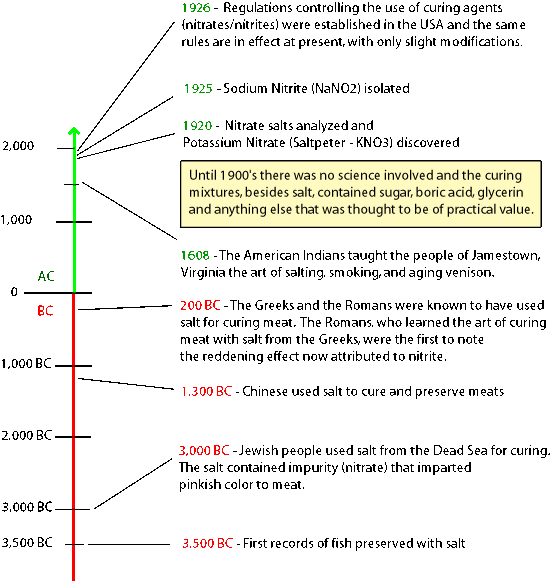
Meats were traditionally cured with Nitrate. Before Nitrate can release nitrite (the real curing agent), it must react with bacteria present in the meat. Putting Nitrate into a refrigerator-kept solution (below 40° F) will inhibit the development of bacteria, and they may not be able to react with Nitrate. On the other hand, sodium nitrite works well at refrigerator temperatures. When used with Nitrates/nitrites, salt is an incredibly effective preserving combination. There has not been even one documented incident of food poisoning of meat cured with salt and Nitrates.
People in the Far East, Africa, South America, and Europe are still curing meats at higher-than-normal temperatures without getting sick. That does not mean we recommend it, but if someone in Canada shoots a 1600 lbs (726 kg) Moose or a 1700 lbs (780 kg) Kodiak Bear, he has to do something with all this meat. He is not going to spend 5,000 dollars on a walk-in cooler, is he? These are exceptional cases when curing can be performed at higher temperatures. After the Second World War ended, most people in Europe did not have refrigerators or meat thermometers; they cured meats with Nitrate and made hams and sausages all the same.
Because of primitive conditions, the curing temperatures were often higher than those recommended today, but any growth of C. botulinum bacteria was prevented by the use of salt and Nitrates.
They also predominantly used potassium Nitrate, which works best at temperatures of 46-50° F (8-10° C), and those were the temperatures of basement cellars. There was little concern about longer shelf life as the product was consumed as fast as it was made. Salt and nitrite will stop Cl. botulinum spores from developing into toxins, even at those higher curing temperatures. Due to increased bacteria growth at those higher curing temperatures, the shelf life of a product would be decreased. Remember, when handling meats, the lower the temperatures the slower the growth of bacteria and the longer life of the product. Extending the shelf life of the product is crucial for commercial meat plants as the product can stay on the shelf longer and has a better chance of being sold. Curing is a more complicated process than salting. In addition to physical reactions like diffusion and water binding, we have additional complex chemical and biochemical reactions that influence the flavor and color of the meat.
What Will Happen if Too Little or Too Much Cure is Added?
Applying insufficient cure results in weaker color and decreased cured flavor. FSIS regulations dictate the maximum allowed nitrite limits and there are no limits for the lower levels. It has been accepted that a minimum of 40-50 ppm of nitrite is needed for any meaningful curing. Too much of the cure will not be absorbed by the meat and will be eaten by a consumer.
What Will Happen if the Curing Time is Shorter or Longer?
If the curing time is too short, some areas of meat (inside or under heavy layers of fat) will exhibit an uneven color, which might be noticeable when slicing a large piece of meat. It is less pronounced in sausages filled with ground meat, although the color may be weaker. If the curing time is longer than a few days, nothing will happen as long as the cured meat is held under refrigeration. You don’t want to cure bone-in meats longer than 30-45 days as they may develop bone sour even when kept at low temperatures. Taste your meats at the end of curing. You can cure them longer in a heavier brine (to increase salt content) or soak them in cold water (to lower salt content).
Cured Meat Color
Fresh Meat Color
The color of fresh raw meat is determined largely by the amount of myoglobin a particular animal carries. Meat color is determined largely by the amount of myoglobin (protein) a particular animal carries. The more myoglobin, the darker the meat, that simple. The amount of myoglobin present in meat increases with the animal's age. This color is pretty much fixed, and there is not much we can do about it unless we mix different meats.
Different parts of the same animal, take the turkey, for example, display a different meat color. To some extent, oxygen use can be related to the animal’s general activity level; muscles that are exercised frequently, such as the legs, need more oxygen. As a result, they develop more myoglobin and a darker color, unlike the breast, which is white due to little exercise.
Pork loin is light pink as this muscle does not work much; however, leg muscles exercise a lot and light red. The heart of any animal is dark red as it works continuously.
Fish float in water and need less muscle energy to support their skeletons. Most fish meat is white, with some red meat around the fins, tail, and the more active parts of the fish which are used for swimming. Most fish don’t have myoglobin at all. There are some antarctic cold water fish that have myoglobin, but it is confined to the hearts only (the flesh of the fish remains white but the heart is of a rosy color). As most of the fish don’t have myoglobin, the meat is not going to be pink and that explains why very few fish recipes include cure.
Some fish, such as salmon and trout have red flesh due to astaxanthin, a naturally occurring pigment in the crustaceans they eat. Most salmon we buy is farm-raised, and as it is fed a prepared commercial diet that even includes antibiotics, its meat is anything but pink. The only reason that farmed-raised salmon flesh is pink is that canthaxanthin (colorant) is added to the food the fish eats.
| Meat Color | Dark Red | Red | Light Red | Pink | Light Pink | Pale Pink |
| Bull | X | |||||
| Cow | X | |||||
| Young Cow | X | |||||
| Veal | X | |||||
| Old Sheep | X | |||||
| Adult Sheep | X | |||||
| Young Sheep | X | |||||
| Old Goat | X | |||||
| Adult Goat | X | |||||
| Young Goat | X | |||||
| Pig | X | |||||
| Young Pig | X | |||||
| Buffalo | X | |||||
| Rabbit | X | |||||
| Horse | X |
Cured Meat Color
The color of cured meat is pink due to the reaction between nitrite and myoglobin. The color can vary from light pink to light red and depends on the amount of myoglobin a particular meat cut contains, the amount of nitrite added, and the cooking temperature.
Chicken breast works very little, so its meat contains a little myoglobin. As a result, the curing process is weak, and the cured color is light pink. Chicken legs, thighs, and neck work continuously so the meat is darker and the curing color will be light red.
Pork can vary from light pink (loin) to light red (ham). Pork belly or jowls have layers of pink meat separated by layers of fat.
Beef is darker as a cow walks a lot and lives longer.
Game meat is the darkest as wild animals are always on the move. Wild boar meat is much darker than that of a domestic pig.
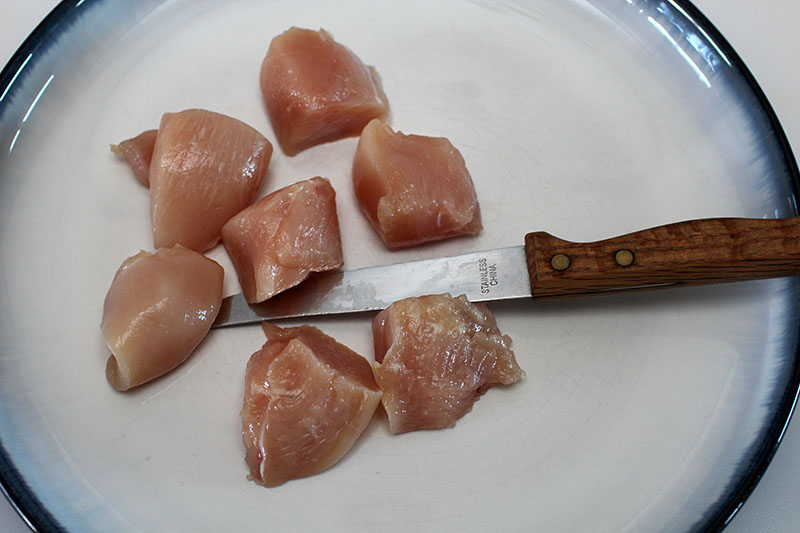
Chicken breast, fresh
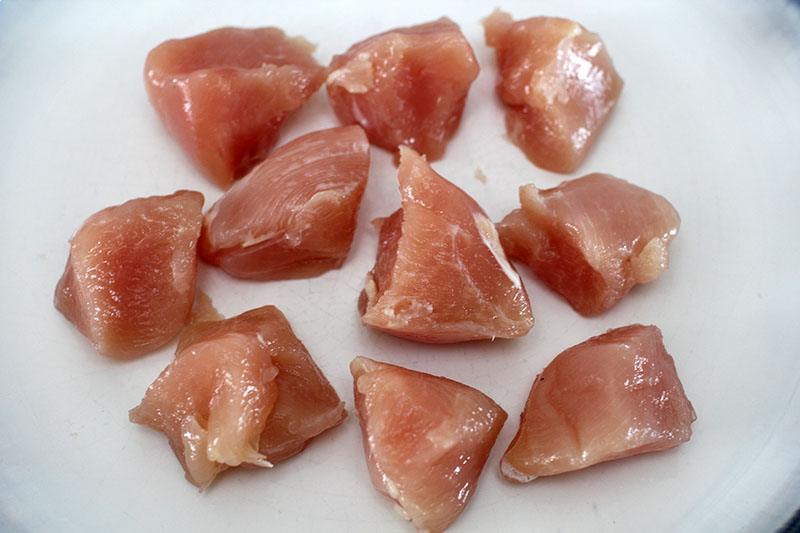
Chicken breast, cured
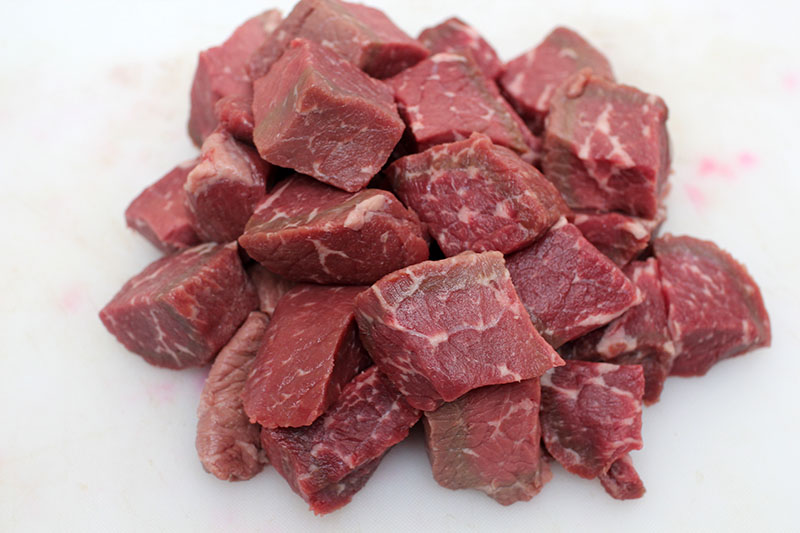
Beef, fresh
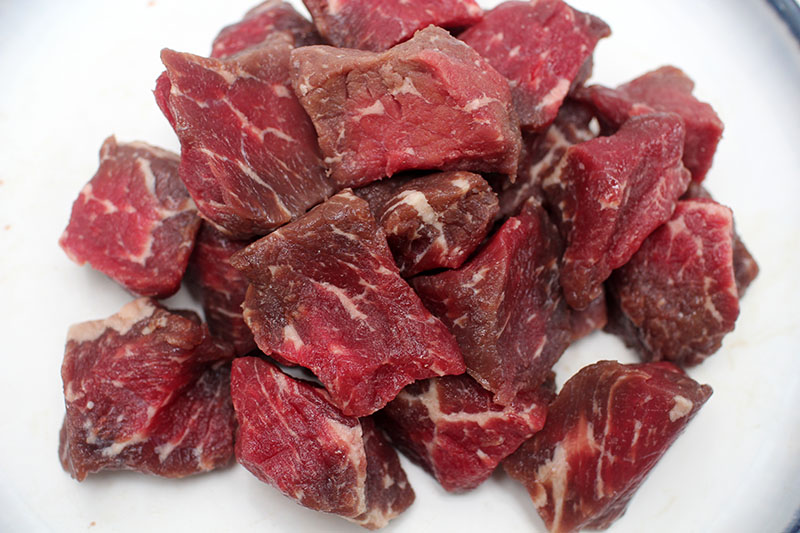
Beef, cured
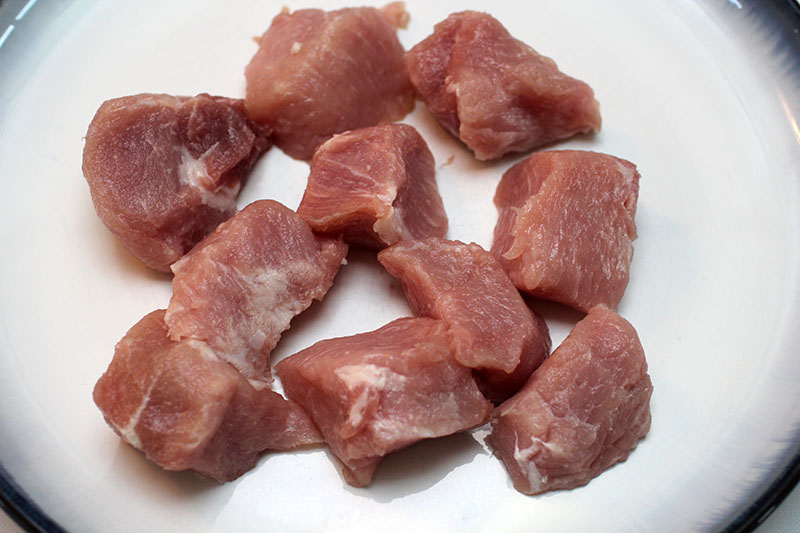
Pork loin, fresh
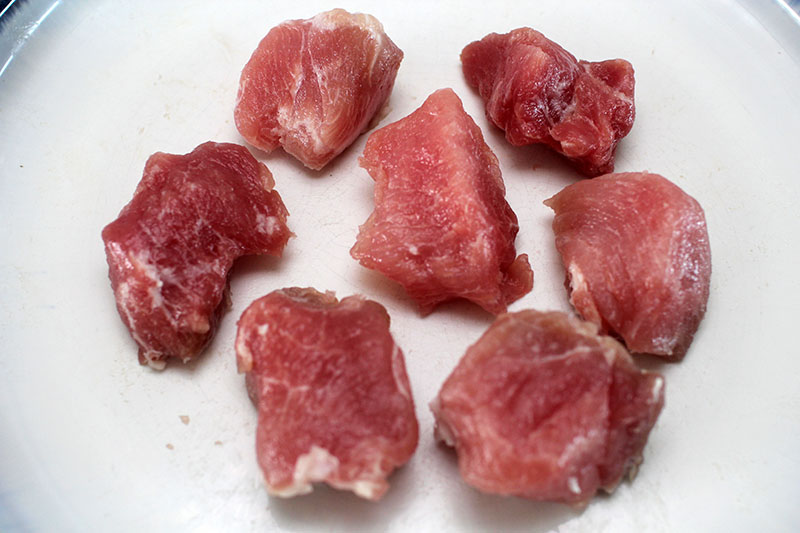
Pork loin, cured
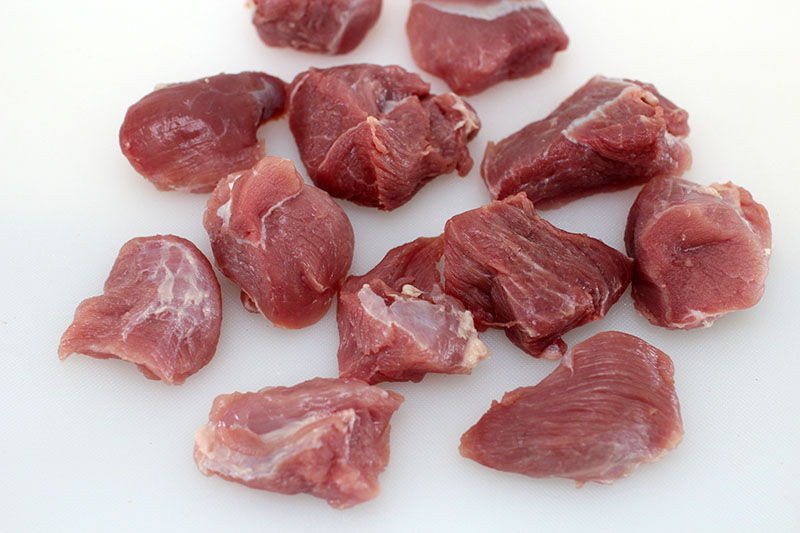
Pork butt, fresh
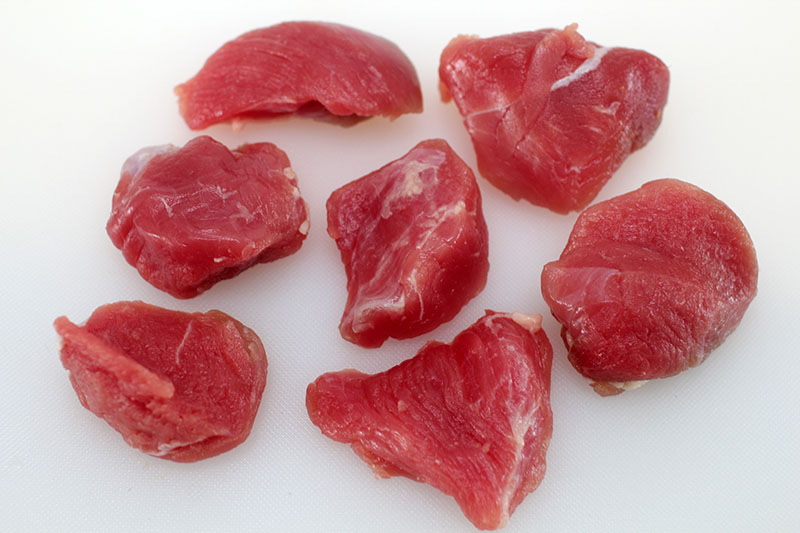
Pork butt, cured
The cured color will suffer If an insufficient amount of Nitrate/nitrite is added to the meat or the curing time is too short. This may be less noticeable in sausages where the meat is ground and stuffed, but if we slice a larger piece like a ham, the poorly developed color will be easily noticeable. Some sections may be gray, some may be pink, and the meat will not look appetizing. To check your cured meats, take a sample, cut across it, and look for a uniform color. About 50 ppm (parts per million) of nitrite is needed for any meaningful curing. Some of it will react with myoglobin to develop color, and some will go into other complex biochemical reactions that develop a characteristic cured meat flavor. If we stay within Food and Drug Administration guidelines (1 oz. Cure #1 per 25 lbs of meat - about 1 level teaspoon of Cure #1 for 5 lbs of meat), we are applying 156 ppm of nitrite, which is enough and safe at the same time.
Curing Fat

Back fat, cured with salt only.
Pork back fat has no myoglobin, so it makes a little sense to cure it with sodium nitrite. Nitrite will not react with fat and the customer will have to eat it. Pork back fat is cured with salt only, and after 3 weeks, it becomes soft and delicious to eat. Cured back fat was always popular in Germany, Poland and Russia, however, take note that such a back fat was about 3-4 inches thick. It will be very hard to find a pig nowadays that could offer such a thick back fat.
Fat trimmings used for sausages are salted only.
Pork bellies and jowls consist of layers of meat and fat. They are cured with salt and sodium nitrite like regular meat; however, the amount of sodium nitrite can be slightly decreased due to the large amount of fat those cuts contain.
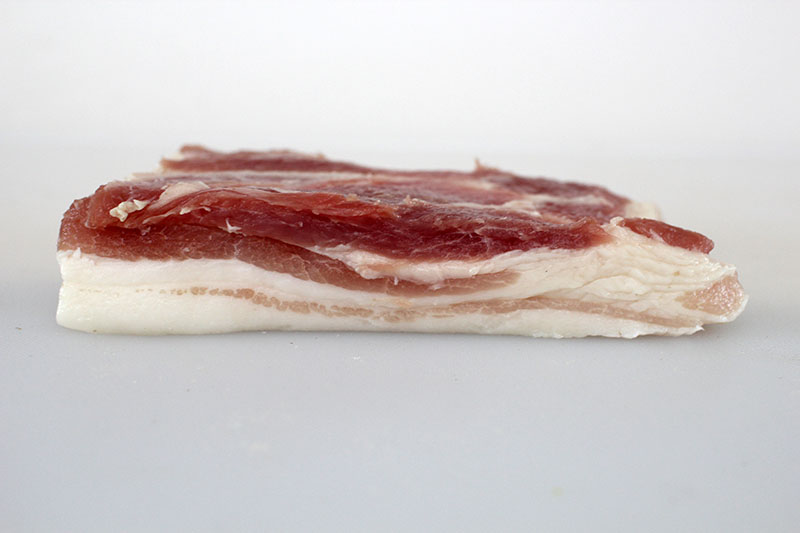
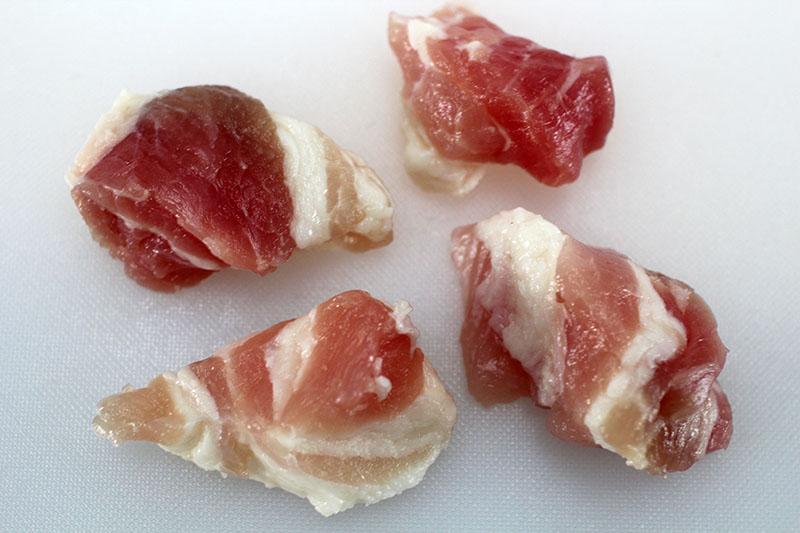
Fresh pork belly. The belly was cut into smaller pieces and cured with salt and sodium nitrite (cure 1). The meat became pink; however, the fat remained white.
Color of Cooked Meat
The color of cooked meat varies from grayish brown for beef and grey-white for pork and is due to denaturation (cooking) of myoglobin. The red color usually disappears in poultry at 152° F (67° C), in pork at 158° F (70° C) and in beef at 167° F (75° C).
Cured meat will develop its true cured color only after submitted to cooking (boiling, steaming, baking) at 140-160° F (60-71° C). The best color is attained at 161° F (72° C). Fermented products such as traditional salami and salt-cured hams are not cooked but develop a dark red color due to biological reactions that occur inside meat between proteins, fats, salt, and bacteria.
In the following photos, all meats (fresh and cured) were cooked. As it can be seen the cured meat becomes red after cooking. Cooked fresh pork leg will become grey, as will roasted pork leg. However, when cured with sodium nitrite (cure 1), it becomes pink ham.
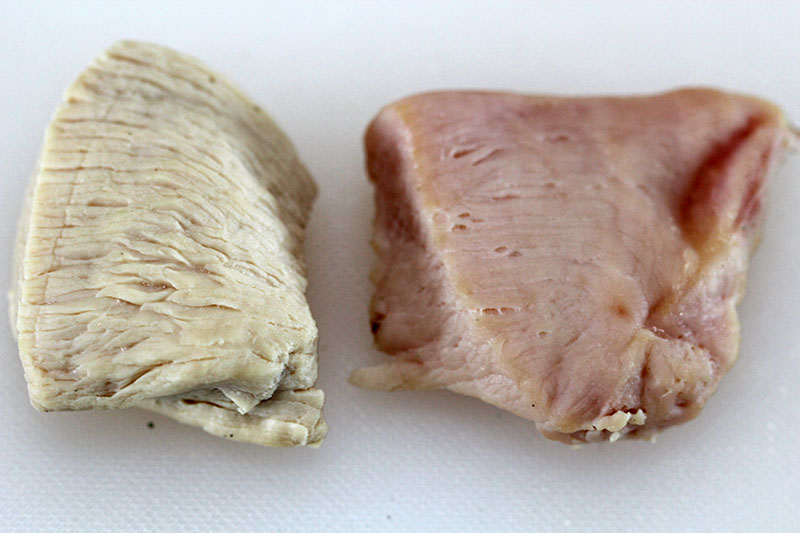
Chicken, left-raw, right-cured
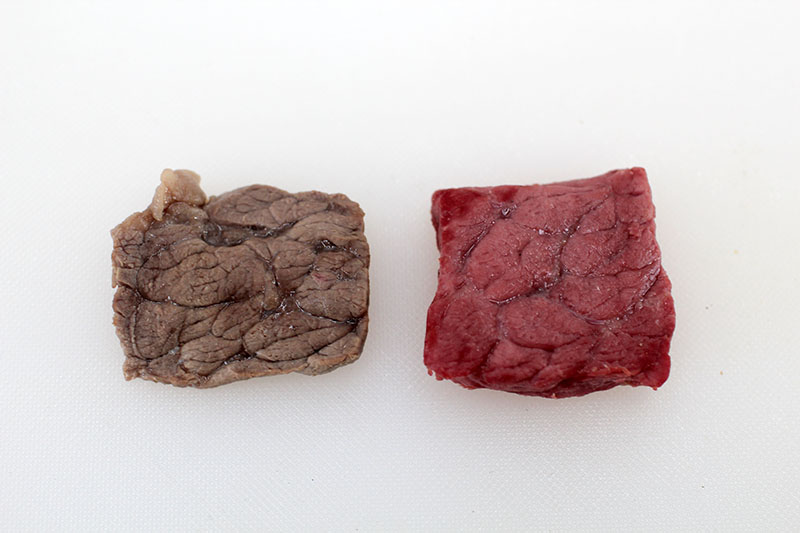
Beef, left-fresh, right-cured
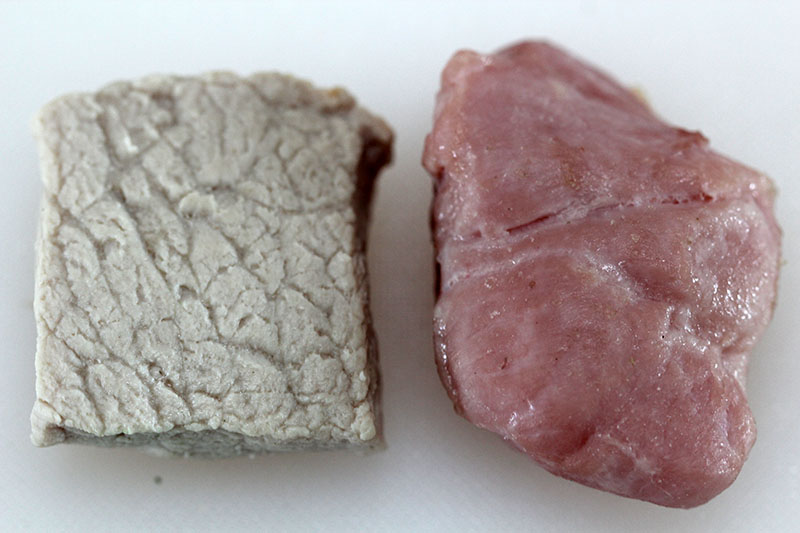
Pork loin, left-fresh, right-cured
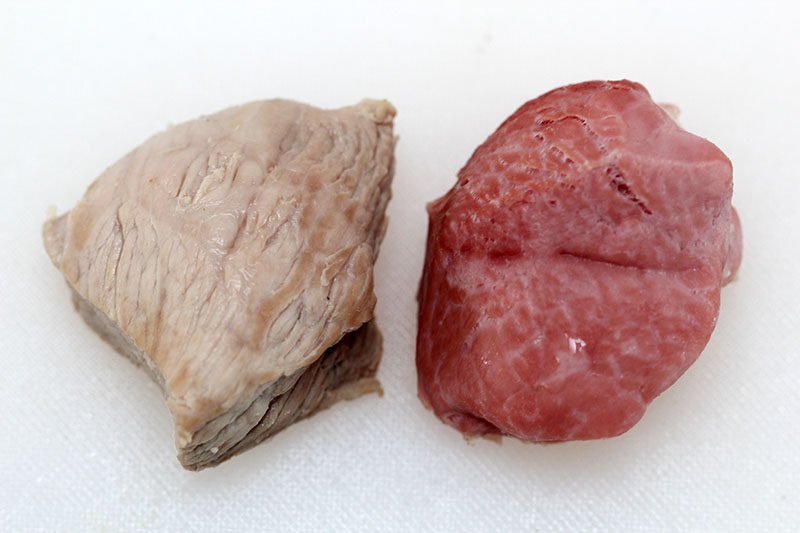
Pork butt, left-fresh, right-cured
Curing With Nitrates/Nitrites
Meat cured only with salt has a better flavor but develops an objectionable dark color. Adding nitrites to meat improves flavor, prevents food poisoning, tenderizes the meat, and develops the pink color widely known and associated with smoked meats. We used potassium Nitrate exclusively in the past because its derivative, sodium nitrite, has not yet been discovered. Sodium Nitrate (NaNO3) does not cure meat directly, and initially, not much happens when it is added to meat. After a while, micrococci bacteria, present in meat, start to react with Nitrate and develop sodium nitrite (NaNO2) that will start the curing process. If those bacteria are not present in sufficient numbers, the curing process may be inhibited.
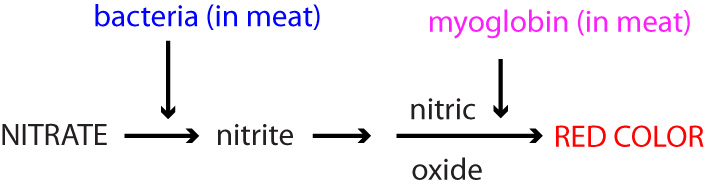
Curing with Nitrate
The reactions that occur are the following:
- KNO3 potassium Nitrate → KNO2 nitrite (action of bacteria)
- KNO2 → HNO2 nitrous acid (in acid medium, pH 5.2 - 5.7)
- HNO2 → NO nitric oxide
- NO → myoglobin → nitrosomyoglobin (pink color)
Potassium Nitrate worked wonderfully at 4-8°C (40-46°F), which was fine as refrigeration was not very common yet. If the temperatures dropped below 4°C (40°F) the bacteria that was needed to force Nitrate into releasing nitrite would become lethargic and the curing would stop. Potassium Nitrate was a slow-working agent, and the meat for sausages had to be cured for 72-96 hours.
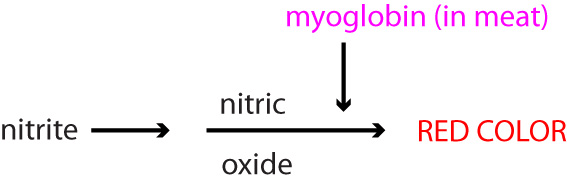
Curing with nitrite
The use of Nitrate is going out of fashion because it is difficult to control the curing process. By adding sodium nitrite directly to meat, we eliminate the risk of having an insufficient number of bacteria and we can cure meats faster and at lower temperatures. Sodium nitrite does not depend on bacteria, it works immediately and at refrigerator temperatures 2-4° C (35-40°F). At higher temperatures, it will work even faster. About 15% of sodium nitrite reacts with myoglobin (color), and about 50% reacts with proteins and fats (flavor).
Curing Accelerators
The time required to develop a cured color may be shortened with the use of cure accelerators. Ascorbic acid (vitamin C), erythorbic acid, or their derivatives, sodium ascorbate and sodium erythorbate, speed up the chemical conversion of nitrite to nitric oxide, which reacts with meat myoglobin and creates nitrosomyoglobin (pink color). They also deplete meat oxygen levels, which prevents the fading color of the cured meat in the presence of light and oxygen. Commercial producers perform curing in one step by injecting meats with a curing solution and then bouncing meat inside the tumbler machine to distribute the solution evenly. There is insufficient time to develop a true cured color, and the cure accelerators are introduced into the curing solution. The meats can be cured fast, and the true cured color will develop.
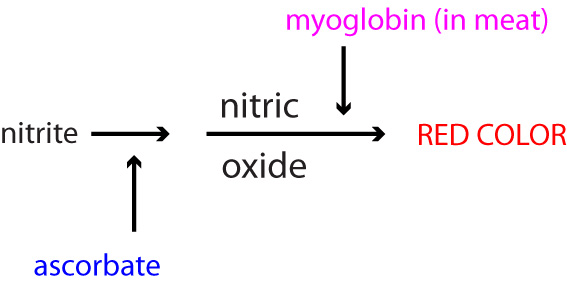
Curing with accelerators
Best Meats for Curing
- Pork - best color, taste, and flavor
- Beef - significant loss of protein and minerals
- Lamb - little improvement
- Veal - little improvement
- Poultry - good
- Fish - good, the looks and flavor of smoked fish is greatly influenced by curing
American Cures
- Cure #1 (also known as Instacure #1, Prague Powder #1 or Pink Cure #1)
- For any aspiring sausage maker, it is necessary to understand and know how to apply Cure #1 and Cure #2, as those two cures are used worldwide, though under different names and with different proportions of nitrates and salt. Cure #1 is a mixture of 1 oz of sodium nitrite (6.25%) to 1 lb of salt. It must be used to cure all meats that will require smoking at low temperatures. It may be used to cure meats for fresh sausages (optional).
- Cure #2 (also known as Instacure #2, Prague Powder #2 or Pink Cure #2)
- Cure #2 is a mixture of 1 oz of sodium nitrite (6.25%) along with 0.64 oz of sodium Nitrate (4%) to 1 lb of salt. It can be compared to the time-releasing capsules used for treating colds. It must be used with any products that do not require cooking, smoking, or refrigeration and is mainly used for products that will be air-cured for a long time, like country ham, salami, pepperoni, and other dry sausages. Both Cure #1 and Cure #2 contain a small amount of FDA-approved red coloring agent that gives them a slight pink color, thus eliminating any possible confusion with common salt, which is why they are sometimes called “pink“ curing salts. Cure #1 is not interchangeable with Cure #2 and vice versa.
Morton™ Salt Cures
In addition to making common Table Salt, the Morton® Salt Company also produces several cures such as Sugar Cure® mix, Smoke Flavored Sugar Cure® mix, Tender Quick® mix, and Sausage and Meat Loaf® seasoning mix. To use them properly, one has to follow instructions that accompany every mix.
Our commonly available cures contain both nitrite and Nitrate.
| Curing Agent | Nitrate | Nitrite |
|---|---|---|
| Cure #1 | No | Yes |
| Cure #2 | Yes | Yes |
| Morton ® Tender Quick | Yes | Yes |
| Morton ® Sugar Cure | Yes | Yes |
| Morton ® Smoke Flavored Sugar Cure | Yes | No |
European Cures
There are different cures in European countries. For example, a commonly used cure in Poland is called “Peklosól” and contains 0.6% Sodium Nitrite and salt. No coloring agent is added, and it is white. In European cures, such a low nitrite percentage in salt is self-regulating, and it is almost impossible to apply too much nitrite to meat, as the latter will taste too salty. Following a recipe, you could replace salt with peklosól, and the established nitrite limits will be preserved. This isn’t the case with American Cure #1, which contains much more sodium nitrite (6.5%), and we have to color it pink to avoid the danger of mistakes and poisoning.
| Country | Cure Name | % of nitrite in salt |
|---|---|---|
| USA | Cure # 1 | 6.25 % |
| Poland | Peklosól | 0.6 % |
| Germany | Pökelsalz | 0.6 % |
| France | Sel nitrité | 0.6 % |
| England | Nitrited salt | various |
| Sweden | Colorazo | 0.6% |
| Australia | Kuritkwik | various |
How to Apply Cures
Well, there are two approaches:
- Like an amateur - collecting hundreds of recipes and relying blindly on each. You lose a recipe, and you don’t know what to do. And how do you know they contain the right amount of cure?
- Like a professional - taking matters into your own hands and applying cures according to the USA Government requirements.
We enclose useful data based on U.S. standards if you want to be professional. Comminuted products - small meat pieces, meat for sausages, ground meat, poultry, etc. Cure #1 was developed in such a way that if we add 4 ounces of Cure #1 to 100 pounds of meat, the quantity of nitrite added to the meat will conform to the legal limits (156 ppm) permitted by the Meat Division of the United States Department of Agriculture.
That corresponds to 1 oz. (28.35 g) of Cure #1 for each 25 lbs. (11.33 kg) of meat or 0.2 oz. (5.66 g) per 5 lbs. (2.26 kg) of meat.
| Comminuted Meat (Sausages) | Cure #1 in ounces | Cure #1 in grams | Cure #1 in teaspoons |
|---|---|---|---|
| 25 lbs. | 1 | 28.35 | 5 |
| 5 lbs. | 0.2 | 5.66 | 1 |
| 1 lb. | 0.04 | 1.1 | 1/5 |
| 1 kg | 0.08 | 2.5 | 1/2 |
Cured dry products - country ham, country-style pork shoulder, prosciutto, etc. These products are prepared from a single piece of meat, and the curing ingredients are rubbed into the surface of the meat several times during the curing period. Nitrite is applied to the surface of the meat or poultry as part of a cure mixture. If you look at the FSIS nitrite limits table on page 36, you will see that the maximum nitrite limit for Dry Cured Products (625 ppm) is four times higher than for Comminuted Products (156 ppm).
To cure meat for sausages (comminuted) and to stay within the 156 ppm nitrite limit, we have to apply no more than 1 oz of Cure #1 for every 25 lbs of meat. To dry cure 25 lbs of pork butts and to stay within 625 nitrite limits, we can add 4 times more of Cure #1, in our case, 4 ounces. Keep in mind that when you add Cure #1 (there is 93.75% salt in it), you are adding extra salt to your meat, and you may re-adjust your recipe.
| Meat for Dry Curing | Cure #1 in ounces | Cure #1 in grams | Cure #1 in teaspoons |
|---|---|---|---|
| 25 lbs. | 4 | 113.4 | 20 |
| 5 lbs. | 0.8 | 22.64 | 4 |
| 1 lb. | 0.16 | 4.4 | 3/4 |
| 1 kg | 0.35 | 10.0 | 1.5 |
The reason that there are much higher allowable nitrite limits for dry-cured products is that nitrite dissipates rapidly in time, and the dry-cured products are air-dried for a long time. Those higher limits guarantee a steady supply of nitrite.
Immersed, Pumped and Massaged Products such as hams, poultry breasts, corned beef. Here, it is much harder to develop a universal formula as so many variables must be determined first. The main factor is determining the % pump when injecting the meat with a syringe or % pick-up when immersing meat in a curing solution. We will calculate the formula for 1 gallon of water, Cure #1, and 10% pick-up gain. Then, the formula can be multiplied or divided to accommodate different amounts of meat. 10% pump or 10% pick-up means that the cured meat should absorb 10% of the brine in relation to its original weight. For immersion, pumped, or massaged products, the maximum in-going nitrite limit is 200 ppm, and that corresponds to adding 4.2 oz of Cure #1 to 1 gallon of water.
| Amount | Cure #1 in ounces | Cure #1 in grams | Cure #1 in teaspoons |
|---|---|---|---|
| 1 gallon (8.33 lbs) of water | 4.2 | 120 | 20 (6 Tbs) |
This is a small amount of brine, and if you want to cure a large turkey, you will need to increase the volume. Just multiply it by a factor of 4, and you will have 4 gallons of water and 1.08 lbs. of Cure #1. The following is the safe formula for immersed products that is easy to measure: 5 gallons of water, 1 lb. of Cure #1. In the above formula at 10% pick-up the nitrite limit is 150 ppm, which is plenty. Keep in mind that adding 1 lb. of Cure #1 to 5 gallons of water will give you 4.2% salt by weight, corresponding only to 16 degrees brine (slightly higher than seawater). If we add an additional 2 lbs. of salt, we will get: 5 gallons of water, 1 lb. of Cure #1, 2 lbs. of salt, and that will give us a 25-degree solution, which is great for poultry.
Useful Information
- If it can’t be cured, don’t smoke it
- When curing is completed, it is advisable to test the meat for color and saltiness by cutting a tiny piece and looking at the cross-cut section. It should have a uniform pink color. If it is too salty, place the meat in cold water in the refrigerator for 12 hours and taste it again. It is much easier to fix the problem now than to eat sausage later with tears in our eyes.
- Add an extra 24 hours of curing time if needed.
- About 1 level teaspoon of Cure #1 is needed for 5 lbs of meat (5-6 teaspoons to 1 oz of cure) or 2.5 grams of cure for 1 kilogram of meat.
- Keep separate different types of meat (lean and fatty pork, beef)) as some of them might go again to the grinder to be ground through a different plate.
- Cured ground meat will be drier and harder to stuff into casings because of the action of the salt. It is advisable to dice the meat or grind it through a big plate and, after curing, regrind it with a plate of a proper size before stuffing. If the meat is not ground again, re-mix it well by hand.
- The two premixed cures, Cure #1, and Cure #2, are not interchangeable.
- Containers for curing are to be made of stainless steel, food-grade plastics, or stone. Nitrates react with aluminum and they should not be used for curing.
- Add sugar only when curing at refrigerator temperature 38 – 40° F (4 –5° C), otherwise fermentation might occur and will spoil the meat.
- Cure mixtures and curing solutions do not work on frozen meat. Meat must be first thawed.
- Dry curing is the preferred method to cure meat for the production of sausages.
- When rubbing ham, make sure the cure is rubbed into the aitch bone joint and hock end of the ham.
- Sodium nitrite is used where curing time will be short: sausages, small pieces of meat.
- Sodium nitrate is used to produce meats that will be cured for at least 4 weeks - large hams or dry sausages.
- A characteristic quality of fresh cured meat is its grey color, which comes minutes after adding nitrite.
- The cured meat will achieve its characteristic pink color when heated to 130° F (54° C) or higher. The best curing color is achieved by cooking cured meat to 161° F ( 72° C) inside temperature.
- Sugar counters the harshness of the salt, improving the flavor. Normally, we add 3% sugar in the salt (that means that for 100 kg of the mix – we have 97 kg salt and 3 kg sugar).
- When using sodium ascorbate or sodium erythorbate in curing solution, it should be used within 24 hours because their reaction with nitrite will lower the nitrite level of the solution and its effectiveness.
- Phosphates should be used only with a wet cure. They increase the water-holding capacities of cured products.
- The length of curing (dry cure method) is seven days per inch of thickness of meat.
- Adding too much nitrates/nitrites (crossing upper limits) to the dry mixture or wet curing solution can impart a bitter and strong curing taste to the meat.
- 50 ppm of sodium nitrite is accepted as the minimum for developing the proper color of the meat.
- Modern-day cured meats at retail have a residual nitrite content of about 10 ppm.