Meats and Sausages

Meat Jellies
Any professional cookbook lists wonderful meat jellies that incorporates different cuts of meats. They are often garnished with fruits and vegetables. Don’t your kids eat fruit jello? You can make your own by mixing commercial gelatin with water and adding fruit to it. Gelatin and glue are derived from a protein called collagen. You may not realize it, but every time you lick quality ice cream, you eat gelatin that came from hides, bone, tendon, skin and connective tissues rich in collagen. Meat jellies are much easier to make than head cheeses as they don’t have to be stuffed which greatly simplifies the procedure. In addition no secondary cooking is needed. Cooked meats are arranged on the bottom of the container, meat broth is carefully poured over it and left for cooling. It basically becomes a meat jelly.
Meat jelly although technically not a sausage, follows the same rules of production as a head cheese. They fit more into general cuisine and many fancy products can be created based on one’s ingenuity and imagination. They are basically more refined products where looks of the products play an important role. Because of that they contain solid chunks of lean “show meat” and use commercial gelatin in order to obtain perfectly clear jelly. Different meats can be incorporated in meat jellies, for example fish fillets, skinless and boneless chicken breast, diced ham etc. As a rule meat jellies don't include low value meat products like skins, snouts, or hearts. Chicken breast or fish fillet will make a great show meat in any meat jelly.
Meat jellies can be easily decorated
- A thin layer of hot gelatin is placed in a form or any dish or plate and allowed to set in a cooler.
- Decorative items are placed on top of the set gelatin.
- A new layer of gelatin is poured on top and allowed to set in a cooler.
- Meat and the remaining gelatin are placed on top and allowed to set in a cooler.
- When ready for consumption the form is briefly placed in hot water which melts a thin layer of gelatin and turning the form upside down will release the meat jelly with decorations being on top
- Decorative pieces such as slices of oranges, apples or hard boiled eggs are used. Herbs, cubed cheese, cracked pepper, slices of pickle, carrots, peas, corn, green scallions are often used in meat jellies.
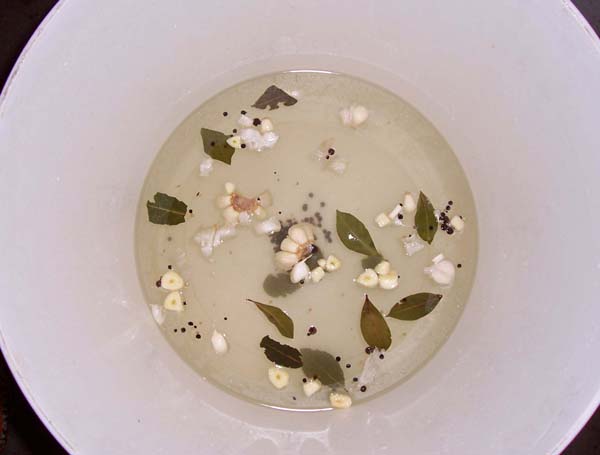
The first and the second layers of gelatin.
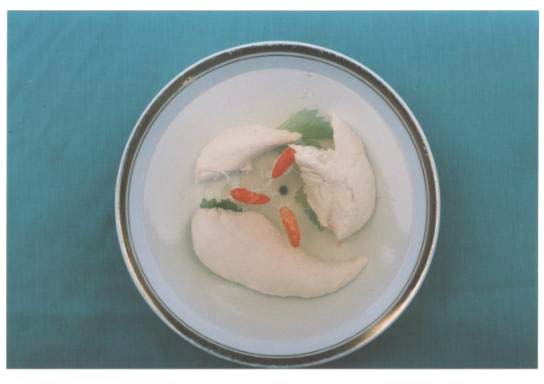
Chicken jelly
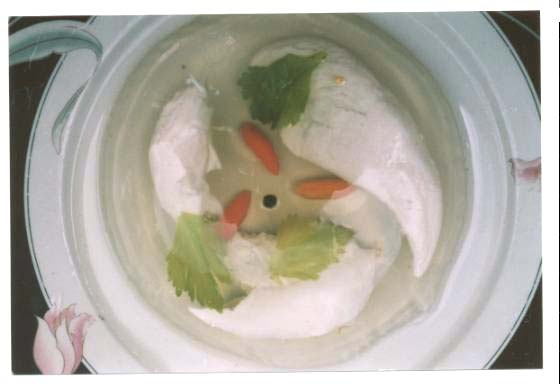
Chicken jelly
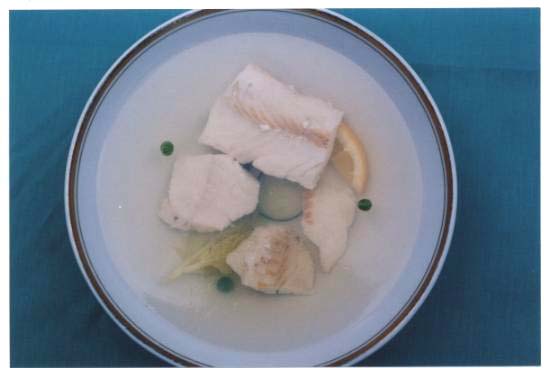
Fish jelly
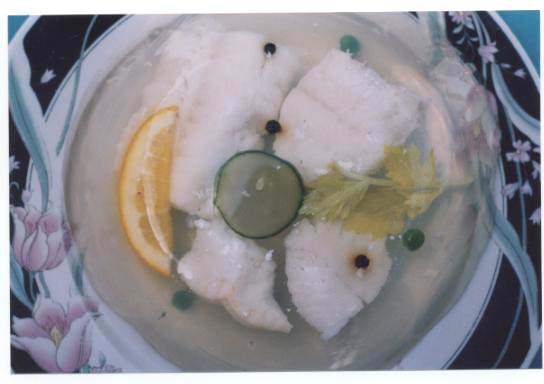
Fish jelly
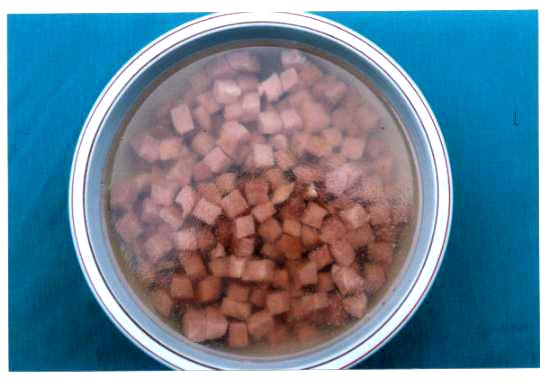
Diced ham jelly
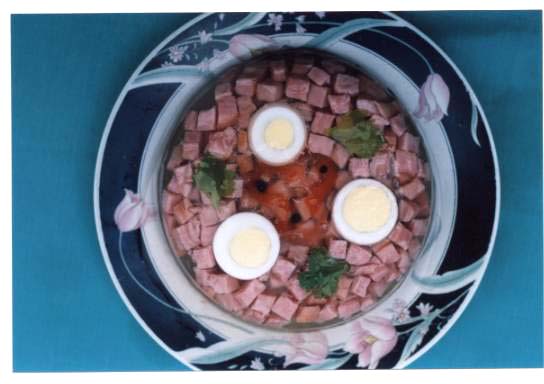
Diced ham jelly
Natural Gelatin
Natural gelatin is obtained from meat stock such as the one used for head cheese manufacture. Natural stock will not be as clear as the one made by dissolving commercial gelatin powder with water. The main reason the natural stock is often cloudy is that it is boiled and not simmered. Do not to boil the stock, always simmer. If you cook your stock gently, below the boiling point, the fat will not emulsify in water and the stock will remain clear.
The natural gelatin that is obtained from the natural stock has a superior taste and flavor that comes from boiling meats and ingredients that were put with meats into the pot. The ingredients such as peppercorns, bay leaf, pimentos, and soup greens are often added to create a better flavor.
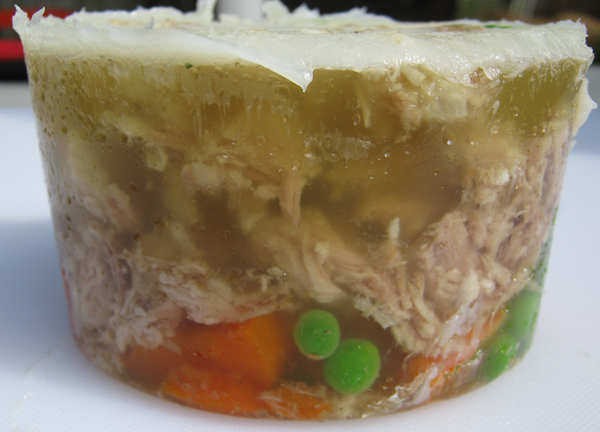
Home made meat jelly with natural gelatin. The fat layer on top is left on purpose as it will be spread on bread. This is very tasteful fat that has been obtained by boiling meats with vegetables and spices.
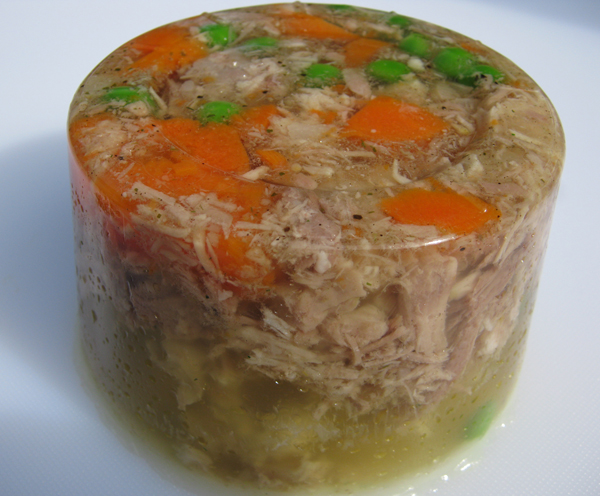
Meat jelly flipped over.
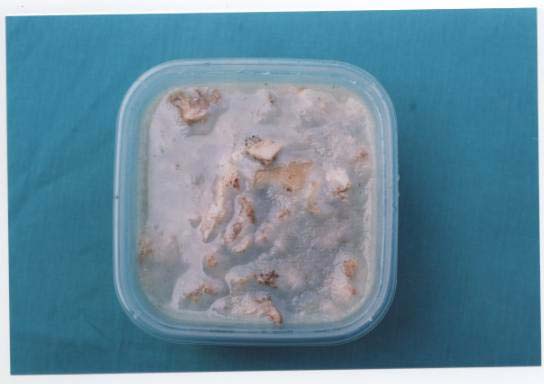
Home made jelly, still in a container. The fat left on the surface.
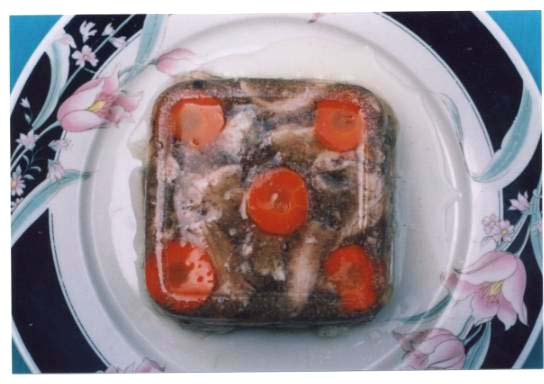
Meat jelly removed from the container and flipped over.
Clarifying stock
The natural stock can be clarified to obtain a clearer version. This is a basic cooking technique that every cook is familiar with.
- Once when the stock cools down a little, the fat will accumulate on the surface and can be easily scooped up and discarded.
- Then the liquid can be strained through a cheese cloth.
- For every quart of stock, lightly beat 3 egg whites with 2 Tbsp of water and 1 tsp of vinegar.
- Add the egg white mix to the stock. Bring stock to boil, then reduce heat and simmer for 20 minutes. Stir constantly with the soup ladle. Do not boil. The egg white will attract fat and impurities and will coagulate. It may float on top of the stock, which should be much clearer now.
- Let it cool for 15 minutes.
- Put several layers of cheese cloth in colander and pour the stock carefully over it.
- Refrigerate stock overnight. Skim any remaining fat off the top. Now you have crystal clear stock with great flavor.
Commercial gelatin
Commercial gelatin is a powder that was obtained from skins, hooves, and other meat cuts that contain a lot of connective tissue. It has no flavor, but is very clear and convenient to apply. A little salt and white vinegar should be added to give it some character. Packets of powdered gelatin are available in every supermarket and all that is required is to mix it with water. Gelatin use is not limited to meats, and you can use it with fruits and juices as well. The size of the packet will dictate how much water is needed. Usually, 1 part of gelatin to 6 parts water will produce a good jelly. If more powder is added the jelly will be much thicker.
Making jelly
- Pour the gelatin into a container with cold water and let it stand until the gelatin absorbs the water. Do not stir.
- Place this container inside another vessel filled with hot water.
- Heat the water until the gelatin solution reaches 160° F (72° C).
Notes:
- Gelatin should be soaked in cold (room temperature) water for about 15 min to swell and then mixed with hot water.
- Commercial gelatin should be used as it produces a very clean, transparent jelly. Traditionally made meat jelly of pork and beef meat may use natural gelatin (broth) as the looks of the product are less important. Lean cuts of meat such as hams, pork loins, chicken breast or fish fillet will look much better in a clean, commercially made gelatin. On the other hand the natural meat broth may be sometimes cloudy but has superior taste.
- Commercial gelatin packets come with instructions and are available in every supermarket, for example Knox® brand. If jelly does not want to set in because gelatin was made too thin, reheat your weak jelly, strain it and reinforce it with an extra packet of gelatin. Then pour your stronger and warmer gelatin over the meat.
- Meat jellies can be made of lean meats and will taste good even if little salt is added (1.0 %).
- The gelatin is often made with wine, brandy and other spirits to create a high quality product.
- Show meat, for example tongues, may be cured in order for meat to develop a pink color.
- If gelatin solution is heated above 160° F, it will lose its binding power.