Meats and Sausages

Fermented Sausages and Safety Hurdles
Fermented sausages and air dried meats are at an extra risk, as in most cases they are not subject to the cooking/refrigerating process. There is less risk involved when we make a simple fresh sausage which will end up in a refrigerator, and will be cooked and eaten within a day or two. Cooked or smoked/cooked products are microbiologically clean as the heat kills bacteria and the product is kept under refrigeration. They will be either eaten soon or frozen for a later use. When making fermented sausages we are playing a totally different game as in most cases the meat is neither cooked nor refrigerated, yet the sausage must be safe to consume. It sounds almost impossible - making a quality product by leaving meat at room temperature for an extended period of time. We know it is not a trick because we have been eating fermented sausages for thousands of years. It is the Bacteria Magic which makes the manufacture of fermented foods possible.
Regardless of what precautions are taken, some bacteria will always be present when fermentation starts. And they will start multiplying rapidly in the first hours. Then, as the lactic bacteria (friendly ones) start feeding on sugar, they produce lactic acid and the sausage becomes more acidic (lower pH) what prevents unwanted bacteria from growing. All this time moisture evaporates from the sausage, and that makes life for bacteria even more difficult as they need free water to survive. Although moisture evaporates from the sausage, salt remains inside which makes the sausage even saltier to bacteria. The scale starts slowly tipping in our favor and there comes a moment, when the sausage is stable and will not spoil when kept at low temperature and at low humidity.
The manufacture of fermented sausages at home conditions creates formidable hazards as:
- in warmer climates temperatures in the kitchen will be much higher than in a commercial meat plant, even with a fully running air conditioning system
- the temperature of the sausage mass may be higher than recommended
- home sausage making equipment such as grinders and stuffers process meats very slowly increasing the temperature
- mixing and stuffing are not performed under a vacuum which may affect color and make fats rancid
- fermenting and drying chamber in most cases is without proper temperature, humidity and air speed control
- lack of proper testing equipment (pH, Aw) and the list goes on......
The only way fermented sausages can be successfully made at home, is to exactly follow the good manufacturing practices and use the safety steps known as hurdles.
Types of Hurdles
When a sophisticated alarm system is installed on the premises it consists of many components: perimeter protection (switches on doors, foil on windows, switch mats, trap wire etc), then a second line of defense comes into play: (motion detectors, glass breakage detectors, photo-electric eyes etc). Fermented sausages are like a sophisticated alarm-it needs many security measures (hurdles) to stop intruders (undesirable bacteria). To prevent the growth of unwanted bacteria we employ a combination of steps known as hurdles:
- using meats with a low bacteria count
- curing with salt
- curing with nitrite/nitrate
- lowering pH of the meat to < 5.3
- lowering Aw (water activity) by drying to < 0.91
- using bio-protective cultures
- smoking
- cooking
- spices
- cleanliness and common sense
Using a combination of different hurdles is more effective that relying on one method only. For example the first hurdle is an application of salt and sodium nitrite which slows down spoilage and keeps pathogenic bacteria at bay. This first hurdle is a temporary one and if we don’t follow up with additional hurdles, such as lowering pH (increasing acidity) and then lowering water activity Aw (eliminating moisture by drying), the product will spoil.
Bacteria will multiply when conditions are favorable but will become lethargic when temperatures drop lower. When temperatures are high enough they will die, some of them will not survive in an oxygen absent atmosphere. Keeping them in check is of utmost importance during the manufacture of fermented and air-dried products as these products are usually not heat treated. In the following table we have compiled data that indicates the physical parameters which can be regulated in order to control the growth of bacteria. It should be noted that when the two hurdles (or more) are applied (pH drop, drying, sugar, starter culture etc), their cumulative strength is magnified and bacteria are constrained more effectively. Adding salt and nitrite creates the first hurdle against the growth of bacteria and as the acidity of the sausage increases and moisture continues to evaporate, the sausage becomes more stable.
The first 24 hours are the most crucial and moisture removal must be slow enough to permit lactic acid bacteria to grow. Lactic bacteria Lactobacillus and Pediococcus like other species need moisture to live and will not produce lactic acid if the Aw - water activity drops below 0.93 which can happen during fast drying. Accelerated drying will decrease moisture levels in the outside area of the sausage and will inhibit curing and color fixing bacteria Staphylococcus, Kocuria (also known as Micrococcus) from doing their job. The resulting hardened and dried surface area of the meat will not be red, it will be grey which will subsequently show on a sliced sausage.
Meat Selection
Meat of a healthy animal is clean and contains very few bacteria. Any invading bacteria will be destroyed by the animal’s immune system. Most bacteria are present on the skin and in the intestines. The slaughtering process starts intruducing bacteria into the exposed surfaces. Every time a knife cuts meat, the blade introduces new bacteria which multiply and slowly migrate towards the inside of the piece. In a stressed animal bacteria are able to travel from the animal’s gut right through the casing into the meat. Some bacteria are present on our hands, others live in our nose and throat and personal hygiene is of utmost importance. In addition, each meat processing facility develops its own microbiological flora in which bacteria live on walls, ceilings, machinery, tools etc. This is the reason why meat plants have to be continuously sanitized and cleaned. All those bacteria are just waiting to jump on a new piece of meat and start working in. Going into details on selecting meats according to their pH or using terms like PSE, DFD or MDM meats is beyond the scope of these pages and will make them confusing to read. What we want to stress is that meat must be perfectly fresh with the lowest count of bacteria possible.
Commercial producers try to keep this number between 100 and 1000 per gram of meat but a home based sausage maker must make sure that:
- meat is very fresh and always kept cold
- facilities and tools are very clean
- working temperatures are as low as possible
- take what you need rule always applies
If the above conditions are not met, bacteria will multiply and will compete for food with cultures inhibiting their growth. The acidity of the meat influences its ability to hold water, and meats with pH > 6.0 can bind water better than meats with pH < 6.0. This moisture helps bacteria to multiply. Selecting meat with lower acicity (5.7-5.8) provides more safety, as it creates less favorable conditions for the growth of undesirable bacteria. It also shortens the fermentation time needed to drop pH to a safe level. By adding different amounts of GDL to the sausage mass commercial processors can adjust the pH level of meat. This will be performed when making fast or medium-fermented sausages. There is little we can do about a selected meat’s bacteria count when buying it in a local supermarket but we have to keep it refrigerated at home. Meat must not be processed above 12° C (54° F), for an extended time, as the growth of Staphylococcus occurs at 15.6° C (60 °F).
Using hurdles as criteria, fermented sausages can be classified as:
| Type | Aw | pH |
| Very perishable | > 0.95 | > 5.2 |
| Perishable | 0.95 - 0.91 | 5.2 - 5.0 |
| Shelf stable | < 0.95 | 5.2 |
| single hurdle enough | < 5.0 (4.6) | |
| < 0.91 (0.85) | single hurdle enough |
The Aw criteria for dry sausages in Europe differ from those mandated in the USA, and European dry sausages must have Aw < 0.90 which makes it drier than its American counterpart.
Curing with Salt
Salt is one of the oldest methods of food preservation. Hundreds years ago heavy salting was commonly used to preserve and to transport fish to different countries, but that fish was non-edible in its original state. It had to be soaked in water first to eliminate any excess salt, and only then it would be cooked. Bacteria hate salt and different strains posess different degrees of resistance. Our initial safety hurdles revolve around this knowledge. For example Lactobacillus lactic acid bacteria as well as curing bacteria Staphylococcus and Kocuria show more resistance to salt than spoilage or pathogenic types. By competing for nutrients with spoilage and pathogenic bacteria they prevent them from growing.
The more salt applied to meat the stronger fence is created against unwanted bacteria, but to stop them from growing by salt alone, the salt levels will have to be so high that the product will not be edible. Such a product will have to be soaked for long time in running water in order to be consumed. What’s more, such elevated salt levels (over 4%) will prevent lactic bacteria from producing lactic acid and as a result no fermentation will take place. Not a practical solution. Well, if stopping them with salt entirely is not a practical solution then how about making life for them just miserable? And this is exactly what we do by adding between 2.3% - 3% salt into the minced meat.
Curing with nitrite/Nitrate
In addition to inhibiting the growth of Cl.botulinum, nitrite also suppresses Salmonella. Although cases of food poisoning by Cl.botulinum are rather rare, they have one thing in common-they are fatal. There has been not even one documented case of food poisoning when nitrite was added to meat.
Lowering pH ( increasing acidity)
When using acidification as a main safety hurdle, most fast-fermented sausages are microbiologically stable when pH 5.3 or lower is obtained within a prescribed time (see standards). Depending on the culture chosen and fermentation temperature, this can be easily accomplished within 7-36 hours for a fast-fermented sausage, and 72-96 hours for a medium-fermented type. In slow-fermented sausages the acidity of meat increases very slowly and never reaches the point that might guarantee safety of the sausage. These sausages depend on lowering water activity (drying) to become microbiologically stable. The introduction of more sugar leads to a lower pH and stronger acidification. About 1 g (0.1%) of dextrose per 1 kg of meat lowers pH of meat by 0.1 pH. This means that 10 g of dextrose added to meat with initial pH value of 5.9 will lower pH by one full unit to 4.9. Sugar levels of 0.5% - 0.7% are usually added for reducing pH levels to just under 5.0. About 1 g (0.1%) of GDL per 1 kg of meat lowers the pH of meat by 0.1 pH. It shall be noted that the addition of sugar already lowers the pH of the meat and adding GDL will lower the pH even more. As it is a natural acid, adding more than 10 g may cause a bitter and sour flavor. In slow-fermented salami pH does not drop generally lower than 5.3 but the sausage is microbiologically stable due to its low moisture level (Aw 0.87-0.88). Most American semi-dry sausages exhibit pH of 4.8 or even lower.
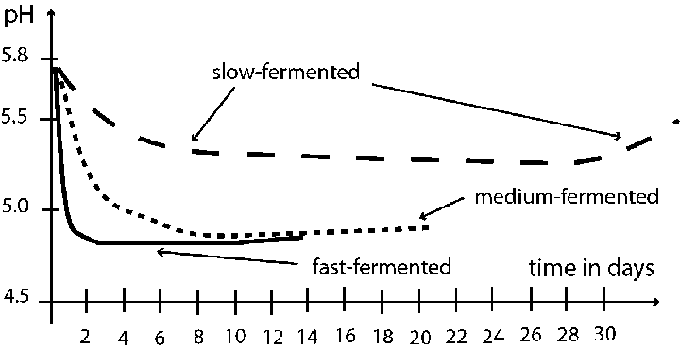
Decrease in pH in slow, medium and fast-fermented sausages
Once the pH reaches 5.3 or less, Staphylococcus aureus and other pathogens are kept in check and further lowering pH or drying sausage at low temperatures would will make it microbiologically stable.
Lowering Aw (removing moisture)
Just adding 3% salt reduces intitial water activity level to 0.97. Then the sausage starts to lose moisture from the time it enters the fermentation process and continues to do so through the drying process. In about 3-6 days the Aw drops to about 0.95 and the sausage is more stable as some pathogenic bacteria (Salmonella, Bacillus) stop multiplying. Drying too fast (Aw 0.95) at the begining of fermentation may inhibit lactic acid bacteria from producing acid. Most microorganisms do not exibit growth below 0.91 water activity with a few exceptions, notably Staphylococcus aureus which remains active until 0.86. Molds of course show great resistance to low moisture levels. The activity of most spoilage and pathogenic bacteria stops when Aw of 0.89 is reached. Aw drop is little affected by pH or number of bacteria, and is more linear in nature. Stated simply, the drying process is time dependent and factors that affect drying will also influence a decrease in water activity. There is a certain relationship between water activity (Aw), food acidity (pH) and the microbiological safety of the sausage:
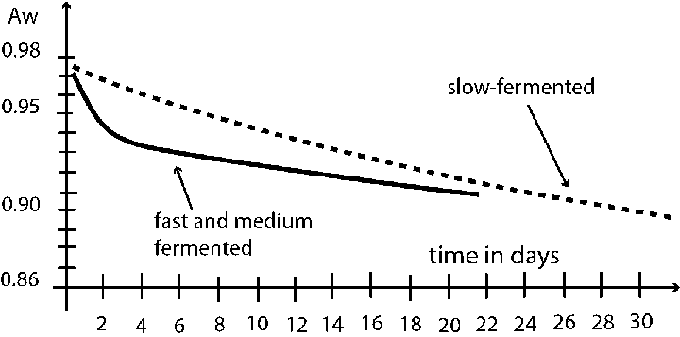
Decrease in Aw in fast, medium and slow-fermented sausages
"The higher Aw, the lower pH is needed to protect sausage against undesirable bacteria and vice versa"
Bio-protective cultures
Bio-protective cultures like Bactoferm™ F-LC may be added for production of fermented sausages with short production type where a higher count of L.monocytogenes bacteria may be suspected.Bactoferm™ F-LC has the ability to control Listeria at the same time as it performs as a classic starter culture for fermented sausages. The culture produces pediocin and bavaricin (kind of "antibiotics"), and that keeps Listeria monocytogenes at safe levels. These proteins, generally known as bacteriocins, act as a defense mechanism against competitive flora by attacking competitors. This is known as competitive exclusion-use of desirable competitive microorganisms to inhibit udesirable microorganism.The addition of any commercial culture provides a safety hurdle as those millons of freshly introduced bacteria compete for food (moisture, oxygen, sugar, protein) with a small number of bacteria residing in meat, preventing them from growing. It may be called a biological competition.Keep in mind that all cultures, although in varying degree, go through a lag phase, which is generally longer for slow fermenting types but can last 6-12 hours, the shorter time corresponding to higher temperatures. Fast-fermenting cultures go through a much shorter lag phase, from 30 minutes to a few hours, also depending on fermentation temperature. During lag phase there is little fermentation taking place, lactic acid bacteria just get comfortable, and they start growing in numbers. Then, they suddenly go into action feeding on sugar and producing lactic acid. The lag phase can be compensated for by: 1. increasing fermentation temperature, 2. increasing the amount of culture, 3. using frozen cultures instead of freeze-dried.
Smoking
Smoking imparts a different flavor, fights bacteria, especially on the surface of the product and thus prevents the growth of molds on fermented sausages. Mold is desired on some traditionally made Italian salamis and obviously smoking is not deployed. It should be pointed out, that when making slow-fermented sausages only cold smoke should be applied and its temperature should correspond to the fermentation or drying temperature present at particular time. Applying smoke which is much cooler than the fermentation temperature, will slow down fermentation. Applying smoke which is much hotter than the fermentation or drying temperature, will create favorable conditions for the growth of undesirable bacteria. When making traditional slow-fermented sausages we apply fermentation temperatures around 18° C (66° F) and even less when drying. To match these values we have to apply cold smoke that falls more or less in the same temperature range (< 22° C, 72° F).
It is a known fact that smoke posesses antibacterial properties and smoking meats was one of the earliest preservation methods. Prolonged cold smoking is the most effective of all smoking methods as it thoroughly penetrates meat. This is possible due to the absence of a hardened outside surface area of the sausage (cooked proteins), typical of sausages that are hot smoked. Smoke which is applied early in the fermentation stage will definitely inhibit to some degree the growth of lactic acid bacteria, especially if the diameter of the sausage is small. In such a case it will be wiser to wait until fermentation is over before the smoke is applied. Applying smoke during the fermentation period creates a barrier to the growth of Staph.aureus at the surface of the product where toxin production may be a problem.
Cooking
Cooking is a very effective way to kill bacteria but it is hard to imagine a classical traditionally made salami that will be cooked. Slow-fermented and spreadable fermented sausages are not cooked as this will alter their texture, taste and flavor. Fast-fermented sausages such as summer sausage, Thuringer, cervelats are made very fast and cooking provides a recognized and approved by the Food and Drug Administration measure of safety. By cooking their products, commercial producers avoid fights with meat inspectors and cover themselves with a strong wall of protection in case something goes wrong and legal litigation might follow. Keep in mind that the fermentation process can be stopped at any time (if no chemical acidulants are added) by submitting sausages to heat treatment.
Cooking fermented sausages makes them definitely safer as the heat will kill bacteria. On the downside, this heat also kills bacteria which are instrumental in developing meat flavor. For example raw semi-dry products exibit higher sensory values than cooked products. The texture of a cooked sausage will suffer too, as the individual specs of fat, so typical in these sausages, will melt down during heat treatment and will not be visible anymore. The texture of the sausage will become creamier. The sausage may be additionally dried to lose some of its weight, but the drying process must be performed at proper drying temperatures (12-15° C, 53-59° F). Many recipes ask for cooking sausages to 137° F ( 58° C) as the risk of trichinosis is eliminated at this temperature. Commercially grown pigs are disease free in the USA and they have been disease free in Europe for long time, where every slaughtered pig is inspected for trichinosis. Freezing meat also prevents the possibility of contracting worms, and cooking such meat does very little. It makes more sense to fully cook meat to FDA recommended 160° F ( 72° C) internal meat temperature. This way all bacteria will be effectively killed and there won’t be any reason to worry.
Guidelines for Cooked Meat Products
Cooked beef, pork, lamb and other meat products can be prepared using one of the following time and temperature combinations to meet either a 6.5-log10 or 7-log10 reduction of Salmonella. The stated temperature is the minimum that must be achieved and maintained in all parts of each piece of meat for at least the stated time:
| Minimal Internal Temperature | Minimum processing time in minutes or seconds after minimum temperature is reached | |||
|---|---|---|---|---|
| º F | º C | 6.5-log10 Lethality | 7-log10 Lethality | |
| 130 | 54.4 | 112 min | 121 min | |
| 131 | 55.0 | 89 min | 97 min | |
| 132 | 55.6 | 71 min | 77 min | |
| 133 | 56.1 | 56 min | 62 min | |
| 134 | 56.7 | 45 min | 47 min | |
| 135 | 57.2 | 36 min | 37 min | |
| 136 | 57.8 | 28 min | 32 min | |
| 137 | 58.4 | 23 min | 24 min | |
| 138 | 58.9 | 18 min | 19 min | |
| 139 | 59.5 | 15 min | 15 min | |
| 140 | 60.0 | 12 min | 12 min | |
| 141 | 60.6 | 9 min | 10 min | |
| 142 | 61.1 | 8 min | 8 min | |
| 143 | 61.7 | 6 min | 6 min | |
| 144 | 62.2 | 5 min | 5 min | |
| 145 | 62.8 | 4 min | 4 min | |
| 146 | 63.3 | 169 sec | 182 sec | |
| 147 | 63.9 | 134 sec | 144 sec | |
| 148 | 64.4 | 107 sec | 115 sec | |
| 149 | 65.0 | 85 sec | 91 sec | |
| 150 | 65.6 | 67 sec | 72 sec | |
| 151 | 66.1 | 54 sec | 54 sec | |
| 152 | 66.7 | 43 sec | 46 sec | |
| 153 | 67.2 | 34 sec | 37 sec | |
| 154 | 67.8 | 27 sec | 27 sec | |
| 155 | 68.3 | 22 sec | 23 sec | |
| 156 | 68.9 | 17 sec | 19 sec | |
| 157 | 69.4 | 14 sec | 15 sec | |
| 158 | 70.0 | 0 sec | 0 sec | |
| 159 | 70.6 | 0 sec | 0 sec | |
| 160 | 71.1 | 0 sec | 0 sec | |
Guidelines for Cooked Poultry Rolls and Other Poultry Products
Cooked poultry rolls and other cooked poultry products should reach an internal temperature of at least 160° F (71.1° C) prior to being removed from the cooking medium. However, cured and smoked poultry rolls and other cured and smoked poultry should reach an intermal temperature of at least 155° F (68.3° C) prior to being removed from the cooking medium.
Guidelines for Cooling Meat Products
During cooling, the product’s maximum internal temperature should not remain betweem 130° and 80° F (54° and 27° C) for more than 1.5 hours nor between 80° F and 40° F (27° and 4° C) for more than 5 hours. This cooling rate can be applied universally to cooked products (e.g., partially cooked or fully cooked, intact or non-intact, meat or poultry). The following process may be used for the slow cooling of ready-to-eat meat and poultry cured with nitrite. Products cured with a minimum of 100 ppm in-going sodium nitrite, may be cooled so that the maximum internal temperature is reduced from 130° to 80° F (54° and 27° C) in 5 hours and from 80° to 45° F (27° and 7° C) in 10 hours (15 hours total cooling time).
Spices
Throughout history, spices were known to posess antibacterial properties and cinnamon, cumin, and thyme were used in the mummification of bodies in ancient Egypt. It is hard to imagine anything that is being cooked in India without curry powder (coriander, turmeric, cumin, fenugreek and other spices). Spices alone can not be used as a hurdle against meat spoilage as the average amount added to meat is only about 0.1% (1 g/1 kg). To inhibit bacteria, the amounts of spices will have to be very large and that will alter the taste of the sausage. Rosemary, mace, oregano and sage have antioxidant properties that can delay the rancidity of fat. Marjoram is a proxidant and will speed up the rancidity of fats. Black pepper, white pepper, garlic, mustard, nutmeg, allspice, ginger, mace, cinnamon, and red pepper are known to stimulate Lactobacillus bacteria to produce lactic acid.
| Spice | Pathogenic Bacteria | |||||
| Staphylococcus aureus | Clostridium botulinum | Clostridium perfingens | Salmonella enterica | E.coli | Campylobacter jejuni | |
| Allspice | x | x | ||||
| Bay leaves | x | x | x | |||
| Cinnamon | x | x | ||||
| Cloves | x | x | x | x | x | |
| Cumin | x | x | x | |||
| Dill | x | |||||
| Fennel | x | x | ||||
| Garlic | x | x | x | x | x | |
| Lemongrass | x | x | x | |||
| Mint | x | |||||
| Onion | x | x | ||||
| Oregano | x | x | x | |||
| Rosemary | x | x | ||||
| Sage | x | x | ||||
| Tarragon | x | x | ||||
| Thyme | x | x | ||||
| Source: Suey-Ping Chi and Yun-Chu Wu, "Handbook of Fermented Meat and Poultry", 2007. | ||||||
Latest research establishes that spices such as mustard, cinnamon, and cloves are helpful in slowing the growth of molds, yeast, and bacteria. Most cases of illness associated with Campylobacter are caused by handling raw poultry or eating raw or undercooked poultry meat and only garlic offers some protection. During the last few years a number of studies were undertaken to investigate its anibacterial and antiviral properties. It is widely believed that garlic contributes positively to our cardiovascular and immune systems and a number of on-the-shelf drugs have entered the market. A detailed research was done on antioxidant and antimicrobial effects of garlic in chicken sausage (see reference below * ) and the conclusion follows:
This study concluded that fresh garlic, garlic powder and garlic oil provide antioxidant and antimicrobial benefits to raw chicken sausage during cold storage (3º C, 38º F) and the effects are concentration dependent. Among the garlic forms studied, fresh garlic at a concentration of 50 g/kg demonstrated the most potent effect, but such a high concentration may not be acceptable by many people because of its strong flavor. However, the addition of fresh garlic at 30 g/kg or garlic powder at 9 g/kg, did not result in a strong flavor and, at the same time, they produced significant antidioxidant and antibacterial effects and extended the shelf life of the product up to 21 days.
What is very significant is that for centuries Thai fermented pork sausage "Nham" and Balinese fermented sausage "Urutan" have been made with 5% of fresh garlic that corresponds to 50 g/kg - the amount found to be effective in the above study.
Use of fresh spice in fermented products is generally not a good idea. Fresh spices being moist may contain bacteria, insects, and molds, which will be introduced into the sausage and may affect the process.
Control of Microbiological Hazards Associated with Fermented Sausages
Staphylococcus aureus
E. coli 0157:H7
Listeria monocytogenes
Salmonella
Campylobacter
Cl. botulinum
Factors Affecting the Growth and Control of Pathogenic Bacteria
| Name | Temperature in º C | Min pH | Min Aw | O2 needs | ||
| Minimum | Optimum | Maximum | ||||
| Salmonella | 7 | 35 - 37 | 45 | 3.8 | 0.94 | FA* |
| Clostridium botulinum | 3 | 18 - 25 | 45 | 5.0 | 0.96 | OA* |
| Clostridium prefringens | 12 | 44 - 49 | 50 | 5.5 | 0.93 | OA* |
| Staphylococcus aureus | 6 | 37 | 48 | 4.2 | 0.85 | FA* |
| Campylobacter jejuni | 30 | 42 | 45 | 4.9 | 0.98 | MA* |
| Listeria monocytogenes | -1.5 | 37 | 45 | 4.4 | 0.92 | FA* |
| Escherichia coli 0157:H7 | 7 | 37 | 46 | 4.4 | 0.95 | FA* |
| Shigella | 7 | 35 - 37 | 47 | 4.0 | 0.91 | FA* |
| Bacillus cereus | 4 | 30 - 37 | 50 | 4.3 | 0.91 | FA* |
Clostridium perfringens is less strictly anaerobic than Clostridium botulinum and can tolerate some exposure to oxygen. Clostridium botulinum is pathogen associated with deadly "food poisoning". Significant growth of Staphylococcus aureus occurs at 15.6º C (60º C) and higher and after fermentation the sausages should be dried below this temperature. Fermentation tables are based on this fact.
|
||||||
Note spoilage bacteria (Pseudomonas spp.) need oxygen to survive and applying vacuum (removing air) during mixing and stuffing is an effective way to inhibit their growth. At home, a precaution must be made so that the sausage mix is stuffed firmly and any air pockets which are visible in a stuffed casing are pricked with a needle. Oxygen also affects the development of curing color and develops rancidity in fats.
Cleanliness and common sense
Home made sausages are subject to ambient temperature of the kitchen and a dose of a common sense is of invaluable help:
- take only what you need from the cooler
- when a part of the meat is processed put it back into the cooler
- if possible keep your equipment cold
- work as fast as possible
- try to keep meat always in refrigerator
- if your premises are not temperature controlled, limit your production to late evening or early morning hours
- keep your equipment clean
- wash your hands often
* Kh.I. Sallam, M. Ishioroshi, and K. Samejima, Antioxidant and Antimicrobial Effects of Garlic in Chicken Sausage, Lebenson Wiss Technol., (2004); 37 (8): 849-855.