Meats and Sausages

Humidity in a Smokehouse
There are some expensive factory made smokehouses that permit humidity control. Most smaller factory made smokehouses cannot even produce cold smoke and humidity control is out of the question. Regulating humidity in a home made smokehouse can be done indirectly, and is relatively simple and cost free. What is required is a fair understanding of a smoking process and humidity behavior.
A particular climate and ambient temperature are the most important factors that a sausagemaker must learn how to manipulate. Thus when smoking in a home made smokehouse the humidity can be controlled by:
- choosing the time of the smoking
- placing a water filled pan inside the smoker
- using moist wood chips or sawdust
The amount of needed humidity is dictated by:
- type of a product - hot smoked sausage, cold smoked sausage, smoked and air-dried ham, or just air-dried ham
- the smoking method that will be employed - cold smoking, hot smoking
Geographical location plays a crucial role here. There is more humidity in areas containing a lot of water like lakes, rivers or the sea shore. Arid areas like deserts or mountains have less water and subsequently less humidity. If you live in the Eastern part of the USA or Gulf states, you have a lot of humidity. If you live in the West (Arizona, New Mexico, California) you get less of it. As you cannot change the physical location of the smokehouse, you have to learn how to go around it and how to choose the time of smoking to your maximum advantage.
The most important rule to remember that when the temperature goes up, the humidity goes down. When the temperature goes down, the humidity goes up (night). That holds true when the weather is relatively stable or when smoking inside. When the clouds come in and it starts to drizzle, the humidity will go up immediately.
Different smoking methods require different humidity levels:
- cold smoking - 75 - 85 %. It is important to employ high humidity levels when cold smoking.
- warm smoking - 50 - 70 %. It is advisable to start smoking at high humidity levels.
- hot smoking - 40 - 50 %. In case of hot smoking which is a relatively short process (about 2 hours), humidity control is of secondary importance.
In dry climates like New Mexico or Arizona the relative humidity stays low at 15 - 20 % during day time and it will not be advisible to smoke meats at such conditions. The meat will prematurely dry out. The remedy will be to place a water pan inside of the smoker and moist wood chips. The best solution is to smoke at night time when the temperature will drop and the humidity will increase.
An often heard complaint when smoking in outside smokehouses is that the meat is wet on the surface and the final product tastes sour. In most cases it is a humidity problem. Outside smokers in most cases have a free standing firebox that is connected to a smoker by a digged in trench or pipe (clay or metal). After rain the ground is soaked wet and this moisture will travel with smoke together. The remedy is to heat up the smokehouse well so that the moisture will evaporate away. Another problem is that when smoking in a popular metal drum at very low temperatures there might be a case that the smokehouse temperature will be lower than the temperature of the entering smoke. Moisture from the outside or even moisture from the wood or the meat itself will condense on the walls of the drum. Then it will combine with soot and other unburnt particles and will start condensing on the meat or sausages. That of course will affect the color of the product and even worse, it will impart a soury flavor to the finished product. The solution is to insulate the drum on the outside with some material and heat up the drum before smoking.
Note controlling humidity levels is very important for commercial manufacturers who produce thousands of sausages a day. Proper humidity control during production and storage will decrease meat loss and will increase profits. It is of lesser importance for a home sausagemaker unless he is making fermented sausages.
Humidity Measurement
Manufacturers of industrial quality humidity sensors that could be inserted into a smokehouse can be located on the Internet although the prices are rather steep.
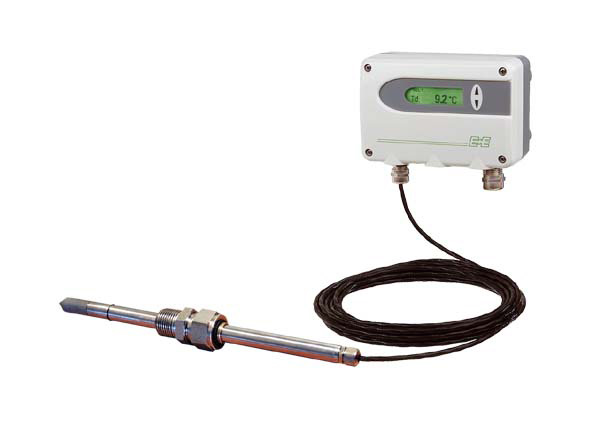
Humidity sensor made by E+E Elektronik, Austria
On the other hand indoor/outdoor humidity meters are reasonably priced. The devices that measure humidity are called hygrometers and there are many to choose from.
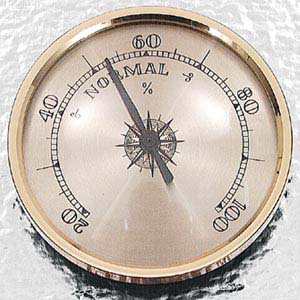
Inexpensive hygrometer
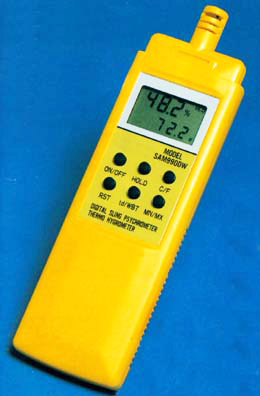
digital hygrometer from NovaLynx Company
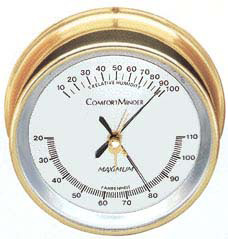
hygrometer and thermometer from Maximum Weather Instruments
In recent years a number of manufacturers started to produce combination units known as "thermo-hygrometers" that can display temperature and humidity at the same time. Many of these consist of a display receiver which displays readings from remotely positioned wireless temperature/humidity sensors.
The Honeywell TM005X Jumbo Display Wireless Thermo-hygrometer is a wireless indoor outdoor thermometer / hygrometer with very large digits. The display can be manually scrolled from indoor, through the remote readings, or it can be set to continuously scan through the indoor readings and all remotes. The display includes a comfort indicator and trend indicators for indoor and outdoor temperature and humidity.
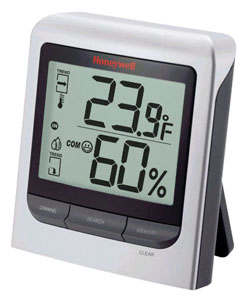
The Honeywell TM005X wireless indoor outdoor thermometer/hygrometer can be placed free standing on a table or shelf, or with the stand folded flat, hung on a wall. Temperature resolution: 0.2° F, humidity resolution: 1%, humidity range: 20-95%. The TM005X can display indoor temperature and humidity, or temperature and humidity from one to three remote senders.
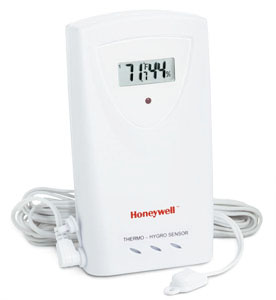
The Honewell TS33F transmitter reports the temperature and humidity from its outdoor location (or from any other location whose temperature and humidity you wish to know) to the weather station or clock (TM005X). In addition to the temperature probe on a 10-foot (3-meter) cable, this sensor has its own LCD temperature and humidity display for viewing at the location where it is installed. TS33F can be used for many applications, including pool, pond, or spa, refrigerator or freezer, and greenhouse or soil.
Dry and Wet Bulb Method
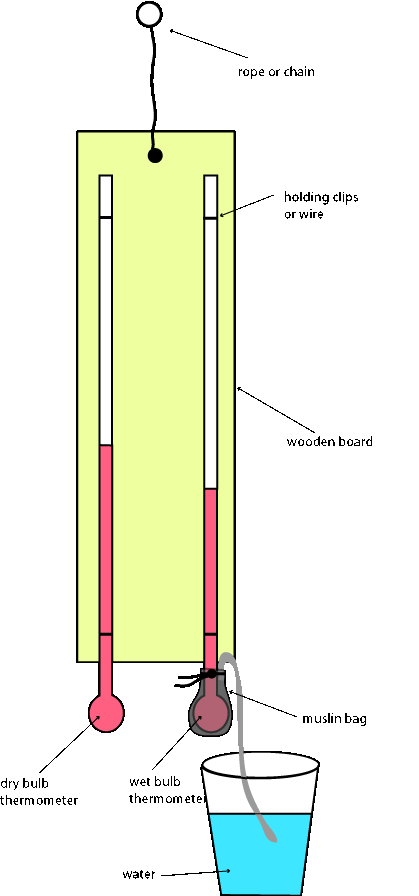
Traditionally humidity was measured by the dry and the wet bulb method. The dry-bulb is a common mercury/liquid thermometer to measure the air temperature. The wet-bulb is a second mercury/liquid thermometer whose bulb is covered by a muslin bag which is kept moist. Both thermometer readings are taken and the difference between them allows us to calculate the humidity using tables.
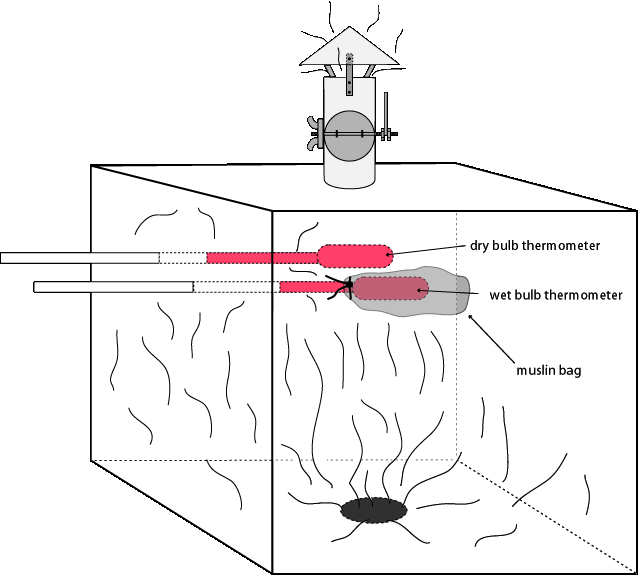
Before the reading is taken the muslin bag that covers bulb of the wet bulb thermometer must be moistened by dripping it in clean water. Then the thermometer is inserted into the smokehouse and after about 30 - 60 seconds the reading is taken. At the same time the temperature of the dry bulb thermometer is also taken and the difference from both readings is obtained. Then the table is consulted to determine the relative humidity. This procedure is explained in details below in the Dry and Wet Bulb Method. The thermometers should be placed horizontally on the same level. If they were placed vertically with the wet bulb thermometer below the dry bulb thermometer, we could obtained incorrect readings as the smoke and air would be cooled by the evaporation of moisture on the wet bulb. It can easily be determined from the wet bulb and the dry bulb tables that the flow speed of the smoke will influence the reading. The slower the flow rate of the smoke, the smaller the difference in temperatures and the higher the relative humidity. The faster smoke flow, the lower relative humidity and the faster drying (moisture removal) from the smoked product.
-
The simplest hygrometer known as "a sling psychrometer" can be made from two thermometers attached (tape, string or wire) to a wooden board and the mercury or liquid filled ends sticking over the edge of the board about 1" (2.5 cm). This thermometer is called the dry-bulb thermometer.
-
The second thermometer has a wet cloth (gauze, muslin bag) around the thermometer bulb, and secured with the rubber band or other ways, This thermometer is called the wet-bulb thermometer.
-
The fan is needed to blow the air on the thermometers until both temperatures will stabilize and the readings are taken. Water will evaporate from a little bag cooling the wet-bulb thermometer.
-
The temperature readings are taken and substracted to get the difference.
-
The humidity table is consulted. Find the dry thermometer temperature in the row on the left, then find the difference between two temperatures in the column on the top. Follow the air temperature to the right and follow the difference in temperature column down. The point where the row and column intersect is the relative humidity. The examples follow below.
A better model can be made by drilling a hole in the top of the board and attaching a handle with a rope or a short piece of chain so that the whole assembly can be whirled around (no fan needed now). During the whirling, the water evaporates from the wick, cooling the wet-bulb thermometer. For the most accurate reading, swing your psychrometer for several minutes, until the thermometer wrapped in cloth gives a constant temperature reading. If the ambient air is dry, more moisture is removed from the bag or wick, cooling the wet-bulb thermometer more and the temperature difference between two thermometers will be greater. The wet-bulb thermometer always gives lower readings than the dry-bulb because of the cooling effect of moisture evaporating from the muslin bag. If the air is very humid the difference will be smaller. If the relative humidity is 100 %, there is no difference between the two temperatures.
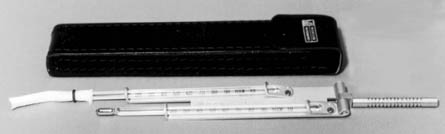
A pocket sling psychrometer. Note the muslin bag on wet-bulb thermometer.
Photo courtesy NovaLynx Corporation
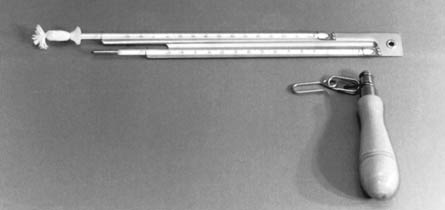
A sling psychrometer
Photo courtesy NovaLynx Corporation
Relative Humidity Table
The following table is just a small section of the complete humidity tables:
| Dry Bulb Temp. (° F) |
Difference between dry bulb and wet bulb temperatures | ||||||||||||||
| 1° | 2° | 3° | 4° | 5° | 6° | 7° | 8° | 9° | 10° | 11° | 12° | 13° | 14° | 15° | |
| 64 | 95 | 90 | 84 | 79 | 74 | 70 | 65 | 60 | 56 | 51 | 47 | 43 | 38 | 34 | 30 |
| 66 | 95 | 90 | 85 | 80 | 75 | 71 | 66 | 61 | 57 | 53 | 48 | 44 | 40 | 36 | 32 |
| 68 | 95 | 90 | 85 | 80 | 76 | 71 | 67 | 62 | 58 | 54 | 50 | 46 | 42 | 38 | 34 |
| 70 | 95 | 90 | 86 | 81 | 77 | 72 | 68 | 64 | 59 | 55 | 51 | 48 | 44 | 40 | 36 |
| 72 | 95 | 91 | 86 | 82 | 77 | 73 | 69 | 65 | 61 | 57 | 53 | 49 | 45 | 42 | 38 |
| 74 | 95 | 91 | 86 | 82 | 78 | 74 | 69 | 65 | 61 | 58 | 54 | 50 | 47 | 43 | 39 |
| 76 | 96 | 91 | 87 | 82 | 78 | 74 | 70 | 66 | 62 | 59 | 55 | 51 | 48 | 44 | 41 |
| 78 | 96 | 91 | 87 | 83 | 79 | 75 | 71 | 67 | 63 | 60 | 56 | 53 | 49 | 46 | 43 |
| 80 | 96 | 91 | 87 | 83 | 79 | 75 | 75 | 68 | 64 | 61 | 57 | 54 | 50 | 47 | 44 |
Note Numbers in blue color denote relative humidity.
Example 1
Dry bulb thermometer shows reading of 70° F and the wet bulb thermometer shows 60° F. Find the relative humidity. The difference between readings is: 70 - 60 = 10° F. Following 70° F dry bulb temperature to the right and 10° F difference between dry bulb and wet bulb temperature down we can see that they intersect at 55 % relative humidity.
Example 2
Dry bulb reads 76° F and the wet bulb reads 62° F. Find the relative humidity. The difference is 76 - 62 = 14° F. Following 76 °F dry bulb temperature to the right and 14° F difference column down we can see that they intersect at 44 % relative humidity.
Note there are also tables in ° C and they can be found on the Internet.

National Weather Service
Relative Humidity and Dew Point Tables for Different Elevations
using Dry-bulb and Wet-bulb temperatures
Without a doubt the most complete set of tables come from the National Weather Service. There are 7 sets of tables, each for a different elevation. Different readings will be obtained when taken at the sea level (altitude 0 feet) and different readings will be obtained in Denver, Colorado also known as the 1 mile city. Denver lies over 5,000 feet above the sea level. At first these tables may seem to be a little intimidating, but they are very accurate and the dry and the wet bulb temperatures, relative humidity, and the dew point, all are included in one table.
Below we present a part of the National Weather Service table that covers dry bulb temperatures from 61° - 65° F for the elevation 0 - 500'.
Wet Bulb Temperatures (40, 41, 42 ...)
| 40 | 41 | 42 | 43 | 44 | 45 | 46 | 47 | 48 | 49 | 50 | 51 | 52 | 53 | 54 | 55 | 56 | 57 | 58 | 59 | 60 | 61 | 62 | 63 | 64 | 65 | |
| 61 | -21 | -4 | +5 | 12 | 18 | 23 | 27 | 30 | 34 | 36 | 39 | 42 | 44 | 46 | 48 | 50 | 52 | 54 | 56 | 58 | 59 | 61 | ||||
| 3 | 7 | 11 | 15 | 19 | 23 | 27 | 31 | 36 | 40 | 44 | 49 | 54 | 58 | 63 | 68 | 73 | 78 | 84 | 89 | 94 | 100 | |||||
| 62 | -44 | -12 | +1 | 9 | 15 | 20 | 25 | 29 | 32 | 35 | 38 | 41 | 43 | 45 | 48 | 50 | 52 | 54 | 55 | 57 | 59 | 60 | 62 | |||
| 1 | 4 | 8 | 12 | 16 | 20 | 24 | 28 | 32 | 37 | 41 | 45 | 50 | 54 | 59 | 64 | 69 | 74 | 79 | 84 | 85 | 89 | 100 | ||||
| -23 | -5 | +5 | 12 | 18 | 23 | 27 | 31 | 34 | 37 | 39 | 42 | 44 | 47 | 49 | 51 | 53 | 55 | 56 | 58 | 60 | 61 | 63 | ||||
| 2 | 6 | 10 | 14 | 17 | 21 | 25 | 29 | 33 | 38 | 42 | 46 | 51 | 55 | 60 | 64 | 69 | 74 | 79 | 84 | 89 | 95 | 100 | ||||
| 64 | -50 | -13 | 0 | +9 | 15 | 21 | 25 | 29 | 32 | 35 | 38 | 41 | 43 | 46 | 48 | 50 | 52 | 54 | 56 | 57 | 59 | 61 | 62 | 66 | ||
| 1 | 4 | 8 | 11 | 15 | 19 | 23 | 26 | 30 | 34 | 39 | 43 | 47 | 51 | 56 | 60 | 65 | 70 | 74 | 79 | 84 | 89 | 95 | 100 | |||
| 65 | -23 | -5 | +5 | 12 | 16 | 23 | 27 | 31 | 34 | 37 | 40 | 42 | 45 | 47 | 49 | 51 | 53 | 55 | 57 | 59 | 60 | 62 | 63 | 65 | ||
| 2 | 6 | 9 | 13 | 16 | 20 | 24 | 28 | 31 | 35 | 39 | 44 | 48 | 52 | 56 | 61 | 65 | 70 | 75 | 80 | 85 | 90 | 95 | 100 |
First left column - Dry Bulb Temperatures (61, 61, 63, 64 and 65).
Example 1
Find the relative humidity if the wet bulb temperature is 54° F and the dry bulb temperature is 61° F?
Answer: Find the wet bulb temperature at the top of the table (54° F), then move down the column. Find the dry bulb temperature at the left side of the table(61° F), then move to the right. The intersection of the wet bulb column and the dry bulb row is a cell with two numbers: 48 and 63. The lower number in blue (63) is the relative humidity and the upper number in red (48) is the dew point temperature.
Example 2:
Find the dew point temperature when the wet bulb reads 65° F and the dry bulb reads 50° F?
Answer: The 65° F dry bulb temperature row and the 50° F wet bulb temperature column intersect at the block of numbers 34 and 31. The red number 34 is the dew point temperature.
Example 3
Let's assume that you would like to double check the data from a different table with the National Weather Service table. All you have is the dry bulb temperature of 64° F and the difference between the dry and wet bulb of 10° F.
Answer: We have to find out the wet bulb temperature and we know that the wet bulb temperature is always lower.
64 (dry bulb temp) - x (wet bulb temp) = 10
The wet bulb temperature is 54° F and at the intersection of the 64° F dry bulb temp and the 54° F wet bulb temperature column we find a block with 46% relative humidity and 51° F dew point temperature.
Notes
- http://www.wrh.noaa.gov/sto/rhtbl.php - complete relative humidity and dew point tables for different elevations from the National Weather Service
- In air conditioned houses the relative humidity remains at the same comfortable level of about 40 - 45 %. The coils of the air handler act as a dehumidifier and remove the moisture of the air. This moisture is water that is dripping from a little drain pipe on the outside.
- In a home refrigerator the humidity remains at about 45% at 40° F (4° C) and about 70% at 0° F (-18° C) in a freezer.
For more information on humidity: