Meats and Sausages

Smoking Meat
Smoking meat is exactly what the name implies: flavoring meat with smoke. Using any kind of improvised device will do the job as long as the smokehouse is made from environmentally safe material. As long as smoke contacts the meat surface it will impart its flavor to the meat. The strength of the flavor depends mainly on the time and density of the smoke. Smoked meats are usually eaten cold at a later date. Many great recipes require that smoked products hang for a designated time to lose more weight to become drier. It is only then that they are ready for consumption.
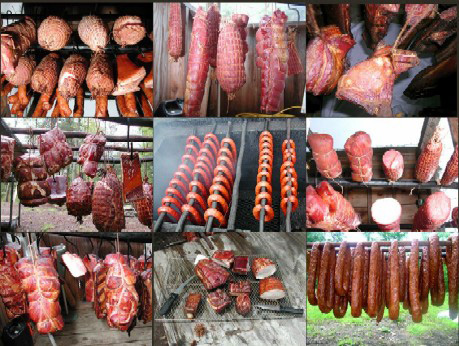
Smoked Meats.
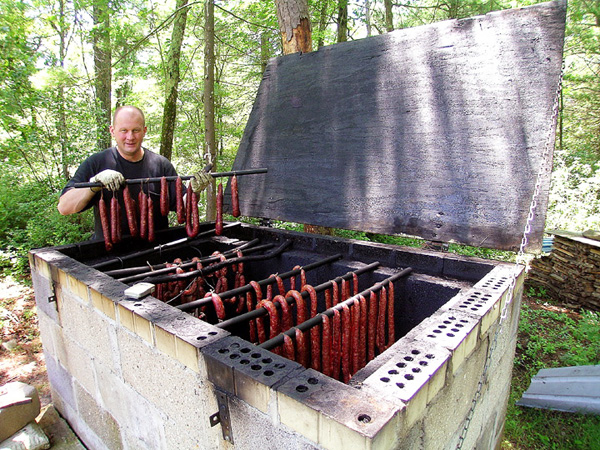
Smoked sausages.
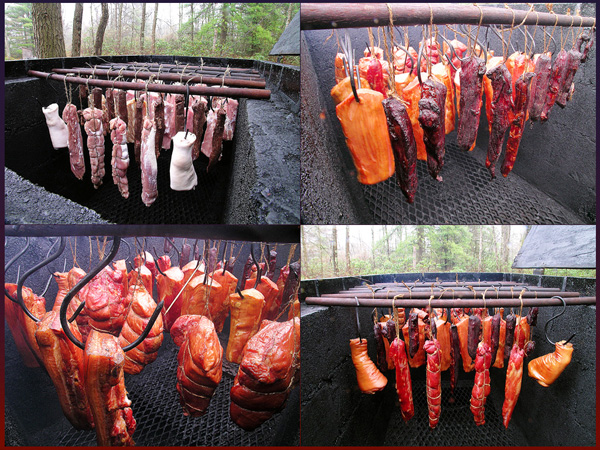
Smoked Meats.
Waldemar Kozik smoking meats in Catskill Mountains, N.Y.
Smoking reasons
Smoking offers many improvements for meat. Besides enhancing the taste and look, it also increases its longevity, and helps preserve the meat by slowing down the spoilage of fat and growth of bacteria. Smoking meat longer leads to more water loss, and results in a saltier and drier product, which naturally increases its shelf life.Man discovered that in addition to salting and curing meat with nitrates, smoking was a very effective tool in preserving meats.
The advantages of smoking meat are numerous. Smoking:
- Kills certain bacteria and slows down the growth of others.
- Prevents fats from developing a rancid taste.
- Prevents mold from forming on fermented sausages.
- Extends shelf life of the product.
- Improves the taste and flavor.
- Changes the color; smoked meats shine and simply look better.
Smoked fish develops a beautiful golden color. The meat on the outside becomes a light brown, red, or almost black depending on the type of wood used, heating temperatures, and total time smoking.
The smell in an ethnic meat store specializing in smoked products can be overwhelming. This experience is not shared with our supermarkets since their products are rarely properly smoked and they are vacuum-sealed to prolong shelf life. Certain classical sausages are smoked for up to 3 days and in today’s era it is hard to imagine a manufacturer that will do that. To survive the frantic pace of today’s market, water is pumped into the meat, chemicals are added for aesthetic and preservation reasons, and smoking is virtually eliminated by adding liquid smoke. As long as the ingredients are not on the list of chemicals that present danger to us, the Food and Drug Administration does not care what goes into the meat. Taste plays a secondary role, as long as the price is good people will buy the product and supermarkets will keep renewing orders. Smoking to preserve meat’s keeping qualities is of less importance today because we can keep the product in a refrigerator or almost indefinitely in a freezer. Originally, curing and smoking was used solely for preservation purposes; today it’s done for the love of its flavor.
Smoking may or may not be followed by cooking. Generally we may say that smoking consists of two steps:
- Smoking. Meats are usually cured before they are submitted to smoking.
- Cooking. This step determines the design and quality of your smokehouse as it needs temperature controls, a reliable heat supply and good insulation to hold the temperature when the weather gets cold. If cooking is performed outside the smokehouse, the unit can be incredibly simple, for example an empty cardboard box.
After smoking is done we increase the temperature to about 170° F (76° C) to start cooking. The smoked meats must be cooked to 154° F (68° C) internal temperature and here the quality and insulation of the smoker plays an important role. Nevertheless, the main smoking process is performed below 160° F (71° C).
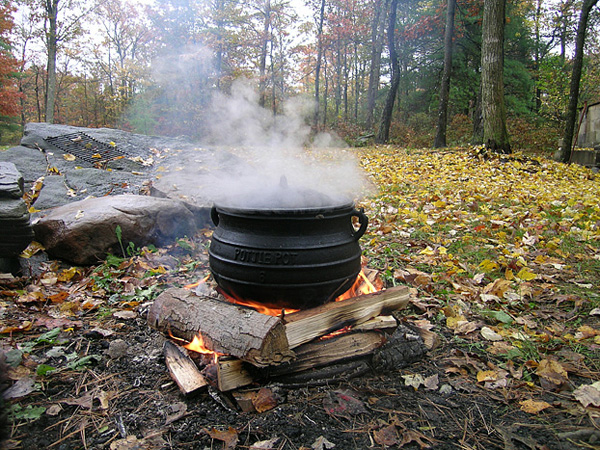
Cooking pot.
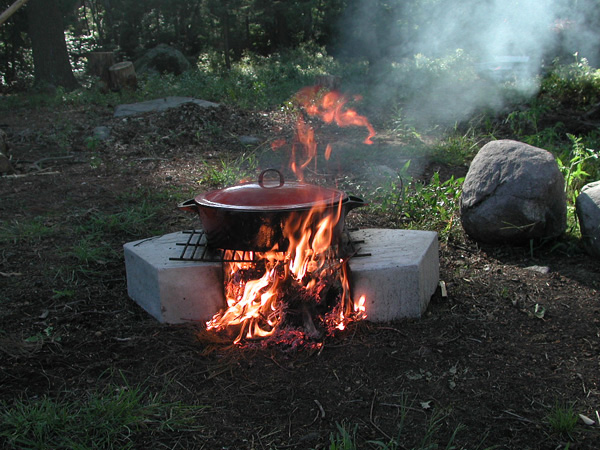
Cooking pot.
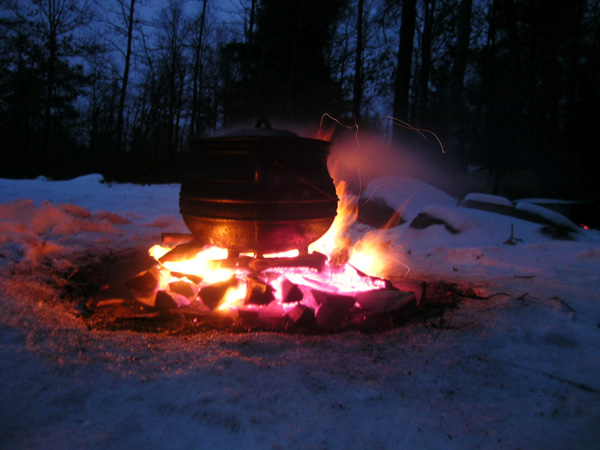
Cooking pot.
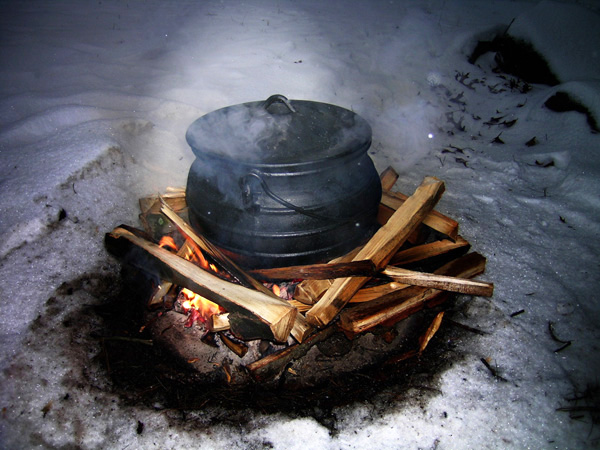
Cooking pot.
We know now that the smoked meat must be cooked, but does that mean that it must be cooked inside of the smokehouse? Don’t we have wonderfully designed and factory built electrical or gas stoves inside every kitchen? They are insulated, have built-in temperature controls and are almost begging for these smoked sausages to be baked inside. How about putting your smoked meats into a pot full of hot water and cooking these products on top of the stove?
Traditionally smoked meats come almost always from cured parts of pork. The most popular large cuts used for smoking are ham, bacon, butt, loin, back fat and smaller parts such as hocks and jowls. Ribs are normally barbecued. Due to their large size those popular cuts require longer curing times although those times can be somewhat shortened when needle pumping precedes the common wet curing method. Hams can be dry or wet cured, butts and loins are normally wet cured and bacon and back fat are commonly dry cured. Trimmings end up for making sausages.
Smoking Without Nitrates
For those who smoke meats without cures, it will be advisable to smoke them at temperatures well above the danger zone (>160° F, 72° C). Such a product will not be pink but will exhibit a typical grayish color of cooked meat. Adding cure to meats that will be smoked brings many benefits (explained later), one of them is preventing the danger of contracting food poisoning, known as botulism. Barbecued meats are smoked at much higher temperatures which eliminates the danger of Clostridium botulinum producing toxins.
Those who insist on smoking meats without nitrates, should be aware that the internal meat temperature trails the temperature of the smokehouse by about 25° F and to be on the outside of the danger zone, the smoking must be performed at temperatures higher than 170° F (77° C) which in our opinion becomes cooking with smoke. Clostridium botulinum bacteria need moisture, warm temperatures and the absence of oxygen. These are prevalent conditions in a small self contained smoker, where incoming air is kept at minimum in order for the sawdust to smolder and not to burst into the flames. A large outside smokehouse with a separate fire pit is at a smaller risk as there is an ample flow of fresh air that enters smoking chamber together with the smoke. Using dry wood increases safety as less moisture will be created.
Smoking Temperatures
Smoking temperature is one of the most important factors in deciding quality. There is no steadfast rule that dictates exact temperature ranges for different types of smoking. A few degrees one way or the other should not create any problem as long as the hot smoking upper temperature limit is not crossed. Crossing this limit will significantly affect the look and the taste of the product. When smoking, the inside temperature of the smoker cannot exceed 170° F (78° C) for any extended time. At this temperature, fat starts to melt quickly. Once it melts, the sausage inside will be a mass of bread crumbs, have a greasy outside, will lose its shine, and will have an inferior taste. If the internal temperature of the sausage was too high during smoking or cooking, your sausage:
- Is greasy on the outside.
- Contains spots of grease under the sausage.
- Is too shriveled and wrinkled.
- Has lost its shine and looks opaque.
- Is crumbly inside with little empty pockets.
The fats start to melt at very low temperatures and we don’t want them to boil and leak through the casings. When faced with excessive temperatures, fats begin to melt and there is no way to undo the damage.
Smoke Deposition
The amount of smoke deposited on a product is influenced by:
- Smoke density - the thicker the smoke, the faster the rate of smoke deposition.
- Smokehouse relative humidity - high humidity favors smoke deposition but inhibits color development.
- The surface condition of the product - moist surface favors smoke but limits color development.
- Smokehouse temperature - higher temperature favors smoke deposition rate.
- Air draft - sufficient air velocity is needed to bring smoke inside. Too fast air might reduce smoke density, not enough air speed and product may be over smoked. Usually a compromise is reached.
How Long to Smoke?
There isn’t one universal time, use your own judgement and keep records. When cold smoking, the times are very long, days or even weeks as the purpose of cold smoking is to preserve the product for future use by removing moisture. There are not many people today that will have the time or patience to smoke products in this manner but those that will try it will be richly rewarded by creating products of different texture and flavor. When hot smoking, the times are short as we smoke and then cook the product trying to achieve the best flavor. The diameter of the meat piece or sausage will be a deciding factor here but you can estimate smoking time by checking the color of the smoked piece as well. Sausages have a small diameter so the times are relatively short. For example, Kabanosy meat stick is stuffed into 24-26 mm sheep casings and 1 hour smoking time is plenty. Polish Smoked sausage stuffed in 36 mm hog casings will need about 1-2 hours. If the color of the sausage is yellow it is lightly smoked, if it is light brown the sausage is nicely smoked, if the color becomes dark brown the sausage is heavily smoked.
Manufacturing Process
The process of making smoked products basically follows the steps for making sausages:
- meat selection
- curing
- conditioning/drying
- smoking
- cooking
- cooling
- storing
Sausages in addition will require extra steps which are grinding, mixing and stuffing.
All these steps are covered in detail in the Sausage Making section.
Fish, poultry and wild game are covered in the Fish, Poultry and Game sections.