Meats and Sausages

Sausage Recipes
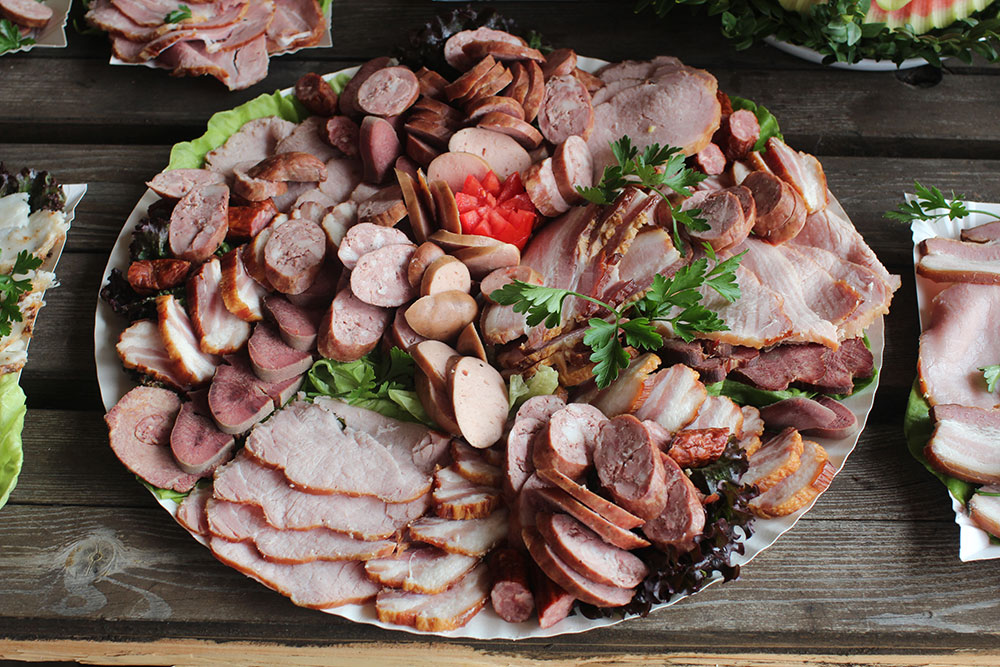
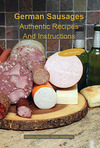
Variety of meats and sausages.
A sausage recipe is just the first step for making quality sausage. The manufacturing process consists of certain rules which must be strictly followed, otherwise the best recipe and most expensive spices will not produce a good sausage. Changing parameters of the manufacturing process will produce a different type of the sausage even if the sausage recipe remains basically the same.
Keep in mind that different types of sausages originate from the same region or a city and may carry the same name, but are made using a different manufacturing process. Moscow sausage does not mean much unless it is followed by its type: Moscow Smoked Sausage, Moscow Dry Sausage, Moscow Blood Sausage etc. It is impossible to define a sausage by saying it is Polish, German or Russian sausage unless the name is followed by the sausage type or the place of its origin. Saying "kielbasa" means that a sausage recipe originated in Poland, but there are over a hundred Polish sausages and they all can be called "kielbasa" so which one we are talking about? However, Kielbasa Krakowska signifies that the sausage was made in the city of Krakow and Kielbasa Jalowcowa implies that the sausage recipe includes juniper. And this is how most countries describe their sausages.
There isn't one standardized recipe for any of the sausages. The best meat science books, written by the foremost experts, list different ingredients for the same sausage, but don't tell you how to make a great product. Once, you know the basic rules, you will transform any sausage recipe into a wonderful product. The most important rules for making quality sausages are listed below with enclosed links to more information on the subject.
Meat selection. Good quality meats make good sausages, that simple. However, before being processed, the meat must be cold, especially fat which should be partially frozen, otherwise the cuts will not be clean.
Curing meat for sausages. This step separates great smoked meats and sausages from low-quality mass-produced supermarket variety which are produced too fast in order to develop the curing flavor which creates a superior smoked ham or sausage.
Grinding. Manual knives and grinder knives must be sharp to produce clean cuts, however, if meat and fat is not cold, the cuts will be smeared.
Mixing. Mix (forcefully knead) meat well with salt, sodium nitrite (cure #1) adding a little water (water is not added to fermented/dry sausages). This allows meat particles to produce exudate (release proteins which are soluble in water and salt solution). Meat becomes sticky and can be easily formed into balls.
Stuffing. Casings should be filled without any visible air pockets. If they occur, they should be pricked with a needle. Most sausage types are firmly stuffed except liver and blood sausages which might expand during cooking.
Conditioning. This, usually neglected process, is very important for smoked sausages. After filling, depending on the diameter of the casing and the speed of the stuffing process, the sausages should hang (rest) for 60-120 minutes. This dries the surface of the casing, allows spices to release more flavor and provides additional time for sodium nitrite (cure #1) to develop a strong red color as in most cases the meat is not properly cured.
Smoking. Not all sausages are smoked, besides, smoked products are more popular in some countries than others. There is a great confusion here about smoking temperatures, wood and smokehouses. To make it very simple-do not apply smoke when sausages are still moist and do not smoke at too high temperature.
Cooking. Sausages are cooked in water at 80° C (176° F) or lower, or baked (usually without smoke) in smokehouse what follows the smoking step.
Cooling. After cooking the sausages are cooled in cold water or air. They should cross the danger zone (60°C/140°F → 6°C/40°F) as fast as possible. Then they are consumed or refrigerated. Cooling also prevents shriveling of the sausage so it remains plump.
Storing. All uncooked meats or sausages should be treated as fresh meat. We can keep on hand an amount that will be consumed within a few days but the rest should be frozen. A ready to eat product (cooked) should not be stored for more than 7 days if held at 41° F, or 4 days at 45° F.
Note: fermented/dry sausages (salami type) are governed by much stricter rules.
Not ready to eat (Uncooked)
Fresh Sausage Recipes
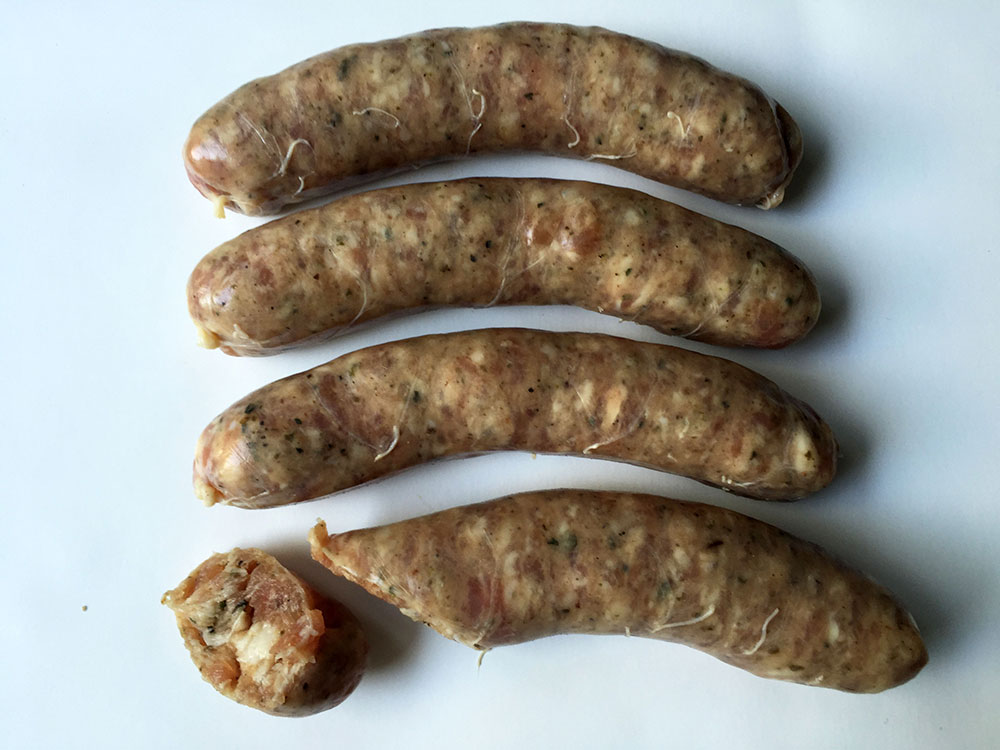
Fresh sausages.
Fresh sausages are not-ready-to-eat sausages which are the easiest to make. The manufacturing process ends with stuffing spiced meat or meat with other materials into a casing. They are either consumed within hours or kept for a few days in refrigerator. For longer storage they must be frozen. Before serving they must be fully cooked. If a freshly stuffed sausage is fully cooked it becomes cooked sausage.
- Alheira de Mirandela
- Andouille
- Bangers
- Battered Sausage
- Beef Sausage-English
- Beef Sausage-Kosher
- Bockwurst
- Bockwurst-American
- Boerewors
- Botifarra Catalana Cruda
- Botillo del Bierzo
- Boudin Cajun
- Bratwurst
- Bratwurst-Austrian
- Bratwurst-Curry
- Bratwurst-Hamburger
- Bratwurst with Egg and Milk
- Breakfast
- Butifarra
- Butifarra Dulce
- Cabbage Pork Sausage
- Cambridge Sausage with Cracker Meal
- Cambridge Sausage with Rice and Rusk
- Cambridge Sausage with Rusk
- Cervellata
- Ćevapčići
- Chakalaka Boerewors
- Chaurice
- Chiang Mai Sausage
- Chicken Curry
- Chipolata
- Chipolata with Rice
- Choriqueso
- Chorizo Antioqueño
- Chorizo Argentinian
- Chorizo Aromático
- Chorizo Criollo Argentino
- Chorizo Criollo Colombiano
- Chorizo Cubano
- Chorizo Mexican
- Chorizo Parillero
- Chorizo Porteńo
- Chorizo-Puerto Rican
- Chorizo Rojo de Teror
- Chorizo-Spanish-Fresh
- Chorizo Verde
- Cotchino Modena
- Cumberland Sausage-Traditional
- Epping Sausage
- Excelsior Sausage
- Figatelli Fresh Sausage
- Figatells
- Fränkische Bratwurst
- Gloucester Sausage
- Greek Sausage
- Greek Sausage-Traditional
- Hessische Bratwurst
- Hmong Sausage
- Italian Bratwurst
- Italian Sausage
- Jalapeno Sausage
- Karnatzlach
- Lamb Sausage-Welsh
- Leek Sausage
- Lincolnshire Sausage
- Lincolnshire Sausage-Traditional
- Linguica-Brazilian
- Longanisa
- Longaniza Chilena
- Longaniza Dominicana
- Longaniza Fresca
- Longaniza Murciana
- Longaniza Parillera
- Longaniza-Puerto Rican
- Lorne Sausage and Square
- Loukanika
- Lucanica
- Luganega di Monza
- Macedonian Sausage
- Makanek
- Manchester Sausage
- Manchester Sausage-Traditional
- Marylebone
- Medister
- Mediterranean Chicken Sausage
- Merguez
- Mititei
- Newmarket Sausage with Bread
- Newmarket Sausage with Rusk
- Nürnberger Bratwürste
- Obispo de Tenancingo
- Oriental Pork Sausage
- Oxford-Beef Sausage
- Oxford Sausage
- Oxford Sausage-Traditional
- Patatera
- Pfälzer Bratwurst
- Pork and Apple Sausage-West Country
- Pork Sausage-American
- Pork Sausage-English
- Pork Sausage with Potato Flour
- Potato Sausage
- Potato Sausage-Swedish
- Pork Sausage with Potato & Sage
- Pork Sausage with Rice
- Rheinische Bratwurst
- Rheinische Bratwurst-Smoked
- Rookworst
- Sai Grok Sausage
- Salchicha de Ternera
- Salchicha de Trufas
- Salchicha Roja
- Salsiccia Fresca
- Saucisse Aux Choix (Cabbage Sausage)
- Saucisse de Choux
- Saucisse de Morteau
- Saucisse de Toulouse
- Saucisse de Veau au Citron
- Schlesische Bratwurst
- Sheftalia
- Spanish Bratwurst
- Suffolk Sausage
- Texas Hot Links
- Thanksgiving Turkey Sausage
- Thüringer Bratwurst
- Tomato Sausage
- Tomato Sausage-English
- Thüringer Rostbratwurst
- Vigan Longanisa
- White Bratwurst
- White Sausage-Polish
- Weiβwurst (White Sausage)
- Wild Bratwurst
- Wiltshire Pudding
- Yorkshire Sausage
- Zampone Modena
- Alheira de Barroso-Montalegre
- Alheira de Vinhais
- All Beef Sausage
- Androja
- Arbatine
- Augsburger-Austrian
- Augsburger-German
- Bacon Sausage
- Baloney
- Baltycka
- Battered Sausage
- Bayerische Bierwurst
- Beef Ham Sausage
- Beef Sausage-Polish
- Beer Sausage-Polish (Kiełbasa piwna)
- Beer Sausage with Goose Meat
- Belzka
- Berliner Dampfwurst
- Bialostocka
- Bialostocka with Goose Fat
- Bielska
- Bierschinken
- Bierwurst
- Bieszczadzka
- Bisbe or Bull
- Blanco de Alicante
- Blancos
- Blanquet de Baleares
- Boar Sausage
- Bologna-American
- Bologna-Country Style
- Bologna-German
- Bologna-Polish
- Botifarra Blanca – La Garriga
- Botifarra Blanca – Lérida
- Botifarra Catalana Trufada
- Botifarra de Huevos (Gerona)
- Botifarra Perol
- Botifarro-Blanquet
- Boudin Blanc
- Boudin Blanc de Liège
- Boudin Blanc de Paris
- Boudin Blanc de Rethel
- Boudin Blanc de Toulouse
- Boudin Blanc - Traditional
- Brain Sausage
- Breinwurst
- Bread and Butter Sausage
- Brunswick Sausage-English
- Burenwurst
- Burgenländisches Hauswürstel
- Butifarra Blanca
- Butifarra Blanca Mezcla (Pork & Beef)
- Butifarra de Huevos
- Butifarra Soledeña
- Butifarra Traidora
- Butifarrón
- Bydgoska
- Bytomska
- Cabanossi-Austrian
- Cabanossi-German
- Cabbage Roll Sausage-Polish
- Camp
- Caraway Sausage
- Cervelatpølse
- Cheerios
- Chicken Sausage
- Chicken Sausage-Indian
- Chinese Sausage
- Chicken Sausage-Smoked
- Chicken with Cheese & Onion
- Chireta
- Cocktailwürstchen
- Currywurst
- Debowiecka
- Debreceni Kolbász
- Debreziner-Austrian
- Debreziner-German
- Deer Sausage
- Delicatessen
- Devon Sausage
- Doctors
- Duck Sausage
- Dürre
- Erbswurst
- Extrawurst
- Falukorv
- Farinheira
- Fen Chang
- Fine Bratwurst
- Finger Sausage
- Fleischwurst
- Frankfurter
- Frankfurter-All Beef
- Frankfurter-Wiener Würstel
- Frankfurter Coney Island
- Fried Sausage-German
- Garlic Sausage
- Game Sausage
- Gelbwurst
- Gelderse Rookworst
- Girella
- Glamorgan
- Glogovska
- Gniezno Sausage
- Goin Chong-Cooked
- Goose Sausage
- Guan Chang
- Haggis
- Haggis-Traditional
- Halberstädter Würstchen
- Ham Sausage-English
- Ham Sausage-German
- Ham Sausage-Polish
- Harbin Red
- Harzer Schmorwurst
- Hog's Pudding-Cornish
- Hog's Pudding-Devonshire
- Hog's Pudding-West Country
- Hot Dog
- Hunter Sausage
- Hunter Sausage Links
- Hurka
- Husarska
- Hutnicka
- Italian Sausage Smoked
- Jadgwurst
- Japanese Fish Sausage
- Jaternice-Czech
- Jauersche
- Jausenwurst
- Jowl Sausage
- Juniper Sausage
- Kabana
- Kabanosy
- Kalbsbratwurst
- Kanga Banga
- Kartoffelwurst With Boiled Potatoes
- Kartoffelwurst With Raw Potatoes
- Kawassy
- Kazy
- Klobasse
- Klöpfer
- Knack d’Alsace
- Knacker
- Knackwurst
- Knoblauchwurst
- Knockpolse
- Knyszynska
- Kochsalami
- Kolska
- Kosher Beef Sausage
- Kosher Sausage With Oil
- Krainer
- Krakauer
- Krakowska
- Krakowska-Traditional
- Krakowska-Dry
- Kranjska Klobasa
- Krolewiecka
- Kujawska
- Kummelwurst
- Lap Cheong
- Lemon Sausage
- Lietuviska
- Limanowska
- Linquiça
- Lisiecka
- Lithuanian
- Loin Sausage
- Lubuska
- Lyoner
- Maranho de Serta
- Mombar Mahshy
- Mondejo or Mondeju
- Morcilla Blanca
- Morcilla Blanca de Cazorla
- Morcilla Blanca Provenzal
- Morcón de Lorca
- Mortadela Bolonia
- Mortadela Cordobesa
- Mortadella Bologna
- Mortadella Deutsch with Peppers
- Mortadella Lyoner
- Mortadella Norddeutsch
- Mortadella Süddeutsch
- Mortadella di Prato
- Mortadella Polish
- Mortadella-Veal
- Moscow Sausage
- Mysliwska
- Münchener Rostbratwurst
- Münchener Weisswurst
- Nevezis
- Olawska
- Onion Sausage
- Opolska
- Palangos
- Pariser
- Pariser Fleischwurst
- Perunamakkara
- Pieniska
- Pinkelwurst
- Podhalanska
- Podkarpacka
- Podlaska
- Polish Hot Smoked
- Polnische
- Polony
- Popular
- Pork Loin Sausage
- Presskopf
- Pumpkin Sausage
- Rabbit Sausage
- Reiswurst
- Relleno de Huéscar
- Rindswurst
- Ring Sausage
- Røde Pølse
- Romanian Sausage
- Rostbratwurst
- Rote
- Rural Sausage
- Russian Hot Smoked
- Ryynimakkara
- Rzeszowska
- Salame d’oca di Mortara
- Salami Cotto
- Salami Krakowskie-Baked
- Salchicha de Turista
- Salchicha Frankfurt Style
- Salchicha Madrileña
- Salchicha Viena Style
- Salzburger
- Saucisse de Choux (Cooked)
- Saucisse de Montbéliard
- Saucisse de Pommes de Terre
- Saucisse de Strasbourg
- Saucisse Viennoise
- Saumagen
- Saumaise
- Sausage Links
- Sausage Links-Parówki
- Sausage Roll with Puff Pastry
- Sausage Roll with Shortcrust Pastry
- Saveloy-Australian
- Saveloy-English
- Saveloy-English-Smoked
- Schinkenwurst (Ham Sausage)
- Schüblinge
- Scotch Pudding
- Scotch White Pudding
- Scotch White Pudding with Leeks
- Serbian Sausage
- Serdelki
- Serdelowa
- Serdelowa with Veal
- Servela
- Servolatka
- Silesian
- Sluzewiecka
- Speckwurst
- Squid Sausage
- Stadtwurst
- Stadtwurst-Nürnberger
- Starowiejska
- Steamed Sausage (Kiełbasa parówkowa)
- Suvalska (Kiełbasa suwalska)
- Tambov
- Tarnogorska
- Tarnovska Sausage (Kiełbasa cielęca tarnowska pieczona)
- Tatar
- Tiroler
- Toad in the Hole
- Tomaszovska (Kiełbasa tomaszowska)
- Torunska (Kiełbasa toruńska parzona podsuszana)
- Tourist Sausage-Polish (Kiełbasa turystyczna pieczona)
- Tourist-Russian
- Touristenwürstchen
- Tuchowska Sausage (Kiełbasa tuchowska)
- Turkey Sausage
- Ukrainian Sausage
- Utopence Sausage
- Värmland
- Vavelska (Kiełbasa wawelska)
- Venison Sausage
- Waldviertler
- Warsaw Sausage (Kiełbasa warszawska)
- Weiβe Zungenwurst
- Weiꞵkrautwürstchen (White Cabbage Sausage)
- White Pudding-Traditional
- White Pudding with Barley
- White Pudding with Oatmeal
- White Pudding with Rusk
- Wiener
- Wiener-Austrian
- Wild Boar Sausage
- Wild Boar Superb Sausage
- Wollwurst
- Yellow Sausage
- Extrawurst
- Yorkshire Pudding
- Zampone
- Zwiebelwurst
- Zulavska Sausage (Kiełbasa żuławska pieczona)
- Zwyczajna
- Zyviecka Sausage(Żywiecka Sausage)
- Aachener Weihnachtsleberwurst
- Bauernleberwurst
- Berliner Leberwurst
- Bratleberwurst
- Braunschweiger
- Braunschweiger Liver Sausage-American
- Cacholeira Branca de Portalegre
- Champignonleberwurst
- Chicken Liver Sausage
- Chicken Liver Sausage-Kosher
- False Liver Sausage
- Fegato Pazzo
- Frankfort Liver Sausage
- Frankfort Yellow Liver Sausage
- Gänseleberwurst
- Geflügelleberwurst
- Goose Liver Sausage
- Goose Liver Sausage with Truffles
- Grützleberwurst
- Hausmacherleberwurst
- Kalbsleberwurst
- Leberstreichwurst
- Leberwurst
- Leberwürstchen
- Leberwurst mit Reis
- Leverpolse
- Lifrapylsa
- Liverpostej
- Liver Sausage-American
- Liver Sausage Czech
- Liver Sausage Economy
- Liver Sausage-English
- Liver Sausage Onions
- Liver Sausage Pate
- Liver Sausage Poultry
- Liver Sausage Rice
- Liver Sausage-Traditional
- Liver Sausage White
- Liver Sausage White Polish
- Liver Sausage with Jowls
- Liver Sausage with Pork and Rice
- Liver Sausage with Raisins
- Liver Sausage with Sardines
- Maksamakkara
- Obornicka Liver Sausage
- Putenleberwurst
- Sahneleberwurst (Liver Sausage with Cream)
- Salchicha de Higado
- Salchicha de Higado con Trufas
- Salchicha de Higado con Trufas y Tomate
- Salchicha de Higado Mezcla
- Salchicha Exquisita de Higado
- Sardellenleberwurst
- Saucisse de Foie (Liver Sausage-Traditional)
- Schwineleberwurst
- Semmelleberwurst
- Semolina Liver Sausage
- Thüringer Leberwurst
- Tomatenleberwurst
- Veal Liver Sausage-Kosher
- Beutelwurst
- Biroldo (Sanguinaccio)
- Black Pudding
- Black Pudding-Cheshire
- Black Pudding-Famed-Bury
- Black Pudding-North Staffordshire
- Black Pudding-Stornoway
- Black Pudding-Stredford
- Black Pudding-Traditional
- Black Pudding with Cream
- Blóðmör
- Bloempanch
- Blood Sausage
- Blood Sausage Supreme
- Blood Sausage with Bread Crumbs
- Blood Sausage with Jowls
- Blood Sausage with Rice
- Blood Sausage with Snouts
- Blood Sausage with Tongues
- Borono
- Blunzn
- Blutwurst with Buchenweizengrütze (Buckwheat)
- Blutwurst with Gerstengrütze (Barley)
- Blutwurst with Graupen (Pearl Barley)
- Blutwurst with Hafergrütze (Oats)
- Blutwurst with Kürbis (Pumpkin)
- Blutwurst with Roggenschrot (Rye)
- Blutwurst with Schrippen (Wheat Roll)
- Botagueña
- Botifarra de Ceba
- Botifarra Negra de Barcelona
- Boudin Noir á la Créme
- Boudin Noir á la Flamande
- Boudin Noir Aux Noix
- Boudin Noir de Lyon
- Boudin Noir-Traditional
- Bratblutwurst
- Butifarra de Baleares
- Butifarra Lorquina
- Butifarra Negra
- Butifarra Negra Mezcla (Pork & Beef)
- Butifarrón de Baleares
- Camayot
- Chinese Blood Sausage
- Chinese Blood Sausage with Rice
- Chouriça de Sangue de Melgaço
- Delgadilla Blood Sausage
- Doi Huyet
- Drisheen
- Emberzao
- Fariñón
- Finney Blood Sausage
- Flönz
- Gutsfleischwurst
- Gyurma
- Hausmacherblutwurst
- Hurka Blood Sausage
- Hurka Blood Sausage
- Italian Blood Sausage, Sweet-Sanguinaccio Dolce
- Lodzka Blood Sausage
- Morcela de Assar de Portalegre
- Morcela de Arroz
- Morcela de Cozer de Portalegre
- Morcela de Estremoz e Borba
- Morcilla
- Morcilla Achorizada
- Morcilla Andaluza
- Morcilla Asturiana
- Morcilla Asturiana-Traditional
- Morcilla de Álava
- Morcilla de Arroz
- Morcilla de Arroz (Castellón de la Plana)
- Morcilla de Burgos
- Morcilla de Calabaza
- Morcilla de Calabaza de Mezcla
- Morcilla de Cebolla
- Morcilla de Cebolla de León
- Morcilla de Cebolla Valenciana
- Morcilla de Cordoba
- Morcilla de Despojos
- Morcilla de la Sierra de Huelva
- Morcilla de Lengua
- Morcilla de Pan
- Morcilla de Picaro
- Morcilla de Sangre de Oveja-Buskantza, Mondejos
- Morcilla de Tocino
- Morcilla de Valladolid
- Morcilla Dulce
- Morcilla Dulce Canaria
- Morcilla Dulce de Soria
- Morcilla Dulce Riojana
- Morcilla Extremeńa (Badajoz)
- Morcilla Francesa
- Morcilla Gallega
- Morcilla Lebaniega
- Morcilla Lustre
- Morcilla Lustre Malagueña
- Morcilla Odolki-Odoloste
- Morcilla Porteńa
- Morcilla Riojana
- Morcilla Riojana de Arroz
- Morcilla Rondeńa
- Morcilla Serrana
- Morcilla Toledana
- Morcilla Vasca
- Morcilla Vasca-Argentinian
- Moronga
- Moscancia
- Mustamakkara
- Navajo
- Oecher Puttes
- Perro Sausage
- Polish Blood Sausage
- Popular Blood Sausage
- Rotwurst
- Sangueira de Barroso-Montalegre
- Scotch Black Pudding
- Silesian Krupnioki
- Simple Blood Sausage
- Soondae
- Thüringer Rotwurst
- Timoleague Brown Pudding
- Träipen
- Verivorst
- Zungenblutwurst
- All Trimmings Head Cheese
- Berliner Sülzwurst
- Black Head Cheese
- Brunszwicki Head Cheese (Salceson brunszwicki)
- Cabeza de Jabalí
- Camayot
- City Head Cheese
- Farmer's Head Cheese
- Goose or Duck Head Cheese
- Hessische Sülzwurst
- Italian Head Cheese
- Mazovia Head Cheese
- Paltruch-Bispot
- Pigs’ Feet and Calf’s Tongue Head Cheese
- Pomerania Head Cheese
- Poultry Bouillon Head Cheese or Gelatin
- Presswurst-Austrian
- Queso de Cabeza
- Queso de Puerco
- Rural Head Cheese
- Russian Head Cheese
- Scrapple
- Scrapple-Traditional
- Silesian Head Cheese
- Souse
- Sulz-American
- Sulz-Austrian
- Sülze
- Sülzwurst
- Supreme White Head Cheese
- Tongue Head Cheese
- Traditional Head Cheese
- Weinsülze
- Wolsztyn Head Cheese
- Zylc
- Aalrauchmettwurst
- American Holsteiner
- Androlla Gallega
- Androlla Maragata
- Baiona Curada
- Baranjski Kulen
- Bauernbratwurst
- Berliner Knacker
- Bispo
- Boerenmetworst
- Botelo Gallego
- Botillo del Bierzo
- Botillo de León
- Braunschweiger Mettwurst (Sliceable)
- Braunschweiger Mettwurst (Spreadable)
- Braunschweiger-Russian
- Buche de Costillas (Badajoz)
- Budapesti Téliszálami
- Butelo de Vinhais
- Butifarra Dulce-Dry
- Bydgoska Sausage
- Cacciatore
- Calabresa-Brazilian
- Cańa de Lomo (Lomo Embuchado de Huelva)
- Cervelat-American
- Cervelatwurst
- Chanfaino or Longaniza
- Chicken Fermented Sausage
- Chistorra
- Chistorra-Txistorra-Traditional
- Chorizo Andaluz
- Chorizo Asturiano
- Chorizo Candelario
- Chorizo Cantabro (Guriezo)
- Chorizo Cular (Salamanca)
- Chorizo de Aragón
- Chorizo De Bilbao
- Chorizo De Bofe
- Chorizo de Calabaza
- Chorizo de Cantipalos
- Chorizo de Cebolla
- Chorizo de Cerdo
- Chorizo de la Sierra de Aracena
- Chorizo de León
- Chorizo de Mezcla
- Chorizo de Pamplona
- Chorizo de Potes
- Chorizo de Soria
- Chorizo de Villarcayo
- Chorizo Extremeńo
- Chorizo Gallego
- Chorizo Ibérico de Huelva
- Chorizo Patatero de Monroy
- Chorizo Patatero Rojo
- Chorizo Quzande de Bandeira
- Chorizo Riojano
- Chorizo Spanish - Traditional
- Chorizo Zamorano
- Chosco de Tineo
- Chosco o Choscu
- Chouriça de Carne de Barroso-Montalegre
- Chouriça de Carne de Melgaço
- Chouriça de Carne de Vinhais
- Chouriço
- Chouriço Azedo de Vinhais
- Chouriço de Abóbora de Barroso-Montalegre
- Chouriço de Carne de Estremoz e Borba
- Chouriço de Portalegre
- Chouriço Mouro de Portalegre
- Ciauscolo
- Coglioni di Mulo
- Csabai Kolbasz
- Deutsche Salami
- Dongguan
- Droë Wors
- Dürre Runde
- Eichsfelder Feldgieker
- El Xolis
- Farinato (Salamanca)
- Farinheira de Estremoz e Borba
- Farinheira de Portalegre
- Farmer
- Feldkieker
- Figatelli Dry Sausage
- Frankfurter-Smoked
- Fuet
- Fuet de Barcelona
- Geräucherte Bratwurst
- Goan
- Goin Chong-Dry
- Gornooryahovski Sudzhuk
- Goteborg
- Göttinger Feldkieker
- Göttinger Stracke
- Grassland
- Greußener Salami
- Güeña
- Gyulai Kolbasz
- Haussalami
- Hofer Rindfleischwurst
- Holsteiner
- Hungarian
- Imperial de Bolańos
- Imperial de Lorca
- Jauntauler Salami
- Kaminwurz
- Kantwurst
- Katenrauchwurst
- Kindziuk
- Kohlwurst
- Kohlwurst-Lippsche
- Kosher Salami
- Kummelwurst
- Lamb Sausage
- Landjäger
- Lap Cheong
- Linguíça do Baixo Alentejo
- Linguiça de Portalegre
- Lithuanian Sausage
- Llangonisa Rotja - Alicantina
- Lomo Embuchado
- Lomo Embuchado de Huelva
- Lomo Embuchado Ibérico
- Lomo Embuchado de Segovia
- Lomo Ibérico de Bellota
- Lomo Ibérico Extremeńo
- Lomo Picado
- Longaniza
- Longaniza Andaluza
- Longaniza de Aragón
- Longaniza de Mezcla
- Longaniza Castillan
- Longaniza Navarra
- Longaniza Navarra-Traditional
- Longaniza o Chanfaino
- Longaniza de Pascua
- Longaniza de Payés
- Longaniza Salamantina
- Longaniza Traditional
- Loukanka
- Lucanian
- Lucanica di Picerno
- Luftgetrocknete Mettwurst
- Medwurst
- Merguez
- Mettwurst-Spreadable
- Metka Brunszwicka
- Morcilla Blanca de Jaén
- Morcón Andaluz
- Morcón Extremeńo
- Morcón Gaditano
- Morrpølse
- Mortadella-Dry
- Moscow Dry
- Nduja
- Neva Dry
- Original Dry
- Ossenworst
- Painho de Portalegre
- Paio de Beja
- Pafitiko Loukaniko
- Patatera Extremeńa
- Pepperoni Dry
- Plockwurst
- Polish Cold Smoked
- Polish Delicatessen Sausage
- Polish Dry - Russian Version
- Rheinische Mettwurst
- Rosette de Lyon
- Russian Cold Smoked
- Sabadiego or Sabadeña
- Sächsische Mettwurst
- Salam de Sibiu
- Salama da Sugo
- Salami Brianza
- Salami Cremona
- Salami di Fabriano
- Salame d'oca di Mortara
- Salami di Varzi
- Salami Piacentino
- Salami Sant'Angelo
- Salametti
- Salami-All Beef
- Salami Calabrese
- Salami de Arles
- Salami de Verona
- Salami di Felino
- Salami Finocchiona
- Salami Genoa
- Salami-German
- Salami Hungarian
- Salami-Hungarian-Traditional
- Salami Krakowskie
- Salami Lombardia
- Salami-Mailänder
- Salami Milano
- Salamini Italiani alla Cacciatora
- Salami Nola
- Salami Piemonte
- Salami-Polish
- Salami-Polish with Culture
- Salami-Russian
- Salsiccia Sarda
- Salami Sorrento
- Salami Spanish (Español)
- Salami Traditional
- Salchicha de Zaratán
- Salchichón
- Salchichón de Lugo
- Salchichón de Mezcla
- Salchichón de Vic
- Salchichón Gallego
- Salmon Sausage
- Salpicão de Vinhais
- Salsiccia di Calabria
- Saucisson au Camembert
- Saucisson aux Noisettes
- Saucisson aux Noix
- Saucisson d’Alsace
- Saucisson d’Ardenne
- Saucisson de Lacaune
- Saucisson de L’Ardéche
- Saucisson sec au Beaufort
- Saucisson sec d’Auvergne
- Schlackwurst
- Schmierwurst
- Šebreljski Ẑelodec
- Secallona-Somalla
- Servolatka
- Sheep Dry
- Skilandis
- Slavonski Kulen
- Snijworst
- Sobrasada
- Sobrasada de Mallorca
- Sobrasada de Mallorca de Cerdo Negro
- Sobrasada Picante Casera
- Sobrasada Valenciana
- Soppressata
- Soppressata di Calabria
- Soprèssa Vicentina
- Soviet
- Stolichnaya Dry
- Sucuk
- Sucuk-Traditional
- Szegedi Teliszalami
- Tambov
- Teewurst Rügenwalder Art
- Tourist
- Touristenwurst
- Urutan
- Westfälische Mettwurst
- Zervelatwurst
- Zgornjesavinjski želodec
- Bockwurst Fish Sausage
- Bratwurst Fish Sausage
- Chaurice Fish Sausage
- Farinheira Fish Sausage
- Fish Bacon Sausage
- Fish Ham Sausage
- Fish Sausage
- Fish Sausage - English (Kosher)
- Fish Sausage Links (Kosher)
- Fish Sausage with Tomato Puree (Kosher)
- Fish Sausage with Oil (Kosher)
- Fish Sausage with Potato Flour
- Fish Sausage with Potatoes
- Fish Sausage - Smoked
- Polish Smoked Fish Sausage
- Sardellenwurst (Sardine Sausage)
- Saucisse de Lieu Jaune au Chou Vert (Fish Sausage with Cabbage Leaves)
- Squid Sausage
- Bean Frankfurter
- Garbanzo Sausage
- Potato
- Rice-Apple Sauce
- Tofu Breadcrumbs
- Tomato
- Victor
- White Pudding
- Barley
- Basic
- Bean
- Beet-Horseradish
- Bread Crumbs
- Bread Pudding
- Buckwheat and Tofu
- Cajun
- Chorizo
- Chorizo-Spanish
- Garam Masala
- Garbanzo
- Glamorgan Sausage
- Granola
- Guan Chang-Vegetarian
- Hot Dog
- Hunter
- Italian
- Lentil
- Oats
- Peanut Butter
- Polenta with Cranberries
- Poppy Seed
- Potato
- Pumpkin and Coconut Sausage
- Quinoa with Black Beans
- Rice with Apple Sauce
- Cranberries
- Smoked
- Teff Snack
- Tofu with Nori
- Diced Tomato
- Tomato Sauce
- White Tofu
Ready to Eat (Cooked or Fermented) Sausage Recipes
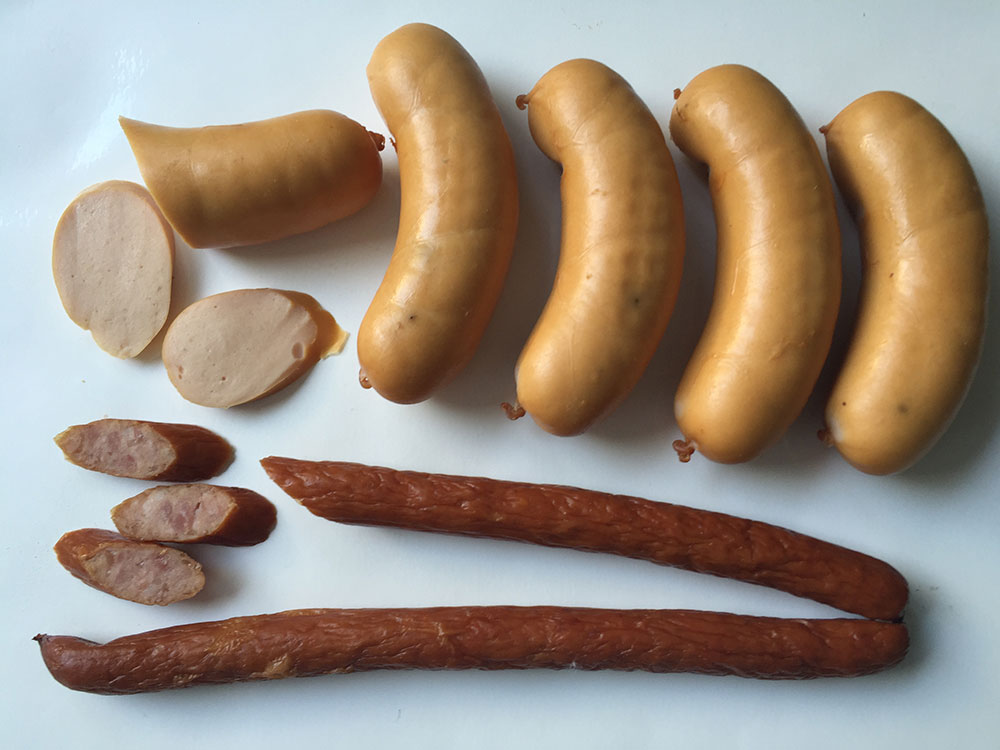
Cooked sausages.
Cooked sausages are ready-to-eat sausages regardless of whether they are heated or consumed cold. This huge group of sausages can be further subdivided by the method of cooking: smoked sausages baked in a smokehouse or cooked in water, unsmoked sausages cooked in water, emulsified sausages like hot dogs or bologna and even special sausages such as head cheeses, liver and blood sausages. They are fully cooked and will last longer than a fresh sausage, however, they still need to be refrigerated or frozen.
Cooked
Regular
Liver Sausage Recipes
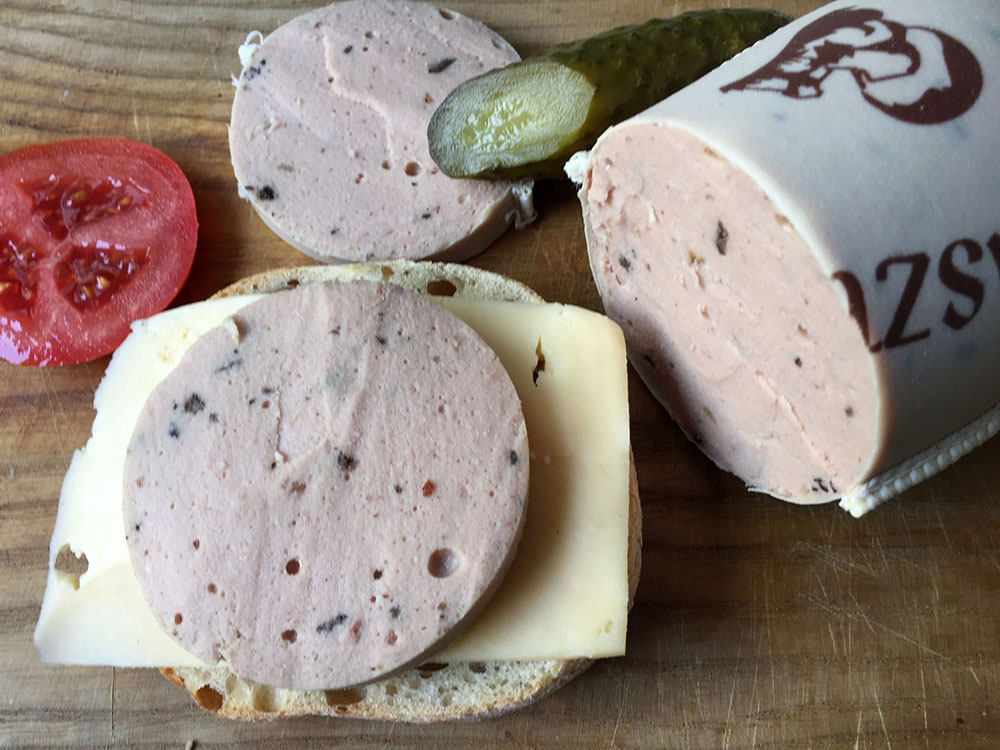
Liver sausages.
Liver sausages contain a large proportion of liver, usually about 30%. The quality and color of the sausage is largely determined by choosing the liver. The way the liver, fat and meats are processed will have the biggest impact on the quality of the sausage. A careful selection of spices will give the sausage its final character. Best liver sausages are made from livers of young animals. Liver must not be cooked as it will lose its emulsifying properties. Occasionally, liver is cooked briefly (blanched) hot water for up to 5 min to remove any leftover blood, however soaking liver in water will accomplish the same.
Blood Sausage Recipes

Blood sausage.
Blood sausages were originally made from inexpensive raw materials such as pork head meat, jowls, tongues, groins, skins, pork or veal lungs, pork liver, beef and lamb liver, pork snouts, beef and liver lips, udders, beef and lamb tripe, veal casings, pork stomachs, pork heart, boiled bone meat and of course blood. This way every part of the animal was utilized and a highly nutritional product was made. In times of war and other hard times when meat was scarce, fillers were added to increase the volume of the sausage. The majority of blood sausage recipes contain chopped onion and filler material such as oatmeal, barley, bread crumbs, rice, cornmeal, buckwheat groats, semolina, flour etc. The addition of filler material makes a sausage very economical. Filler material such as rice, barley or buckwheat groats must be pre-cooked. Blood sausages like highly aromatic spices such as pepper, thyme, marjoram, caraway, pimento, cloves, nutmeg, allspice and coriander. Often apples, pine nuts, chestnuts, raisins and cream are added.
Head Cheese Recipes
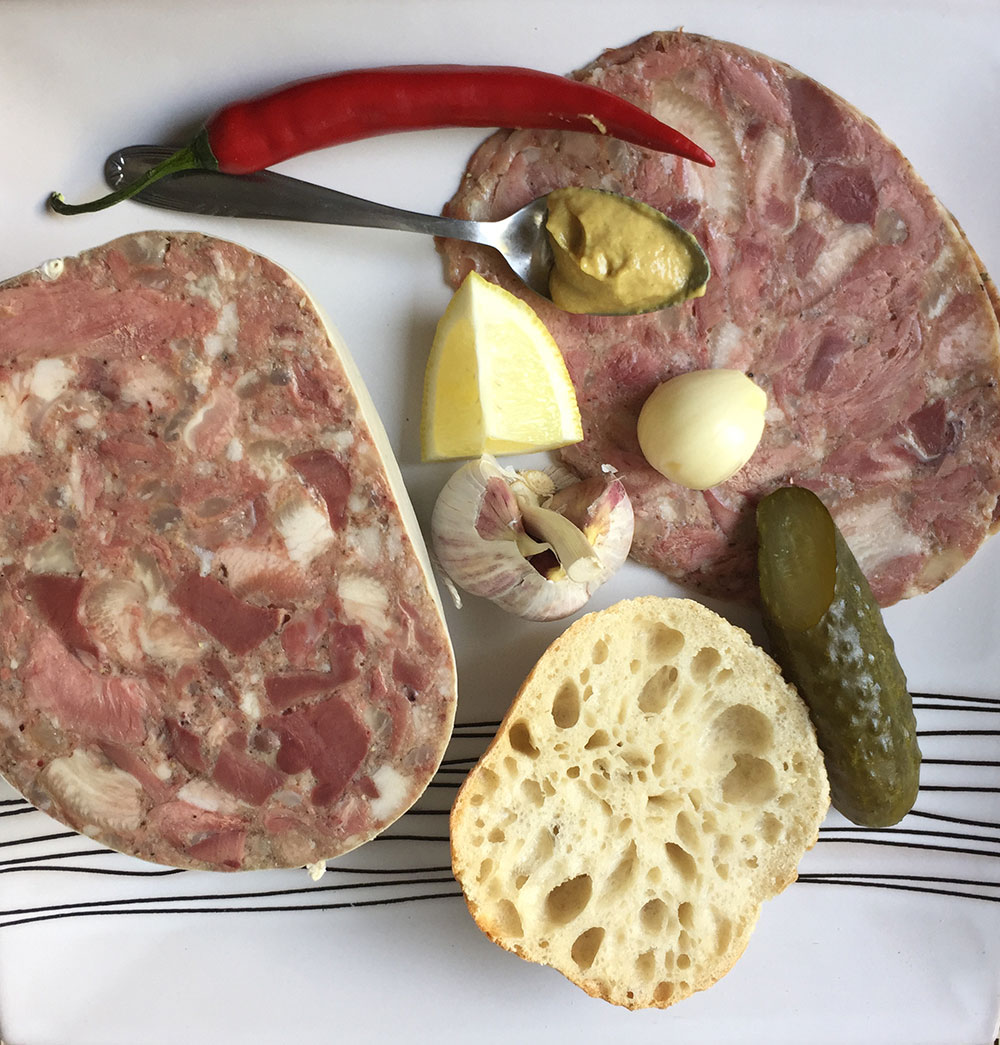
Head cheese.
Head cheese, brawn, or souse are not cheeses, but rather jellied loaves or sausages that may or may not be stuffed into the large diameter casing. In English, the name head cheese doesn’t sound appealing which prevents many people from trying the product. In other languages it is called in a friendlier manner, without the word “head” being part of the name. When vinegar is added, it is called “souse” and this already sounds much better. The manufacturing process for meat jelly and head cheese is very similar the difference is packing the product; the head cheese is stuffed into a large diameter casing and meat jelly is poured into a bowl. Meat jelly contains more of meat stock. Head cheeses can be easily found in places that cater to Central Europeans, Eastern Europeans, Italians or people of Spanish origin.
Fermented and Dry Sausage Recipes
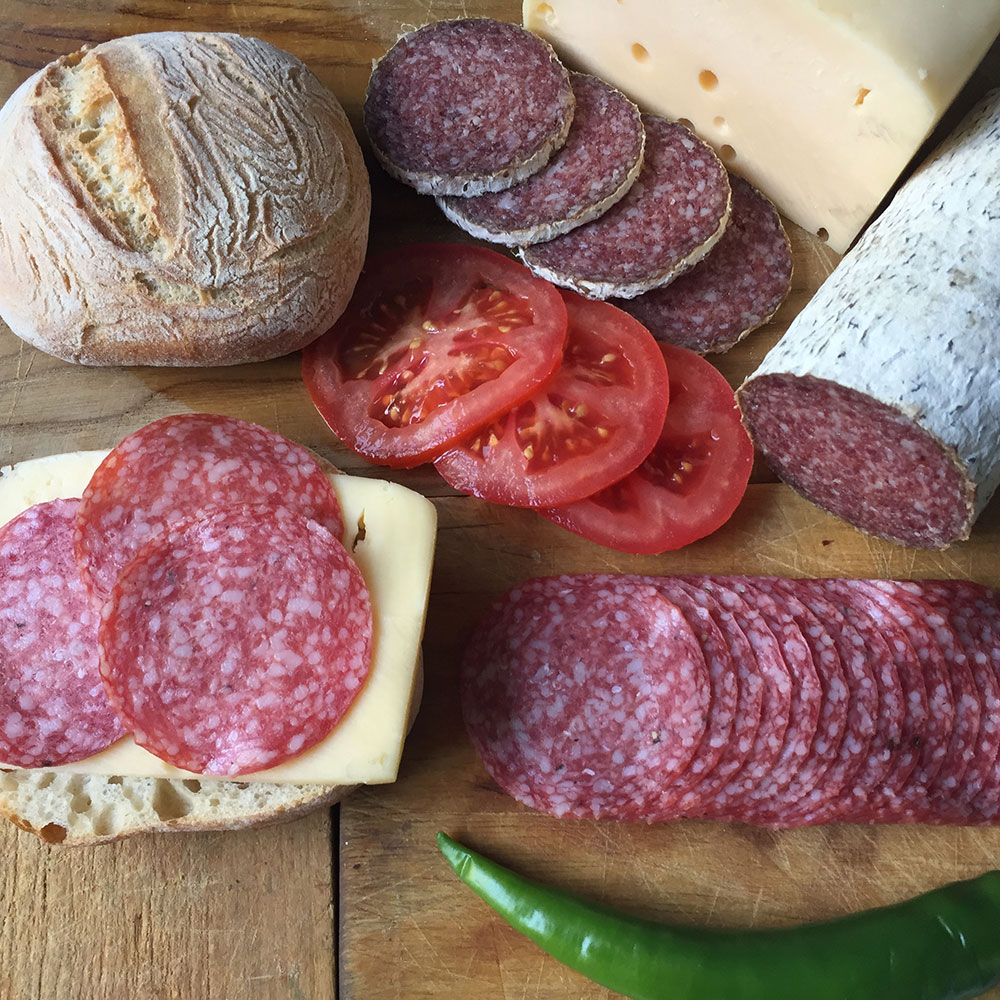
Fermented sausages - salami.
Fermented and dry sausages are more difficult to make and require better understanding of the sausage making process. Many sausage recipes call for starter cultures, in addition, parameters such as temperature, humidity and time must be carefully controlled. Traditionally made salami is the best example of a slightly fermented dry sausage. Summer sausage is a deeply fermented semi-dry sausage. Fermented sausages can be smoked or not, for example, Italian or Spanish salami will not be smoked, but Hungarian, Polish or Russian will be.
Dry
Dry and cold smoked sausages are closely related to traditionally made salami.
Semi-Dry
Spreadable
Low Fat
Low fat sausage recipes make it possible to produce sausages with a much lower fat content. This is accomplished by replacing animal fats with oil emulsion, filler materials, adding more water or using fat replacers.
Extended Value
Value added sausages are nutritious, yet inexpensive sausages. These sausages are made with filler material such as rusk, bread crumbs, dry rolls, rice, flours, barley or buckwheat groats or textured vegetable protein. They are healthier sausages because they contain less fat and less calories. Natural gums such as potato starch, gelatin, carrageenan, xanthan gum and konjac flour are usually added to create a unified texture.
Fish Sausage Recipes
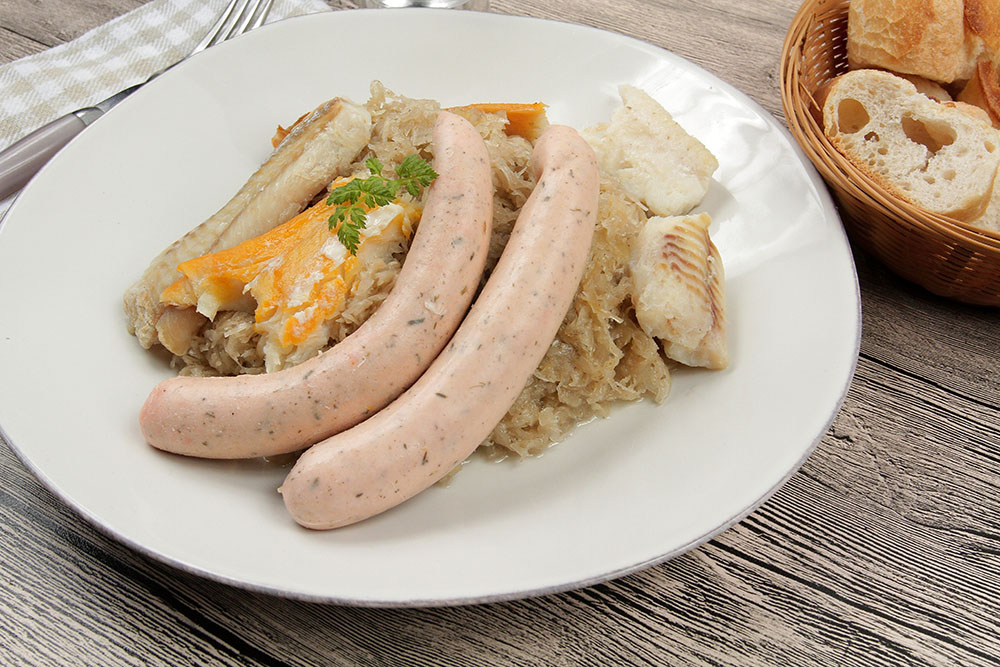
Fish sausage.
Fish sausages bring a new flavor which might satisfy those who claim that all fish taste the same. Another argument for making fish sausages is that fish sausages are much healthier as they contain less fat and cholesterol. Fish is a high-protein, low-fat food that provides the gamut of health benefits. White-fleshed fish, in particular, is lower in fat than any other source of animal meat, and oily fish are high in omega-3 fatty acids, or the good fats. It is impossible to eliminate completely the “fishy” flavor, however, adding pork fat or semi-fat pork will improve the flavor. For people who object to eating pork on religious grounds, adding vegetable oil will do.
Vegetarian and Vegan Sausage Recipes
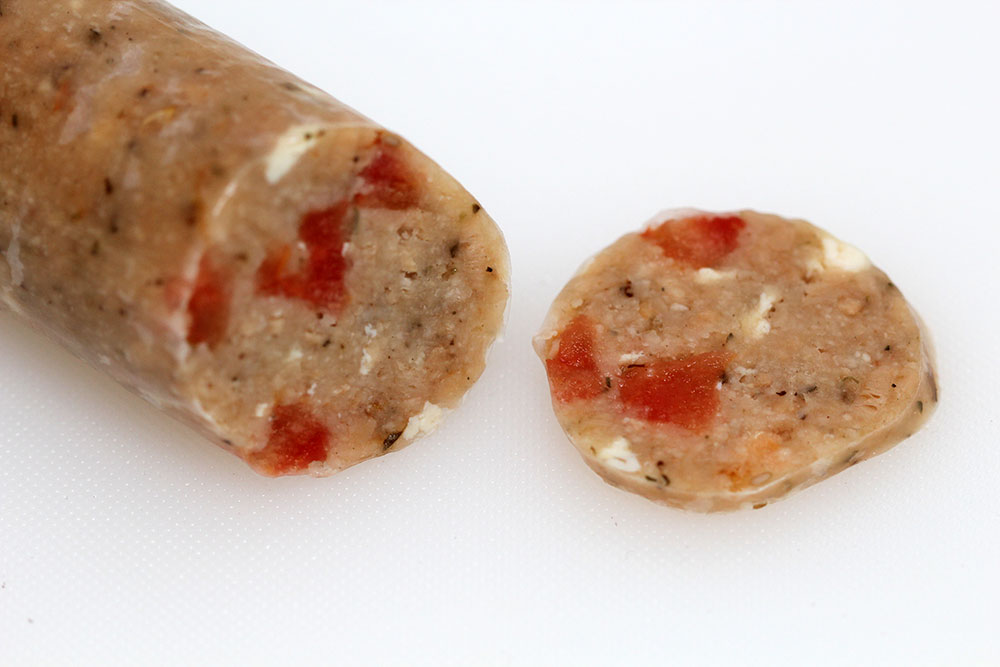
Vegetarian sausage.
Vegetarian and vegan sausage recipes conform to similar processing rules that govern making of extended value sausages. Animal protein is replaced with beans, soy protein concentrate/isolate or textured vegetable protein (TVP). Because they do not contain meat obtaining a good texture may sometimes be difficult to achieve. For this reason, the recipes usually include natural gums, starch, flour or other binding agents.
Sausages by Country
Additional sausage recipes grouped by their country of origin.
Hams and Other Meats
Here are some additional recipes for hams and other meats.